
- A. 15
- B. 9
- C. 10
- D. 21
Correct answer & explanation hidden
Log in to view solution →- A. 12
- B. 10
- C. 9
- D. 5
Correct answer & explanation hidden
Log in to view solution →- A. 2870
- B. 3080
- C. 3210
- D. 3320
Correct answer & explanation hidden
Log in to view solution →- A. 136
- B. 114
- C. 92
- D. 80
Correct answer & explanation hidden
Log in to view solution →- A. 8
- B. 7
- C. 6
- D. 5
Correct answer & explanation hidden
Log in to view solution →- A. $\dfrac{5}{2}$
- B. $\dfrac{3}{2}$
- C. 2
Correct answer & explanation hidden
Log in to view solution →- A. not continuous at $x=0$ and $x=1$
- B. continuous at $x=0$ and $x=1$
- C. continuous at $x=0$, but not continuous at $x=1$
- D. continuous at $x=1$, but not continuous at $x=0$
Correct answer & explanation hidden
Log in to view solution →- A. 15
- B. 16
- C. 17
- D. 18
Correct answer & explanation hidden
Log in to view solution →- A. $\pi-\frac{8}{3}$
- B. $2\pi-\frac{16}{3}$
- C. $\pi+\frac{8}{3}$
- D. $2\pi+\frac{16}{3}$
Correct answer & explanation hidden
Log in to view solution →- A. Only statement (A) is true
- B. Only statement (B) is true
- C. Both statements (A) and (B) are true
- D. Neither statement (A) nor statement (B) is true
Correct answer & explanation hidden
Log in to view solution →- A. $\left(\frac{\pi}{4},3\sqrt 6\right)$
- B. $\left(\frac{\pi}{3},6\right)$
- C. $\left(\frac{\pi}{3},3\sqrt 6\right)$
- D. $\left(\frac{\pi}{4},6\right)$
Correct answer & explanation hidden
Log in to view solution →- A. Only (A) is true
- B. Only (B) is true
- C. Both (A) and (B) are true
- D. Neither (A) nor (B) is true
Correct answer & explanation hidden
Log in to view solution →- A. 10051.50
- B. 10049.50
- C. 10101.50
- D. 10100
Correct answer & explanation hidden
Log in to view solution →- A. $\pi-\tan^{-1}\frac{33}{5}$
- B. $-\pi+\tan^{-1}\frac{33}{5}$
- C. $\pi-\tan^{-1}\frac{8}{9}$
- D. $-\pi+\tan^{-1}\frac{8}{9}$
Correct answer & explanation hidden
Log in to view solution →- A. $\log_e\!\left(\frac{(2+\sqrt5)^2}{\sqrt{1+\sqrt5}}\right)+\frac{\sqrt5}{2}$
- B. $\log_e\!\left(\frac{\sqrt2(2+\sqrt5)^2}{\sqrt{1+\sqrt5}}\right)-\frac{\sqrt5}{2}$
- C. $\log_e\!\left(\frac{2(2+\sqrt5)}{\sqrt{1+\sqrt5}}\right)-\frac{\sqrt5}{2}$
- D. $\log_e\!\left(\frac{\sqrt2(3-\sqrt5)^2}{\sqrt{1+\sqrt5}}\right)+\frac{\sqrt5}{2}$
Correct answer & explanation hidden
Log in to view solution →- A. 8
- B. 9
- C. 10
- D. 12
Correct answer & explanation hidden
Log in to view solution →- A. $\frac{47}{81}$
- B. $\frac{16}{27}$
- C. $\frac{49}{81}$
- D. $\frac{50}{81}$
Correct answer & explanation hidden
Log in to view solution →- A. 38
- B. 32
- C. 36
- D. 40
Correct answer & explanation hidden
Log in to view solution →- A. straight line
- B. parabola
- C. hyperbola
- D. circle
Correct answer & explanation hidden
Log in to view solution →- A. 1.25
- B. 12.5
- C. 125
- D. 1250
Correct answer & explanation hidden
Log in to view solution →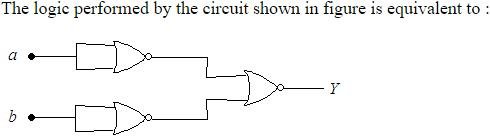
- A. OR
- B. NAND
- C. AND
- D. NOR
Correct answer & explanation hidden
Log in to view solution →- A. $\lambda_A \ln 2 = \lambda_B$
- B. $\lambda_A = \lambda_B \ln 2$
- C. $\lambda_A = \lambda_B$
- D. $\lambda_A = 2\lambda_B$
Correct answer & explanation hidden
Log in to view solution →- A. $4\lambda$
- B. $\dfrac{3}{2}\lambda$
- C. $3\lambda$
- D. $\dfrac{\lambda}{4}$
Correct answer & explanation hidden
Log in to view solution →- A. $2.12 \times 10^8$ m/s
- B. $3.12 \times 10^7$ m/s
- C. $5 \times 10^7$ m/s
- D. $\sqrt{2} \times 10^8$ m/s
Correct answer & explanation hidden
Log in to view solution →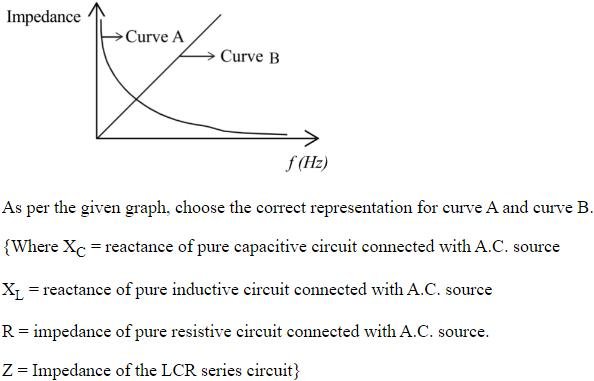
- A. $A = X_C,\ B = X_L$
- B. $A = X_L,\ B = Z$
- C. $A = X_C,\ B = R$
- D. $A = X_L,\ B = R$
Correct answer & explanation hidden
Log in to view solution →- A. $8.85 \times 10^{-13}$ J
- B. $88.5 \times 10^{-13}$ J
- C. $28.5 \times 10^{-13}$ J
- D. $17.7 \times 10^{-13}$ J
Correct answer & explanation hidden
Log in to view solution →- A. 2%
- B. 0.2%
- C. 1%
- D. 0.1%
Correct answer & explanation hidden
Log in to view solution →- A. +25%
- B. -25%
- C. Zero
- D. -50%
Correct answer & explanation hidden
Log in to view solution →- A. 1 : 4
- B. 4 : 1
- C. 1 : 2
- D. 2 : 1
Correct answer & explanation hidden
Log in to view solution →- A. 1 : 2
- B. 2 : 1
- C. 2 : 3
- D. 1 : 4
Correct answer & explanation hidden
Log in to view solution →-
A.
Graph showing KE increasing linearly from 0 to A
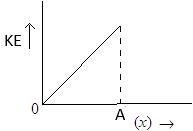
-
B.
Graph showing KE constant from 0 to A
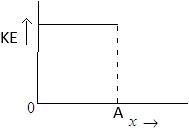
-
C.
Graph showing KE increasing nonlinearly from 0 to A
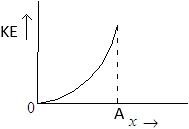
-
D.
Graph showing KE decreasing from maximum at $x=0$ to zero at $x=A$
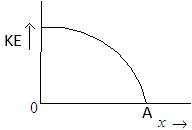
Correct answer & explanation hidden
Log in to view solution →- A. $v_{rms}$(mono) $>$ $v_{rms}$(dia) $>$ $v_{rms}$(poly)
- B. $v_{rms}$(mono) $<$ $v_{rms}$(dia) $<$ $v_{rms}$(poly)
- C. $v_{rms}$(mono) $=$ $v_{rms}$(dia) $=$ $v_{rms}$(poly)
- D. $v_{rms}$(dia) $<$ $v_{rms}$(poly) $<$ $v_{rms}$(mono)
Correct answer & explanation hidden
Log in to view solution →- A. $-2090\,\text{kJ}$
- B. $+2090\,\text{kJ}$
- C. $-2426\,\text{kJ}$
- D. $+2476\,\text{kJ}$
Correct answer & explanation hidden
Log in to view solution →- A. $-48^\circ$F
- B. $-63^\circ$F
- C. $-112^\circ$F
- D. $-148^\circ$F
Correct answer & explanation hidden
Log in to view solution →- A. 3 : 16
- B. 4 : 3
- C. 3 : 4
- D. 1 : 16
Correct answer & explanation hidden
Log in to view solution →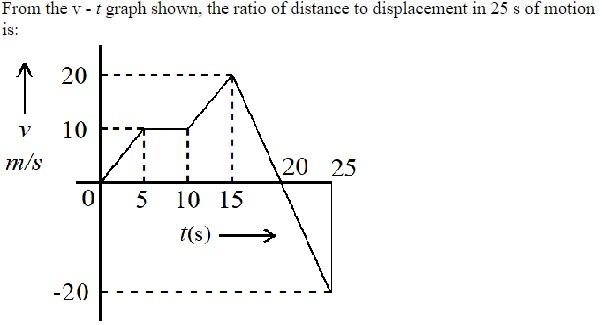
- A. 1
- B. $\frac{1}{2}$
- C. $\frac{5}{3}$
- D. $\frac{3}{5}$
Correct answer & explanation hidden
Log in to view solution →- A. 1 cm
- B. 2 cm
- C. 4 cm
- D. 8 cm
Correct answer & explanation hidden
Log in to view solution →- A. 5
- B. 100
- C. 50
- D. 25
Correct answer & explanation hidden
Log in to view solution →- A. Both Statements I and Statements II are correct.
- B. Both Statements I and Statements II are incorrect.
- C. Statements I is correct but Statements II is incorrect.
- D. Statements I is incorrect but Statements II is correct.
Correct answer & explanation hidden
Log in to view solution →- A. Both A and R are correct and R is the correct explanation of A
- B. Both A and R are correct but R is NOT the correct explanation of A
- C. A is correct but R is not correct
- D. A is not correct but R is correct
Correct answer & explanation hidden
Log in to view solution →- A. A-III, B-II, C-I, D-IV
- B. A-III, B-I, C-II, D-IV
- C. A-III, B-IV, C-I, D-II
- D. A-III, B-IV, C-II, D-I
Correct answer & explanation hidden
Log in to view solution →- A. $\mathrm{I^-}$ only
- B. $\mathrm{Ag^+}$ and $\mathrm{I^-}$ both
- C. $\mathrm{K^+}$ only
- D. $\mathrm{NO_3^-}$ only
Correct answer & explanation hidden
Log in to view solution →- A. $\mathrm{Li < Be < B < C < N < O < F}$
- B. $\mathrm{Li < B < Be < C < O < N < F}$
- C. $\mathrm{B > Li > Be > C > N > O > F}$
- D. $\mathrm{Li < Be < B < C < O < N < F}$
Correct answer & explanation hidden
Log in to view solution →- A. Copper matte
- B. Copper scrap
- C. Blister copper
- D. Reduced copper
Correct answer & explanation hidden
Log in to view solution →- A. Both the statements I and II are correct
- B. Both the statements I and II are incorrect
- C. Statement I is correct but Statement II is incorrect
- D. Statement I is incorrect but Statement II is correct
Correct answer & explanation hidden
Log in to view solution →- A. A-IV, B-I, C-III, D-II
- B. A-IV, B-III, C-I, D-II
- C. A-III, B-IV, C-II, D-I
- D. A-III, B-II, C-IV, D-I
Correct answer & explanation hidden
Log in to view solution →- A. Oxidation state of Ga in the salt $\mathrm{GaAlCl_4}$ is $+3$.
- B. Ga is coordinated with Cl in $\mathrm{GaAlCl_4}$
- C. Ga is more electronegative than Al and is present as a cationic part of the salt $\mathrm{GaAlCl_4}$
- D. Cl forms bond with both Al and Ga in $\mathrm{GaAlCl_4}$
Correct answer & explanation hidden
Log in to view solution →- A. [Co(NH3)3(NO2)3]
- B. [Co(en)3]
- C. [Co(en)2Cl2]
- D. [Pt(NH3)2Cl2]
Correct answer & explanation hidden
Log in to view solution →- A. $\mathrm{EDTA^{4-},\ NCS^-,\ C_2O_4^{2-}}$
- B. $\mathrm{NO_2^-,\ C_2O_4^{2-},\ EDTA^{4-}}$
- C. $\mathrm{C_2O_4^{2-},\ ethylene\ diamine,\ H_2O}$
- D. $\mathrm{C_2O_4^{2-},\ NO_2^-,\ NCS^-}$
Correct answer & explanation hidden
Log in to view solution →- A. Both the statements I and II are correct
- B. Both the statements I and II are incorrect
- C. Statement I is correct but Statement II is incorrect
- D. Statement I is incorrect but Statement II is correct
Correct answer & explanation hidden
Log in to view solution →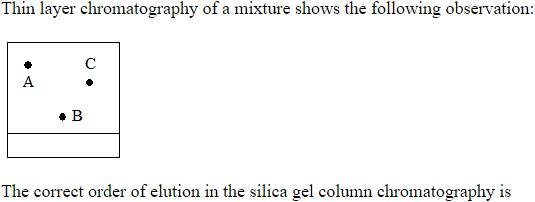
- A. B, C, A
- B. A, C, B
- C. C, A, B
- D. B, A, C
Correct answer & explanation hidden
Log in to view solution →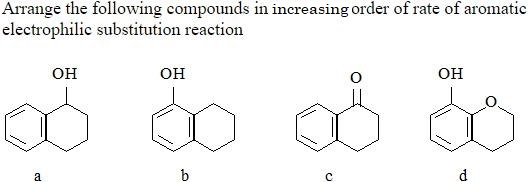
-
A.
c, a, b, d

-
B.
b, c, a, d

-
C.
d, b, c, a

-
D.
d, b, a, c

Correct answer & explanation hidden
Log in to view solution →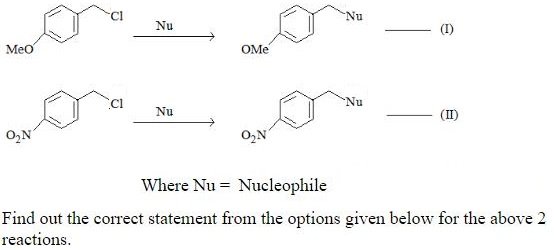
- A. Reaction (I) is of 1st order and reaction (II) is of 2nd order
- B. Reactions (I) and (II) both are of 1st order
- C. Reactions (I) and (II) both are of 2nd order
- D. Reaction (I) is of 2nd order and reaction (II) is of 1st order
Correct answer & explanation hidden
Log in to view solution →- A. $\mathrm{[Fe_3(OH)_2(OAc)_6]Cl}$
- B. $\mathrm{K_3[Co(NO_2)_6]}$
- C. $\mathrm{Fe_4[Fe(CN)_6]_3}$
- D. $\mathrm{(NH_4)_3[As(Mo_3O_{10})_4]}$
Correct answer & explanation hidden
Log in to view solution →-
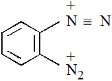
A.
Benzotriazole ring with one nitrogen shown as $N^+$ and a terminal diazonium-type group
-
B.
Benzotriazole ring containing an $NH$ group

-
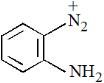
C.
o-Diazonium benzene derivative with one $NH_2$ group
-
D.
Benzimidazole-like fused ring with $NH$
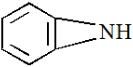
Correct answer & explanation hidden
Log in to view solution →- A. Polytetrafluoroethane
- B. Polyacrylonitrile
- C. High density polythene
- D. Low density polythene
Correct answer & explanation hidden
Log in to view solution →-
A.
Fischer projection with $CHO$ at top, both $OH$ on left, and $CH_2OH$ at bottom
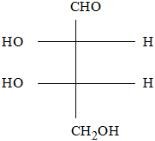
-
B.
Cyclic Fischer/Haworth-type projection with $CHO$ at top and substituents inconsistent with an aldotetrose
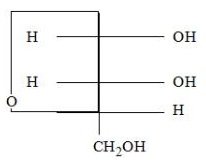
-
C.
Fischer projection with $CHO$ at top, upper $OH$ on right and lower $OH$ on left
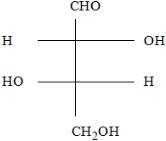
-
D.
Cyclic projection with upper $OH$ on right and lower $OH$ on left
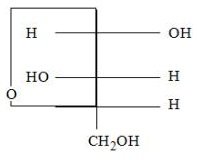
Correct answer & explanation hidden
Log in to view solution →- A. $C_2O_4^{2-}$ & $NO_3^-$
- B. $CH_3COO^-$ & $NO_3^-$
- C. $SO_3^{2-}$ & $CH_3COO^-$
- D. $SO_3^{2-}$ & $C_2O_4^{2-}$
Correct answer & explanation hidden
Log in to view solution →