
- A. 7
- B. $\frac{29}{5}$
- C. $\frac{33}{5}$
- D. 13
Correct answer & explanation hidden
Log in to view solution →- A. $(-\infty,-3)$
- B. $(-6,\infty)$
- C. $(-\infty,\infty)$
- D. $(-6,-3)$
Correct answer & explanation hidden
Log in to view solution →- B. -16
- C. 16
- D. 32
Correct answer & explanation hidden
Log in to view solution →- A. It has unique solution if $a=b=6$
- B. It has unique solution if $a=b=8$
- C. It has infinitely many solutions if $a=3,\ b=8$
- D. It has infinitely many solutions if $a=3,\ b=6$
Correct answer & explanation hidden
Log in to view solution →- A. $10^9$
- B. $9^{10}$
- C. $10^6$
- D. $6^{10}$
Correct answer & explanation hidden
Log in to view solution →- A. 7260
- B. 7220
- C. 7360
- D. 7380
Correct answer & explanation hidden
Log in to view solution →- A. Only $(S1)$ is true
- B. Only $(S2)$ is true
- C. Both $(S1)$ and $(S2)$ are true
- D. Both $(S1)$ and $(S2)$ are false
Correct answer & explanation hidden
Log in to view solution →- A. -4
- B. -2
- C. 2
- D. 4
Correct answer & explanation hidden
Log in to view solution →- A. 323
- B. 313
- C. 423
- D. 413
Correct answer & explanation hidden
Log in to view solution →- A. $\dfrac{\pi + 2 - 3\sqrt{3}}{6}$
- B. $\dfrac{5\pi + 2 + 3\sqrt{3}}{6}$
- C. $\pi$
Correct answer & explanation hidden
Log in to view solution →- A. $\log_e\left(\dfrac{512}{81}\right)$
- B. $\log_e\left(\dfrac{64}{27}\right)$
- C. $\log_e\left(\dfrac{256}{81}\right)$
- D. $\log_e\left(\dfrac{32}{27}\right)$
Correct answer & explanation hidden
Log in to view solution →- A. $2\sqrt{2}(\sqrt{2}+1)$
- B. 4
- C. $2(\sqrt{2}+1)$
- D. $4\sqrt{2}$
Correct answer & explanation hidden
Log in to view solution →- A. $\dfrac{1}{15}$
- B. $\dfrac{4}{15}$
- C. $\dfrac{8}{15}$
- D. $\dfrac{14}{15}$
Correct answer & explanation hidden
Log in to view solution →- A. no point
- B. one point
- C. two points
- D. infinite number of points
Correct answer & explanation hidden
Log in to view solution →- A. 60
- B. 61
- C. $\dfrac{304}{5}$
- D. $\dfrac{314}{5}$
Correct answer & explanation hidden
Log in to view solution →- A. $(3,33)$
- B. $(-6,45)$
- C. $(-3,43)$
- D. $(6,29)$
Correct answer & explanation hidden
Log in to view solution →- A. $3\sqrt{5}$
- B. $2\sqrt{6}$
- C. $3\sqrt{6}$
- D. $2\sqrt{5}$
Correct answer & explanation hidden
Log in to view solution →- A. $\frac{21}{16}$
- B. $\frac{15}{16}$
- C. $\frac{81}{64}$
- D. $\frac{37}{16}$
Correct answer & explanation hidden
Log in to view solution →- A. $-3$
- B. $0$
- C. $1$
- D. $5$
Correct answer & explanation hidden
Log in to view solution →- A. a fallacy
- B. equivalent to $B\vee \sim C$
- C. equivalent to $\sim A$
- D. equivalent to $\sim C$
Correct answer & explanation hidden
Log in to view solution →- A. $(1000 \pm 0.14)$ J
- B. $(1000 \pm 140)$ J
- C. $(500 \pm 0.14)$ J
- D. $(500 \pm 140)$ J
Correct answer & explanation hidden
Log in to view solution →- A. $1800$ m
- B. $900$ m
- C. $1200$ m
- D. $2700$ m
Correct answer & explanation hidden
Log in to view solution →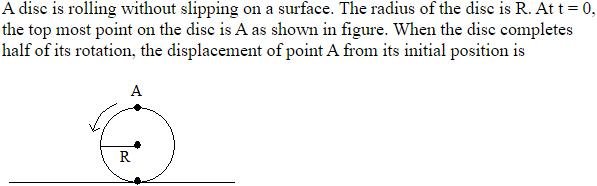
- A. $2R\sqrt{1+4\pi^2}$
- B. $2R$
- C. $R\sqrt{\pi^2+1}$
- D. $R\sqrt{\pi^2+4}$
Correct answer & explanation hidden
Log in to view solution →- A. $3:4$
- B. $9:16$
- C. $4:3$
- D. $16:9$
Correct answer & explanation hidden
Log in to view solution →- A. 12 Ns
- B. 3 Ns
- C. 6 Ns
- D. 36 Ns
Correct answer & explanation hidden
Log in to view solution →- A. 67.2
- B. 33.6
- C. 16.8
- D. 11.2
Correct answer & explanation hidden
Log in to view solution →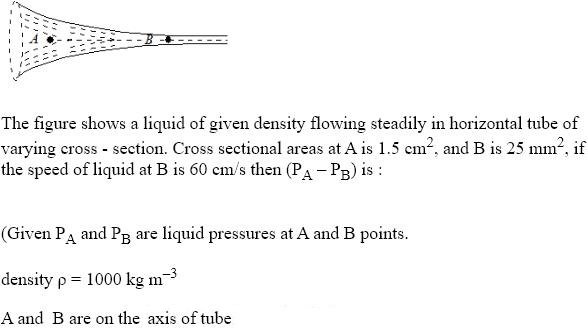
- A. 27 Pa
- B. 175 Pa
- C. 135 Pa
- D. 36 Pa
Correct answer & explanation hidden
Log in to view solution →- A. $3P$
- B. $2P$
- C. $P$
- D. $\frac{P}{2}$
Correct answer & explanation hidden
Log in to view solution →- A. 4
- B. 8
- C. 27
- D. 28
Correct answer & explanation hidden
Log in to view solution →-
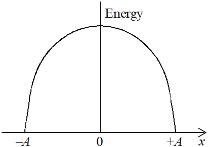
A.
A dome-shaped curve, maximum at x = 0 and zero at x = ±A
-
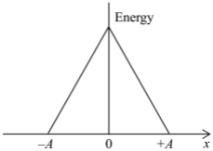
B.
An inverted V-shaped graph with peak at x = 0
-
C.
A U-shaped parabola with minimum at x = 0 and zero at x = ±A
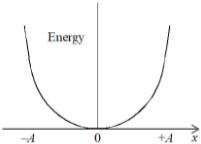
-
D.
A curve that is maximum at x = -A, decreases to x = 0, then decreases further for x > 0
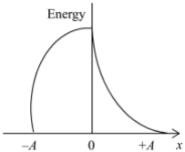
Correct answer & explanation hidden
Log in to view solution →- A. 2
- B. 4
- C. 16
- D. 2:4
Correct answer & explanation hidden
Log in to view solution →- A. $\oint \vec{B} \cdot d\vec{l} = \mu_0 I$
- B. $\oint \vec{E} \cdot d\vec{l} = -\frac{\phi_B}{dt}$
- C. $\oint \vec{D} \cdot d\vec{A} = Q$
- D. $\oint \vec{E} \cdot d\vec{l} = 0$
Correct answer & explanation hidden
Log in to view solution →- A. (A) only
- B. (D) only
- C. (C) and (E) only
- D. (B) and (D) only
Correct answer & explanation hidden
Log in to view solution →- A. $\dfrac{d\,n_1 n_2}{2(n_1+n_2)}$
- B. $\dfrac{d\,n_1 n_2}{n_1+n_2}$
- C. $\dfrac{2d(n_1+n_2)}{n_1 n_2}$
- D. $\dfrac{d(n_1+n_2)}{2n_1 n_2}$
Correct answer & explanation hidden
Log in to view solution →- A. 264
- B. 540
- C. 276
- D. 138
Correct answer & explanation hidden
Log in to view solution →- A. 3.82 MeV
- B. 4.25 MeV
- C. 5.9 MeV
- D. 2.12 MeV
Correct answer & explanation hidden
Log in to view solution →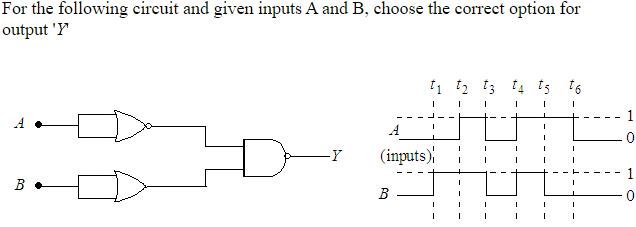
-
A.
Output Y stays low until t6, then goes high
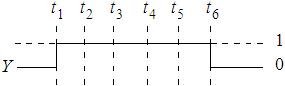
-
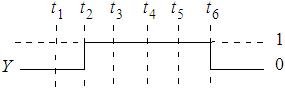
B.
Output Y is high only between t2 and t6
-
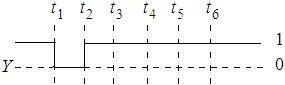
C.
Output Y is high only between t1 and t2
-
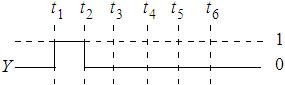
D.
Output Y is high only between t1 and t2, then low
Correct answer & explanation hidden
Log in to view solution →- A. A – II, B – IV, C – III, D – I
- B. A – III, B – IV, C – I, D – II
- C. A – II, B – IV, C – I, D – III
- D. A – II, B – I, C – IV, D – III
Correct answer & explanation hidden
Log in to view solution →- A. $1.0 \times 10^{-8}$ Nm
- B. $2.0 \times 10^{-10}$ Nm
- C. $4.0 \times 10^{-10}$ Nm
- D. $1.5 \times 10^{-9}$ Nm
Correct answer & explanation hidden
Log in to view solution →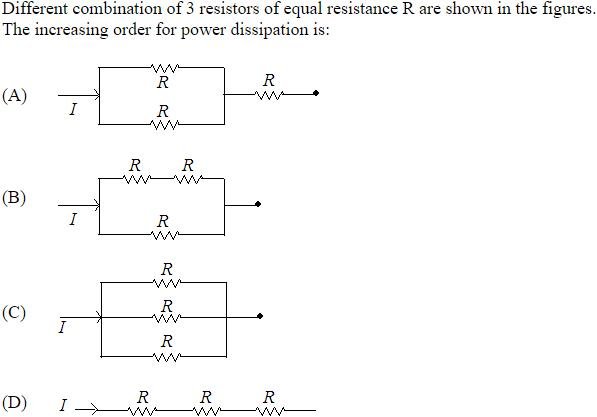
- A. $P_A < P_B < P_C < P_D$
- B. $P_C < P_B < P_A < P_D$
- C. $P_C < P_D < P_A < P_B$
- D. $P_B < P_C < P_D < P_A$
Correct answer & explanation hidden
Log in to view solution →- A. One third of this value
- B. $\frac{1}{9}$th of this value
- C. Three times of this value
- D. $\frac{1}{27}$th of this value
Correct answer & explanation hidden
Log in to view solution →- A. $\mathrm{NO \rightarrow NO^+}$
- B. $\mathrm{O_2 \rightarrow O_2^+}$
- C. $\mathrm{O_2 \rightarrow O_2^{2-}}$
- D. $\mathrm{N_2 \rightarrow N_2^+}$
Correct answer & explanation hidden
Log in to view solution →- A. Lyophilic sol is dispersed in lyophobic sol.
- B. Lyophobic sol is coagulated
- C. Film of lyophilic sol is formed over lyophobic sol.
- D. Film of lyophobic sol is formed over lyophilic sol.
Correct answer & explanation hidden
Log in to view solution →- A. A, B and D Only
- B. A, B, C and D
- C. B and D Only
- D. A, C and D Only
Correct answer & explanation hidden
Log in to view solution →- A. Titanium - van Arkel Method
- B. Nickel - Mond process
- C. Zinc - Liquation
- D. Copper - Electrolysis
Correct answer & explanation hidden
Log in to view solution →- A. Both the Statements I and II are correct
- B. Both the Statements I and II are incorrect
- C. Statement I is correct but Statement II is incorrect
- D. Statement I is incorrect but Statement II is correct
Correct answer & explanation hidden
Log in to view solution →- A. Both Sr and Be elements are present in the ionic salt.
- B. The reaction is an example of acid - base neutralization reaction.
- C. The element Be is present in the cationic part of the ionic salt.
- D. Be is tetrahedrally coordinated in the ionic salt.
Correct answer & explanation hidden
Log in to view solution →- A. Colourless liquid with trigonal bipyramidal geometry
- B. Colourless liquid with square pyramidal geometry
- C. Colourless gas with square pyramidal geometry
- D. Colourless gas with trigonal bipyramidal geometry.
Correct answer & explanation hidden
Log in to view solution →- A. It is a cyclic compound.
- B. It contains banana bonds.
- C. It can react with water.
- D. It has electronic delocalization.
Correct answer & explanation hidden
Log in to view solution →- A. Eu, Gd
- B. Eu, Yb
- C. Dy, Gd
- D. Lu, Yb
Correct answer & explanation hidden
Log in to view solution →- A. A, C, and E Only
- B. A and C Only
- C. A and E Only
- D. D and E Only
Correct answer & explanation hidden
Log in to view solution →- A. $\mathrm{NO^\bullet}$
- B. $\mathrm{OH^\bullet}$
- C. $\mathrm{Cl^\bullet}$
- D. $\mathrm{CH_3^\bullet}$
Correct answer & explanation hidden
Log in to view solution →- A. Two benzene rings connected by a double bond
- B. Cyclopropanone
- C. Two conjugated ring systems connected by a double bond
- D. A cyclopropene ring connected by a double bond to a cyclopropene-type ring
Correct answer & explanation hidden
Log in to view solution →- A. $\mathrm{S_N2}$, $A =$ iso-butyl ethyl ether; $\mathrm{S_N1}$, $B =$ tert-butyl ethyl ether
- B. $\mathrm{S_N1}$, $A =$ tert-butyl ethyl ether; $\mathrm{S_N2}$, $B =$ iso-butyl ethyl ether
- C. $\mathrm{S_N1}$, $A =$ tert-butyl ethyl ether; $\mathrm{S_N1}$, $B =$ 2-butyl ethyl ether
- D. $\mathrm{S_N2}$, $A =$ 2-butyl ethyl ether; $\mathrm{S_N2}$, $B =$ iso-butyl ethyl ether
Correct answer & explanation hidden
Log in to view solution →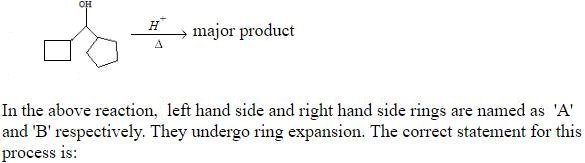
- A. Finally both rings will become six membered each.
- B. Finally both rings will become five membered each.
- C. Ring expansion can go upto seven membered rings
- D. Only A will become 6 membered.
Correct answer & explanation hidden
Log in to view solution →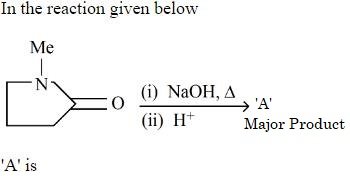
-
A.
MeHN-(CH2)3-COOH

-
B.
MeN with ring and two OH groups

-
C.
MeN-substituted five-membered ring with an OH group

-
D.
MeHN-(CH2)3-CHO

Correct answer & explanation hidden
Log in to view solution →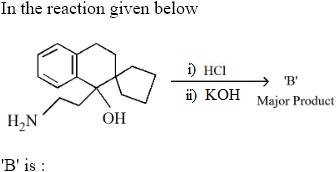
-
A.
Fused-ring product retaining side chain NH2

-
B.
Fused-ring product with cyclohexane-like ring

-
C.
Nitrogen-containing bridged product
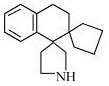
-
D.
Aromatic fused product with NH2 side chain

Correct answer & explanation hidden
Log in to view solution →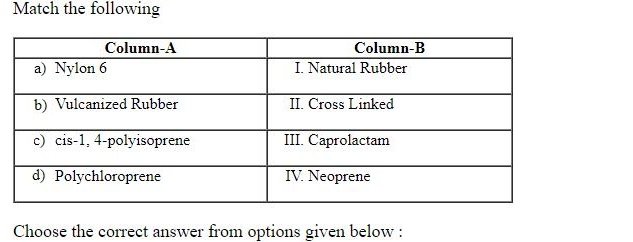
- A. a->II, b->III, c->IV, d->I
- B. a->III, b->II, c->I, d->IV
- C. a->III, b->IV, c->I, d->II
- D. a->IV, b->III, c->II, d->I
Correct answer & explanation hidden
Log in to view solution →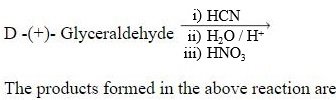
- A. Two optically active products
- B. One optically active and one meso product
- C. One optically inactive and one meso product
- D. D(+)-Glyceraldehyde sequence leading to products in Hindi-labeled option
Correct answer & explanation hidden
Log in to view solution →