Empowering Students with AI-Powered Assessments & Intelligent Learning

JEE Main 2023 (15 Apr, Shift 1)

60 questions from this JEE Main 2023 paper. Log in to view the correct answer and explanation for each question.

Q1 MATHS Unit 7: Limit Continuity and Differentiability
If the domain of the function $f(x)=\log_e(4x^2+11x+6)+\sin^{-1}(4x+3)+\cos^{-1}\left(\frac{10x+6}{3}\right)$ is $(\alpha,\beta]$, then $36|\alpha+\beta|$ is equal to
  • A. 45
  • B. 54
  • C. 63
  • D. 72

Correct answer & explanation hidden

Log in to view solution →
Q2 CHEMISTRY Unit 14: Some Basic Principles of Organic Chemistry
The number of real roots of the equation $x|x|-5|x+2|+6=0$, is
  • A. 6
  • B. 3
  • C. 5
  • D. 4

Correct answer & explanation hidden

Log in to view solution →
Q3 MATHS Unit 12: Vector Algebra
If the set $\left\{\operatorname{Re}\left(\dfrac{z-\bar z+z\bar z}{2-3z+5\bar z}\right): z\in\mathbb{C},\ \operatorname{Re}(z)=3\right\}$ is equal to the interval $(\alpha,\beta]$, then $24(\beta-\alpha)$ is equal to
  • A. 27
  • B. 30
  • C. 36
  • D. 42

Correct answer & explanation hidden

Log in to view solution →
Q4 MATHS Unit 3: Matrices and Determinants
Let the determinant of a square matrix $A$ of order $m$ be $m-n$, where $m$ and $n$ satisfy $4m+n=22$ and $17m+4n=93$. If $\det\big(n\,\operatorname{adj}(\operatorname{adj}(mA))\big)=3^a5^b6^c$, then $a+b+c$ is equal to
  • A. 84
  • B. 96
  • C. 101
  • D. 109

Correct answer & explanation hidden

Log in to view solution →
Q5 MATHS Unit 10: Co-ordinate Geometry
Let the system of linear equations $$-x+2y-9z=7$$ $$-x+3y+7z=9$$ $$-2x+y+5z=8$$ $$-3x+y+13z=\lambda$$ has a unique solution $x=\alpha, y=\beta, z=\gamma$. Then the distance of the point $(\alpha,\beta,\gamma)$ from the plane $2x-2y+z=\lambda$ is
  • A. 7
  • B. 9
  • C. 11
  • D. 13

Correct answer & explanation hidden

Log in to view solution →
Q6 MATHS Unit 4: Permutations and Combinations
The total number of three-digit numbers, divisible by 3, which can be formed using the digits $1,3,5,8$, if repetition of digits is allowed, is
  • A. 18
  • B. 20
  • C. 21
  • D. 22

Correct answer & explanation hidden

Log in to view solution →
Q7 MATHS Unit 5: Binomial Theorem and its Simple Applications
Let $(a+bx+cx^2)^{10}=\sum_{i=0}^{20}p_i x^i$, $a,b,c\in\mathbb{N}$. If $p_1=20$ and $p_2=210$, then $2(a+b+c)$ is equal to
  • A. 6
  • B. 8
  • C. 12
  • D. 15

Correct answer & explanation hidden

Log in to view solution →
Q8 MATHS Unit 4: Permutations and Combinations
Let $A_1$ and $A_2$ be two arithmetic means and $G_1,G_2,G_3$ three geometric means of two distinct positive numbers. Then $G_1^4+G_2^4+G_3^4+G_1^2G_2^2G_3^2$ is equal to
  • A. $2(A_1+A_2)G_1G_3$
  • B. $(A_1+A_2)G_1^2G_3^2$
  • C. $(A_1+A_2)^2G_1G_3$
  • D. $2(A_1+A_2)G_1^2G_3^2$

Correct answer & explanation hidden

Log in to view solution →
Q9 MATHS Unit 7: Limit Continuity and Differentiability
Let $[x]$ denote the greatest integer function and $f(x)=\max\{1+x+[x],\,2+x,\,x+2[x]\}$, $0\le x\le 2$. Let $m$ be the number of points in $[0,2]$, where $f$ is not continuous and $n$ be the number of points in $(0,2)$, where $f$ is not differentiable. Then $(m+n)^2+2$ is equal to
  • A. 2
  • B. 3
  • C. 6
  • D. 11

Correct answer & explanation hidden

Log in to view solution →
Q10 MATHS Unit 8: Integral Calculus
If $\int_0^1 \frac{1}{(5+2x-2x^2)}\left(1+e^{(2-4x)}\right)\,dx=\frac{1}{\alpha}\log_e\left(\frac{\alpha+1}{\beta}\right)$, $\alpha,\beta>0$, then $\alpha^4-\beta^4$ is equal to
  • A. -21
  • C. 19
  • D. 21

Correct answer & explanation hidden

Log in to view solution →
Q11 MATHS Unit 9: Differential Equations
Let $x=x(y)$ be the solution of the differential equation $2(y+2)\log_e(y+2)\,dx+(x+4-2\log_e(y+2))\,dy=0$, $y>-1$, with $x\,(e^4-2)=1$. Then $x(e^9-2)$ is equal to
  • A. 3
  • B. $\frac{10}{3}$
  • C. $\frac{4}{9}$
  • D. $\frac{32}{9}$

Correct answer & explanation hidden

Log in to view solution →
Q12 MATHS Unit 10: Co-ordinate Geometry
If $(\alpha,\beta)$ is the orthocenter of the triangle $ABC$ with vertices $A(3,-7)$, $B(-1,2)$ and $C(4,5)$, then $9\alpha-6\beta+60$ is equal to
  • A. 25
  • B. 30
  • C. 35
  • D. 40

Correct answer & explanation hidden

Log in to view solution →
Q13 MATHS Unit 10: Co-ordinate Geometry
The number of common tangents, to the circles $x^2+y^2-18x-15y+131=0$ and $x^2+y^2-6x-6y-7=0$, is
  • A. 1
  • B. 2
  • C. 3
  • D. 4

Correct answer & explanation hidden

Log in to view solution →
Q14 MATHS Unit 11: Three Dimensional Geometry
Let the foot of perpendicular of the point $P(3,-2,-9)$ on the plane passing through the points $(-1,-2,-3)$, $(9,3,4)$, $(9,-2,1)$ be $Q(\alpha,\beta,\gamma)$. Then the distance of $Q$ from the origin is
  • A. $\sqrt{35}$
  • B. $\sqrt{38}$
  • C. $\sqrt{29}$
  • D. $\sqrt{42}$

Correct answer & explanation hidden

Log in to view solution →
Q15 MATHS Unit 11: Three Dimensional Geometry
Let $S$ be the set of all values of $\lambda$, for which the shortest distance between the lines $\frac{x-\lambda}{1}=\frac{y-3}{4}=\frac{z+6}{1}$ and $\frac{x+\lambda}{3}=\frac{y}{-4}=\frac{z-6}{0}$ is $13$. Then $8\left|\sum_{\lambda\in S}\lambda\right|$ is equal to
  • A. 302
  • B. 304
  • C. 306
  • D. 308

Correct answer & explanation hidden

Log in to view solution →
Q16 MATHS Unit 12: Vector Algebra
Let $S$ be the set of all $$(\lambda,\mu)$$ for which the vectors $\lambda\hat i-\hat j+\hat k$, $\hat i+2\hat j+\mu\hat k$ and $3\hat i-4\hat j+5\hat k$, where $\lambda-\mu=5$, are coplanar, then $\sum_{(\lambda,\mu)\in S}80(\lambda^2+\mu^2)$ is equal to
  • A. 2130
  • B. 2210
  • C. 2290
  • D. 2370

Correct answer & explanation hidden

Log in to view solution →
Q17 MATHS Unit 12: Vector Algebra
Let ABCD be a quadrilateral. If E and F are the mid points of the diagonals AC and BD respectively and $(\overrightarrow{AB}-\overrightarrow{BC})+(\overrightarrow{AD}-\overrightarrow{DC})=k\,\overrightarrow{FE}$, then $k$ is equal to
  • A. -4
  • B. -2
  • C. 2
  • D. 4

Correct answer & explanation hidden

Log in to view solution →
Q18 MATHS Unit 1: Sets Relations and Functions
A bag contains 6 white and 4 black balls. A die is rolled once and the number of balls equal to the number obtained on the die are drawn from the bag at random. The probability that all the balls drawn are white is
  • A. $\frac{1}{5}$
  • B. $\frac{11}{50}$
  • C. $\frac{9}{50}$
  • D. $\frac{1}{4}$

Correct answer & explanation hidden

Log in to view solution →
Q19 MATHS Unit 2: Complex Numbers and Quadratic Equations
The mean and standard deviation of 10 observations are 20 and 8 respectively. Later on, it was observed that one observation was recorded as 50 instead of 40. Then the correct variance is
  • A. 11
  • B. 12
  • C. 13
  • D. 14

Correct answer & explanation hidden

Log in to view solution →
Q20 MATHS Unit 2: Complex Numbers and Quadratic Equations
Negation of $p\wedge(q\wedge\sim(p\wedge q))$ is
  • A. $\sim(p\vee q)$
  • B. $p\vee q$
  • C. $(\sim(p\wedge q))\wedge q$
  • D. $(\sim(p\wedge q))\vee p$

Correct answer & explanation hidden

Log in to view solution →
Q31 PHYSICS Unit 10: Oscillations and Waves
In a linear Simple Harmonic Motion (SHM) (A) Restoring force is directly proportional to the displacement. (B) The acceleration and displacement are opposite in direction. (C) The velocity is maximum at mean position. (D) The acceleration is minimum at extreme points. Choose the correct answer from the options given below:
  • A. (A), (B) and (C) Only
  • B. (C) and (D) only
  • C. (A), (C) and (D) only
  • D. (A), (B) and (D) only

Correct answer & explanation hidden

Log in to view solution →
Q32 PHYSICS Unit 8: Thermodynamics
A flask contains Hydrogen and Argon in the ratio 2:1 by mass. The temperature of the mixture is $30^\circ\mathrm{C}$. The ratio of average kinetic energy per molecule of the two gases $(\text{Ar}/\text{K}\ \text{hydrogen})$ is (Given: Atomic Weight of Ar = 39.9)
  • A. $\frac{39.9}{2}$
  • B. 1
  • C. 39.9
  • D. 2

Correct answer & explanation hidden

Log in to view solution →
Q33 PHYSICS Unit 4: Work Energy and Power
A thermodynamic system is taken through cyclic process. The total work done in the process is :
  • A. Zero Choice A image
  • B. 200 J Choice B image
  • C. 100 J Choice C image
  • D. 300 J Choice D image

Correct answer & explanation hidden

Log in to view solution →
Q34 PHYSICS Unit 7: Properties of Solids and Liquids
A wire of length $L$ and radius $r$ is clamped rigidly at one end. When the other end of the wire is pulled by a force $f$, its length increases by $l'$. Another wire of same material of length $2L$ and radius $2r$ is pulled by a force $2f$. Then the increase in its length will be:
  • A. $l'$
  • B. $2l'$
  • C. $4l'$
  • D. $\frac{l'}{2}$

Correct answer & explanation hidden

Log in to view solution →
Q35 PHYSICS Unit 6: Gravitation
A body is released from a height equal to the radius ($R$) of the earth. The velocity of the body when it strikes the surface of the earth will be: (Given $g$ = acceleration due to gravity on the earth)
  • A. $\sqrt{2gR}$
  • B. $\sqrt{4gR}$
  • C. $\sqrt{\frac{gR}{2}}$
  • D. $\sqrt{gR}$

Correct answer & explanation hidden

Log in to view solution →
Q36 PHYSICS Unit 6: Gravitation
Two identical particles each of mass $m$ go round a circle of radius $a$ under the action of their mutual gravitational attraction. The angular speed of each particle will be:
  • A. $\sqrt{\frac{Gm}{2a^3}}$
  • B. $\sqrt{\frac{Gm}{4a^3}}$
  • C. $\sqrt{\frac{Gm}{8a^3}}$
  • D. $\sqrt{\frac{Gm}{a^3}}$

Correct answer & explanation hidden

Log in to view solution →
Q37 MATHS Unit 12: Vector Algebra
A vector in $x-y$ plane makes an angle of $30^\circ$ with $y$-axis. The magnitude of $y$-component of vector is $2\sqrt{3}$. The magnitude of $x$-component of the vector will be:
  • A. 2
  • B. $\sqrt{3}$
  • C. $\frac{1}{\sqrt{3}}$
  • D. 6

Correct answer & explanation hidden

Log in to view solution →
Q38 PHYSICS Unit 2: Kinematics
The position of a particle related to time is given by $x = (5t^2 - 4t + 5)$ m. The magnitude of velocity of the particle at $t = 2s$ will be:
  • A. $14\ \text{ms}^{-1}$
  • B. $16\ \text{ms}^{-1}$
  • C. $10\ \text{ms}^{-1}$
  • D. $06\ \text{ms}^{-1}$

Correct answer & explanation hidden

Log in to view solution →
Q39 PHYSICS Unit 1: Units and Measurements
The speed of a wave produced in water is given by $v = \lambda^a g^b \rho^c$. Where $\lambda$, $g$ and $\rho$ are wavelength of wave, acceleration due to gravity and density of water respectively. The values of $a$, $b$ and $c$ respectively, are:
  • A. 1, 1, 0
  • B. $\frac{1}{2}, 0, \frac{1}{2}$
  • C. $\frac{1}{2}, \frac{1}{2}, 0$
  • D. 1, -1, 0

Correct answer & explanation hidden

Log in to view solution →
Q40 PHYSICS Unit 3: Laws of Motion
The position vector of a particle related to time $t$ is given by $$\vec{r} = (10t\,\hat{i} + 15t^2\,\hat{j} + 7\hat{k})\,\text{m}$$ The direction of net force experienced by the particle is:
  • A. Positive x-axis
  • B. Positive y-axis
  • C. Positive z-axis
  • D. In $x-y$ plane

Correct answer & explanation hidden

Log in to view solution →
Q41 PHYSICS Unit 11: Electrostatics
The electric field due to a short electric dipole at a large distance $(r)$ from center of dipole on the equatorial plane varies with distance as:
  • A. $\frac{1}{r}$
  • B. $\frac{1}{r^2}$
  • C. $\frac{1}{r^3}$
  • D. $r$

Correct answer & explanation hidden

Log in to view solution →
Q42 PHYSICS Unit 16: Optics
The height of transmitting antenna is $180\ \text{m}$ and the height of the receiving antenna is $245\ \text{m}$. The maximum distance between them for satisfactory communication in line of sight will be: (given $R = 6400\ \text{km}$)
  • A. 48 km
  • B. 56 km
  • C. 96 km
  • D. 104 km

Correct answer & explanation hidden

Log in to view solution →
Q43 PHYSICS Unit 12: Current Electricity
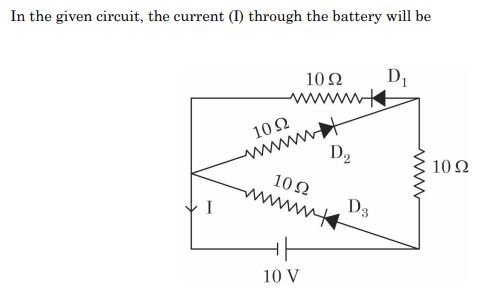
In the given circuit, the current $(I)$ through the battery will be
Question 43 image
  • A. 1.5 A
  • B. 2.5 A
  • C. 1 A
  • D. 2 A

Correct answer & explanation hidden

Log in to view solution →
Q44 PHYSICS Unit 18: Atoms and Nuclei
The half-life of a radioactive nucleus is $5$ years. The fraction of the original sample that would decay in $15$ years is:
  • A. $\frac{1}{4}$
  • B. $\frac{1}{8}$
  • C. $\frac{3}{4}$
  • D. $\frac{7}{8}$

Correct answer & explanation hidden

Log in to view solution →
Q45 PHYSICS Unit 17: Dual Nature of Matter and Radiation
The de Broglie wavelength of an electron having kinetic energy $E$ is $\lambda$. If the kinetic energy of electron becomes $\frac{E}{4}$, then its de-Broglie wavelength will be:
  • A. $\frac{\lambda}{2}$
  • B. $2\lambda$
  • C. $\frac{\lambda}{\sqrt{2}}$
  • D. $\sqrt{2}\lambda$

Correct answer & explanation hidden

Log in to view solution →
Q46 PHYSICS Unit 16: Optics
A single slit of width $a$ is illuminated by a monochromatic light of wavelength $600\,\text{nm}$. The value of $a$ for which first minimum appears at $\theta = 30^\circ$ on the screen will be:
  • A. $0.6\,\mu\text{m}$
  • B. $1.2\,\mu\text{m}$
  • C. $1.8\,\mu\text{m}$
  • D. $3\,\mu\text{m}$

Correct answer & explanation hidden

Log in to view solution →
Q47 PHYSICS Unit 15: Electromagnetic Waves
Match List I with List II of Electromagnetic waves with corresponding wavelength range : List I (A) Microwave (B) Ultraviolet (C) X-Ray (D) Infra-red List II (I) $400\,\text{nm}$ to $1\,\text{nm}$ (II) $1\,\text{nm}$ to $10^{-3}\,\text{nm}$ (III) $1\,\text{mm}$ to $700\,\text{nm}$ (IV) $0.1\,\text{m}$ to $1\,\text{mm}$ Choose the correct answer from the options given below:
  • A. (A)-(I), (B)-(IV), (C)-(II), (D)-(III)
  • B. (A)-(IV), (B)-(II), (C)-(I), (D)-(III)
  • C. (A)-(IV), (B)-(I), (C)-(II), (D)-(III)
  • D. (A)-(IV), (B)-(I), (C)-(III), (D)-(II)

Correct answer & explanation hidden

Log in to view solution →
Q48 PHYSICS Unit 14: Electromagnetic Induction and Alternating Currents
A $12\,\text{V}$ battery connected to a coil of resistance $6\,\Omega$ through a switch, drives a constant current in the circuit. The switch is opened in $1\,\text{ms}$. The emf induced across the coil is $20\,\text{V}$. The inductance of the coil is:
  • A. $5\,\text{mH}$
  • B. $8\,\text{mH}$
  • C. $10\,\text{mH}$
  • D. $12\,\text{mH}$

Correct answer & explanation hidden

Log in to view solution →
Q49 PHYSICS Unit 12: Current Electricity
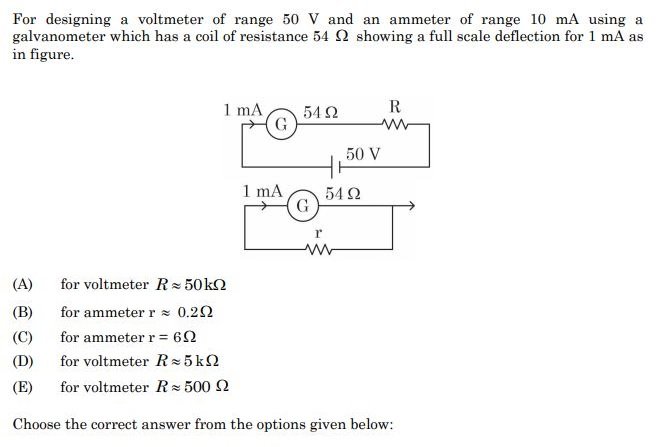
For designing a voltmeter of range $50\,\text{V}$ and an ammeter of range $10\,\text{mA}$ using a galvanometer which has a coil of resistance $54\,\Omega$ showing a full scale deflection for $1\,\text{mA}$ as in figure.
Question 49 image
  • A. for voltmeter $R \approx 50\,\text{k}\Omega$
  • B. for ammeter $r \approx 0.2\,\Omega$
  • C. for ammeter $r = 6\,\Omega$
  • D. for voltmeter $R \approx 5\,\text{k}\Omega$

Correct answer & explanation hidden

Log in to view solution →
Q50 PHYSICS Unit 12: Current Electricity
Given below are two statements: Statement I : The equivalent resistance of resistors in a series combination is smaller than least resistance used in the combination. Statement II : The resistivity of the material is independent of temperature. In the light of the above statements, choose the correct answer from the options given below :
  • A. Both Statement I and Statement II are true
  • B. Both Statement I and Statement II are false
  • C. Statement I is true but Statement II is false
  • D. Statement I is false but Statement II is true

Correct answer & explanation hidden

Log in to view solution →
Q61 CHEMISTRY Unit 3: Chemical Bonding and Molecular Structure
Which of the following expressions is correct in case of a CsCl unit cell (edge length 'a')?
  • A. $r_{\mathrm{Cs}^+} + r_{\mathrm{Cl}^-} = a$
  • B. $r_{\mathrm{Cs}^+} + r_{\mathrm{Cl}^-} = \dfrac{a}{\sqrt{2}}$
  • C. $r_{\mathrm{Cs}^+} + r_{\mathrm{Cl}^-} = \dfrac{\sqrt{3}}{2}a$
  • D. $r_{\mathrm{Cs}^+} + r_{\mathrm{Cl}^-} = \dfrac{a}{2}$

Correct answer & explanation hidden

Log in to view solution →
Q62 CHEMISTRY Unit 2: Atomic Structure
Given below are two statements: Statement I : According to Bohr's model of hydrogen atom, the angular momentum of an electron in a given stationary state is quantised. Statement II : The concept of electron in Bohr's orbit violates the Heisenberg uncertainty principle. In the light of the above statements, choose the most appropriate answer from the options given below:
  • A. Both Statement I and Statement II are correct
  • B. Both Statement I and Statement II are incorrect
  • C. Statement I is correct but Statement II is incorrect
  • D. Statement I is incorrect but Statement II is correct

Correct answer & explanation hidden

Log in to view solution →
Q63 CHEMISTRY Unit 3: Chemical Bonding and Molecular Structure
Consider the following statements: (A) $\mathrm{NF_3}$ molecule has a trigonal planar structure. (B) Bond length of $\mathrm{N_2}$ is shorter than $\mathrm{O_2}$. (C) Isoelectronic molecules or ions have identical bond order. (D) Dipole moment of $\mathrm{H_2S}$ is higher than that of water molecule. Choose the correct answer from the options given below:
  • A. (A) and (B) are correct
  • B. (B) and (C) are correct
  • C. (C) and (D) are correct
  • D. (A) and (D) are correct

Correct answer & explanation hidden

Log in to view solution →
Q64 CHEMISTRY Unit 6: Equilibrium
Which of the following statement(s) is/are correct? (A) The pH of $1\times 10^{-8}$ M HCl solution is 8. (B) The conjugate base of $\mathrm{H_2PO_4^-}$ is $\mathrm{HPO_4^{2-}}$. (C) $K_w$ increases with increase in temperature. (D) When a solution of a weak monoprotic acid is titrated against a strong base at half neutralisation point, $\mathrm{pH}=\dfrac{1}{2}pK_a$. Choose the correct answer from the options given below:
  • A. (A), (B), (C)
  • B. (B), (C), (D)
  • C. (B), (C)
  • D. (A), (D)

Correct answer & explanation hidden

Log in to view solution →
Q65 CHEMISTRY Unit 13: Purification and Characterisation of Organic Compounds
Which one of the following is not an example of calcination?
  • A. $\mathrm{Fe_2O_3\cdot xH_2O \xrightarrow{\Delta} Fe_2O_3 + xH_2O}$
  • B. $\mathrm{CaCO_3 \xrightarrow{\Delta} CaO + CO_2}$
  • C. $\mathrm{CaCO_3\cdot MgCO_3 \xrightarrow{\Delta} CaO + MgO + 2CO_2}$
  • D. $\mathrm{2PbS + 3O_2 \xrightarrow{\Delta} 2PbO + 2SO_2}$

Correct answer & explanation hidden

Log in to view solution →
Q66 CHEMISTRY Unit 7: Redox Reactions and Electrochemistry
During water-gas shift reaction
  • A. carbon is oxidized to carbon monoxide.
  • B. carbon monoxide is oxidized to carbon dioxide.
  • C. carbon dioxide is reduced to carbon monoxide.
  • D. water is evaporated in presence of catalyst.

Correct answer & explanation hidden

Log in to view solution →
Q67 CHEMISTRY Unit 13: Purification and Characterisation of Organic Compounds
Given below are two statements: One is labelled as Assertion A and the other is labelled as Reason R: Assertion (A) : BeCl$_2$ and MgCl$_2$ produce characteristic flame Reason (R) : The excitation energy is high in BeCl$_2$ and MgCl$_2$ In the light of the above statements, choose the correct answer from the options given below :
  • A. Both (A) and (R) are true and (R) is the correct explanation of (A)
  • B. Both (A) and (R) are true but (R) is NOT the correct explanation of (A)
  • C. (A) is true but (R) is false
  • D. (A) is false but (R) is true

Correct answer & explanation hidden

Log in to view solution →
Q68 CHEMISTRY Unit 13: Purification and Characterisation of Organic Compounds
For a good quality cement, the ratio of silica to alumina is found to be
  • A. 1.5
  • B. 3
  • C. 4.5
  • D. 2

Correct answer & explanation hidden

Log in to view solution →
Q69 CHEMISTRY Unit 10: p-Block Elements
The number of $\mathrm{P{-}O{-}P}$ bonds in $\mathrm{H_4P_2O_7}$, $(\mathrm{HPO_3})_3$ and $\mathrm{P_4O_{10}}$ are respectively
  • A. 0, 3, 4
  • B. 0, 3, 6
  • C. 1, 2, 4
  • D. 1, 3, 6

Correct answer & explanation hidden

Log in to view solution →
Q70 CHEMISTRY Unit 12: Coordination Compounds
The complex with highest magnitude of crystal field splitting energy $\Delta_o$ is
  • A. $[\mathrm{Ti(H_2O)_6}]^{3+}$
  • B. $[\mathrm{Cr(H_2O)_6}]^{3+}$
  • C. $[\mathrm{Mn(H_2O)_6}]^{3+}$
  • D. $[\mathrm{Fe(H_2O)_6}]^{3+}$

Correct answer & explanation hidden

Log in to view solution →
Q71 CHEMISTRY Unit 10: p-Block Elements
The possibility of photochemical smog formation will be minimum at
↻ Repeated question — also appeared in 2023 (1 set)
  • A. New-Delhi in August (Summer)
  • B. Srinagar, Jammu and Kashmir in January
  • C. Mumbai in May
  • D. Kolkata in October

Correct answer & explanation hidden

Log in to view solution →
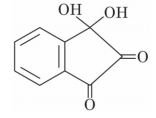
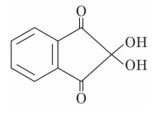
Q72 CHEMISTRY Unit 17: Organic Compounds Containing Oxygen
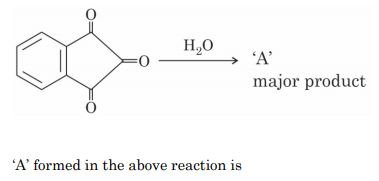
The product formed in the above reaction is
Question 72 image
  • A. Benzene-fused cyclopentane triol with one ketone and two adjacent OH groups Choice A image
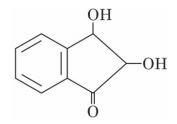
  • B. Benzene-fused cyclopentane with two OH groups and one ketone at the right side Choice B image
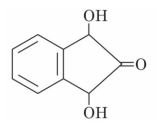
  • C. Benzene-fused cyclopentane with two OH groups on the top carbon and one ketone Choice C image
  • D. Benzene-fused cyclohexane diketone with a gem-diol side chain Choice D image
Correct answer & explanation hidden

Log in to view solution →
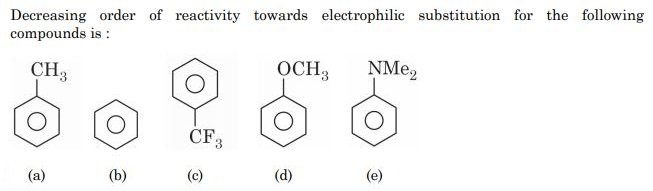
Q73 CHEMISTRY Unit 15: Hydrocarbons
Decreasing order of reactivity towards electrophilic substitution for the following compounds is:
Question 73 image
  • A. $a > d > e > b > c$
  • B. $e > d > a > b > c$
  • C. $d > a > e > c > b$
  • D. $c > b > a > d > e$

Correct answer & explanation hidden

Log in to view solution →
Q74 CHEMISTRY Unit 15: Hydrocarbons
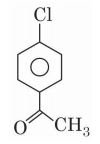
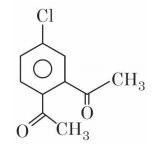
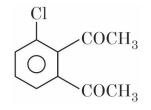
The major product formed in the Friedel-Craft acylation of chlorobenzene is
  • A. Chlorobenzene with $\mathrm{COCH_3}$ para to Cl and another $\mathrm{CH_3}$ substituent Choice A image
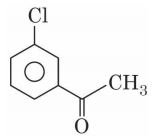
  • B. p-chloroacetophenone Choice B image
  • C. Diaroylated chlorobenzene Choice C image
  • D. 2,6-diacetylchlorobenzene Choice D image

Correct answer & explanation hidden

Log in to view solution →
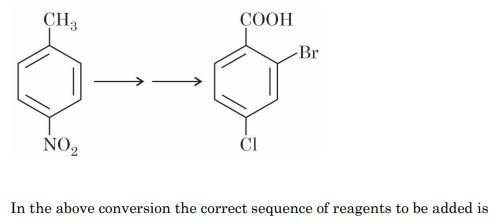
Q75 CHEMISTRY Unit 16: Organic Compounds Containing Halogens
In the above conversion the correct sequence of reagents to be added is
Question 75 image
  • A. $(i)$ $\mathrm{Br_2/Fe}$, $(ii)$ $\mathrm{Fe/H^+}$, $(iii)$ $\mathrm{KMnO_4}$, $(iv)$ $\mathrm{Cl_2}$
  • B. $(i)$ $\mathrm{KMnO_4}$, $(ii)$ $\mathrm{Br_2/Fe}$, $(iii)$ $\mathrm{Fe/H^+}$, $(iv)$ $\mathrm{Cl_2}$
  • C. $(i)$ $\mathrm{Br_2/Fe}$, $(ii)$ $\mathrm{Fe/H^+}$, $(iii)$ $\mathrm{HONO}$, $(iv)$ $\mathrm{CuCl}$, $(v)$ $\mathrm{KMnO_4}$
  • D. $(i)$ $\mathrm{Fe/H^+}$, $(ii)$ $\mathrm{HONO}$, $(iii)$ $\mathrm{CuCl}$, $(iv)$ $\mathrm{KMnO_4}$, $(v)$ $\mathrm{Br_2}$

Correct answer & explanation hidden

Log in to view solution →
Q76 CHEMISTRY Unit 17: Organic Compounds Containing Oxygen
The product formed in the following multistep reaction is : $i)$ $\mathrm{B_2H_6}$ $ii)$ $\mathrm{H_2O_2,\ NaOH}$ $iii)$ PCC $iv)$ $\mathrm{CH_3MgBr}$ $\mathrm{CH_3{-}CH{=}CH_2}$
  • A. $\mathrm{CH_3{-}C(OH)(CH_3){-}CH_3}$
  • B. $\mathrm{CH_3{-}CH_2{-}CH(OH){-}CH_3}$
  • C. $\mathrm{CH_3{-}CH_2{-}C(=O)OCH_3}$
  • D. $\mathrm{CH_3{-}CH_2{-}CH_2{-}CH_2{-}OH$

Correct answer & explanation hidden

Log in to view solution →
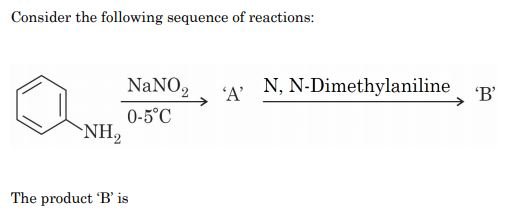
Q77 CHEMISTRY Unit 18: Organic Compounds Containing Nitrogen
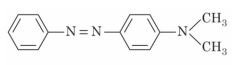
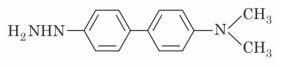
Consider the following sequence of reactions: Aniline is treated with $\mathrm{NaNO_2}$ at $0$–$5^\circ\mathrm{C}$ to give 'A', which on reaction with $N,N$-dimethylaniline gives 'B'. The product 'B' is
Question 77 image
  • A. Azobenzene derivative with one $\mathrm{CH_3}$ on each nitrogen Choice A image
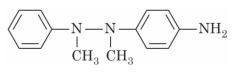
  • B. Hydrazo compound linking two phenyl rings, one end bearing $\mathrm{N(CH_3)_2}$ Choice B image
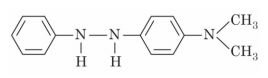
  • C. Azo compound: $\mathrm{Ph-N=N-Ph-N(CH_3)_2}$ Choice C image
  • D. Hydrazine derivative linking two phenyl rings, ending with $\mathrm{N(CH_3)_2}$ Choice D image
Correct answer & explanation hidden

Log in to view solution →
Q78 CHEMISTRY Unit 18: Organic Compounds Containing Nitrogen
Match List I with List II: List I – (Monomer) (A) Tetrafluoroethene (B) Acrylonitrile (C) Caprolactam (D) Isoprene List II – (Polymer) (I) Orlon (II) Natural rubber (III) Teflon (IV) Nylon-6 Choose the correct answer from the options given below:
  • A. (A)-(III), (B)-(I), (C)-(IV), (D)-(II)
  • B. (A)-(III), (B)-(IV), (C)-(II), (D)-(I)
  • C. (A)-(II), (B)-(III), (C)-(IV), (D)-(I)
  • D. (A)-(IV), (B)-(I), (C)-(II), (D)-(III)

Correct answer & explanation hidden

Log in to view solution →
Q79 CHEMISTRY Unit 19: Biomolecules
Which is not true for arginine?
  • A. It is a crystalline solid.
  • B. It has high solubility in benzene.
  • C. It has a fairly high melting point.
  • D. It is associated with more than one $pK_a$ values.

Correct answer & explanation hidden

Log in to view solution →
Q80 CHEMISTRY Unit 20: Principles Related to Practical Chemistry
Which of the following statement is correct for paper chromatography?
  • A. Paper sheet forms the stationary phase.
  • B. Water present in the pores of the paper forms the stationary phase.
  • C. Paper and water present in its pores together form the stationary phase.
  • D. Water present in the mobile phase gets absorbed by the paper which then forms the stationary phase.

Correct answer & explanation hidden

Log in to view solution →