
- A. $A = B$
- B. $A \subset B,\ A \ne B$
- C. $B \subset A,\ A \ne B$
- D. $A \cap B = \varnothing$
Correct answer & explanation hidden
Log in to view solution →- A. $9-\sqrt{3}$
- B. $9+\sqrt{3}$
- C. $11+\sqrt{3}$
- D. $11-\sqrt{3}$
Correct answer & explanation hidden
Log in to view solution →- A. $3$
- B. $4$
- C. $7$
- D. $14$
Correct answer & explanation hidden
Log in to view solution →- A. $20$
- B. $23$
- C. $25$
- D. $28$
Correct answer & explanation hidden
Log in to view solution →- A. $27:11$
- B. $35:16$
- C. $2:1$
- D. $65:37$
Correct answer & explanation hidden
Log in to view solution →- A. $60\sqrt{2}$
- B. $60\sqrt{3}$
- C. $30\sqrt{2}$
- D. $30\sqrt{3}$
Correct answer & explanation hidden
Log in to view solution →- A. $3250$
- B. $3450$
- C. $3420$
- D. $3520$
Correct answer & explanation hidden
Log in to view solution →- A. $1$
- B. $0$
- C. $\sqrt d$
- D. $\frac{1}{\sqrt d}$
Correct answer & explanation hidden
Log in to view solution →- A. -\left(\frac{3 + \log_e 4}{2 + \log_e 8}\right)
- B. -\left(\frac{3 + \log_e 16}{4 + \log_e 8}\right)
- C. -\left(\frac{3 + \log_e 8}{2 + \log_e 4}\right)
- D. -\left(\frac{2 + \log_e 8}{3 + \log_e 4}\right)
Correct answer & explanation hidden
Log in to view solution →- A. $5\log_e 2 - 3$
- B. $5\log_e 2 + 3$
- C. $10\log_e 2 - 6$
- D. $10\log_e 2 + 6$
Correct answer & explanation hidden
Log in to view solution →- A. $\log_e\!\left(\frac{(\pi+4)^2}{32}\right)-\frac{\pi^2}{4(\pi+4)}$
- B. $\log_e\!\left(\frac{(\pi+4)^2}{16}\right)+\frac{\pi^2}{4(\pi+4)}$
- C. $\log_e\!\left(\frac{(\pi+4)^2}{16}\right)-\frac{\pi^2}{4(\pi+4)}$
- D. $\log_e\!\left(\frac{(\pi+4)^2}{32}\right)+\frac{\pi^2}{4(\pi+4)}$
Correct answer & explanation hidden
Log in to view solution →- A. $y-2x=5$
- B. $6x-y=15$
- C. $y-x=5$
- D. $6x+y=10$
Correct answer & explanation hidden
Log in to view solution →- A. 12
- B. 13
- C. 14
- D. 15
Correct answer & explanation hidden
Log in to view solution →- A. $\frac{12}{5}$
- B. $\frac{12}{5\sqrt{5}}$
- C. $12\sqrt{5}$
- D. $\frac{12}{\sqrt{5}}$
Correct answer & explanation hidden
Log in to view solution →- A. 640
- B. 680
- C. 720
- D. 760
Correct answer & explanation hidden
Log in to view solution →- A. 12
- B. 11
- C. 10
- D. 9
Correct answer & explanation hidden
Log in to view solution →- A. 75
- B. 82
- C. 123
- D. 164
Correct answer & explanation hidden
Log in to view solution →- A. $200(3-\sqrt{3})$
- B. $600(\sqrt{3}-1)$
- C. $300(\sqrt{3}-1)$
- D. $300(\sqrt{3}+1)$
Correct answer & explanation hidden
Log in to view solution →- A. $(P \Rightarrow Q) \wedge (Q \Rightarrow R)$
- B. $(P \wedge R) \Rightarrow Q$
- C. $(P \Rightarrow R) \vee (Q \Rightarrow R)$
- D. $(P \vee R) \Rightarrow Q$
Correct answer & explanation hidden
Log in to view solution →- A. 14%
- B. 10%
- C. 12%
- D. 15%
Correct answer & explanation hidden
Log in to view solution →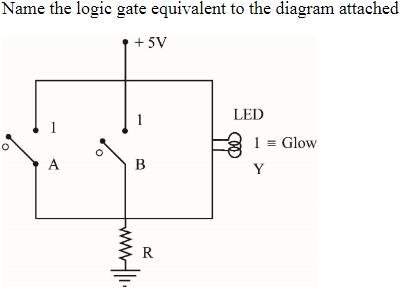
- A. NAND
- B. NOR
- C. AND
- D. OR
Correct answer & explanation hidden
Log in to view solution →- A. $F = Mg\left(1 - \frac{\rho_0}{\rho}\right)$
- B. $F = Mg\left(1 + \frac{\rho_0}{\rho}\right)$
- C. $F = Mg\left(1 + \frac{\rho}{\rho_0}\right)$
- D. $F = Mg\left(1 \pm \rho\rho_0\right)$
Correct answer & explanation hidden
Log in to view solution →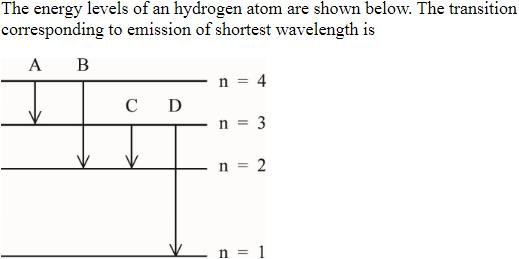
- A. A
- B. B
- C. C
- D. D
Correct answer & explanation hidden
Log in to view solution →- A. $\lambda_\alpha > \lambda_p > \lambda_e$
- B. $\lambda_\alpha < \lambda_p < \lambda_e$
- C. $\lambda_\alpha = \lambda_p < \lambda_e$
- D. $\lambda_\alpha = \lambda_p = \lambda_e$
Correct answer & explanation hidden
Log in to view solution →- A. $\lambda_2 = \sqrt{2}\lambda_1,\ \nu_2 = \nu_1$
- B. $\lambda_2 = \frac{1}{\sqrt{2}}\lambda_1,\ \nu_2 = \nu_1$
- C. $\lambda_2 = \lambda_1,\ \nu_2 = \frac{1}{\sqrt{2}}\nu_1$
- D. $\lambda_2 = \lambda_1,\ \nu_2 = \sqrt{2}\nu_1$
Correct answer & explanation hidden
Log in to view solution →- A. 1
- B. 2
- C. 4
- D. $1/2$
Correct answer & explanation hidden
Log in to view solution →- A. A and C only
- B. B and C only
- C. C and D only
- D. B and D only
Correct answer & explanation hidden
Log in to view solution →- A. 7
- B. 5
- C. 2
- D. 1
Correct answer & explanation hidden
Log in to view solution →- A. uniform in the region $r < a$ and inversely proportional to distance $r$ from the axis, in the region $r > a$
- B. zero in the region $r < a$ and inversely proportional to $r$ in the region $r > a$
- C. directly proportional to $r$ in the region $r < a$ and inversely proportional to $r$ in the region $r > a$
- D. inversely proportional to $r$ in the region $r < a$ and uniform throughout the region $r > a$
Correct answer & explanation hidden
Log in to view solution →
-
A.
Graph showing resistivity decreasing linearly with temperature
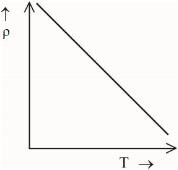
-
B.
Graph showing resistivity increasing linearly with temperature
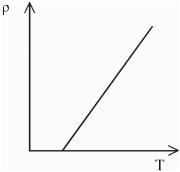
-
C.
Graph showing resistivity increasing nonlinearly with temperature
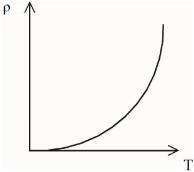
-
D.
Graph showing resistivity decreasing nonlinearly with temperature
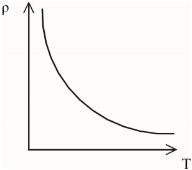
Correct answer & explanation hidden
Log in to view solution →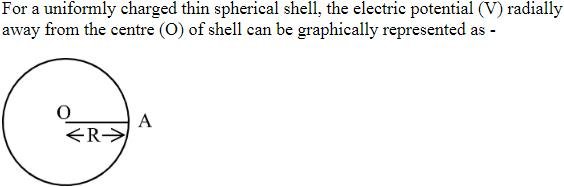
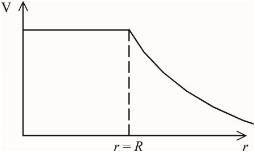
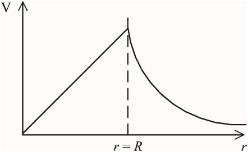
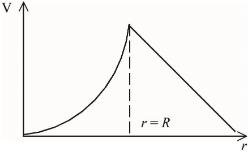
-
A.
Graph with constant $V$ for $r<R$, then linearly decreasing for $r>R$
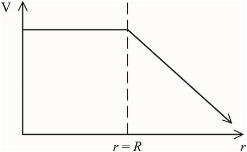
-
B.
Graph with constant $V$ for $r<R$, then decreasing as $1/r$ for $r>R$
-
C.
Graph increasing linearly inside, then decreasing as $1/r$ outside
-
D.
Graph increasing nonlinearly inside, then linearly decreasing outside
Correct answer & explanation hidden
Log in to view solution →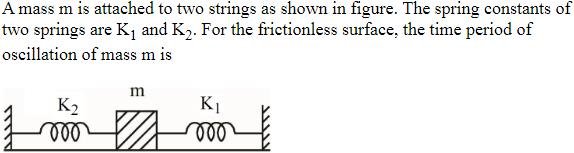
- A. $2\pi \sqrt{\dfrac{m}{K_1+K_2}}$
- B. $2\pi \sqrt{\dfrac{m}{K_1-K_2}}$
- C. $\dfrac{1}{2\pi}\sqrt{\dfrac{K_1+K_2}{m}}$
- D. $\dfrac{1}{2\pi}\sqrt{\dfrac{K_1-K_2}{m}}$
Correct answer & explanation hidden
Log in to view solution →- A. 500 W
- B. 600 W
- C. 1200 W
- D. 800 W
Correct answer & explanation hidden
Log in to view solution →- A. 0.25
- B. 0.50
- C. 0.75
- D. 1.25
Correct answer & explanation hidden
Log in to view solution →- A. 4.33
- B. 6.33
- C. 2.33
- D. 5.33
Correct answer & explanation hidden
Log in to view solution →- A. Both A and R are correct and R is the correct explanation of A
- B. Both A and R are correct but R is NOT the correct explanation of A
- C. A is true but R is false
- D. A is false but R is true
Correct answer & explanation hidden
Log in to view solution →- A. 0.25 N
- B. 0.50 N
- C. 0.75 N
- D. 1.5 N
Correct answer & explanation hidden
Log in to view solution →- A. Both A and R are correct and R is the correct explanation of A
- B. Both A and R are correct but R is NOT the correct explanation of A
- C. A is true but R is false
- D. A is false but R is true
Correct answer & explanation hidden
Log in to view solution →- A. $W$
- B. $2W$
- C. $2^{2/3}W$
- D. $2^{1/3}W$
Correct answer & explanation hidden
Log in to view solution →- A. $XY_3$
- B. $X_3Y$
- C. $X_2Y_3$
- D. $X_3Y_2$
Correct answer & explanation hidden
Log in to view solution →- A. $\left(\dfrac{K_{eq}}{6c^5}\right)^{1/5}$
- B. $\left(\dfrac{K_{eq}}{108c^4}\right)^{1/5}$
- C. $\left(\dfrac{K_{eq}}{5c^4}\right)^{1/5}$
- D. $\left(\dfrac{K_{eq}}{25c^2}\right)^{1/5}$
Correct answer & explanation hidden
Log in to view solution →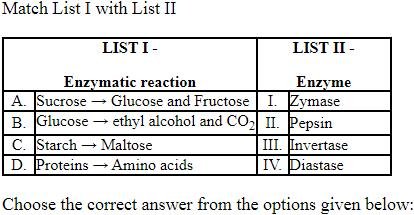
- A. A-I, B-II, C-IV, D-III
- B. A-III, B-I, C-IV, D-II
- C. A-III, B-I, C-II, D-IV
- D. A-I, B-IV, C-III, D-II
Correct answer & explanation hidden
Log in to view solution →- A. Ne and F
- B. Ne and Cl
- C. Ar and F
- D. Ar and Cl
Correct answer & explanation hidden
Log in to view solution →- A. A and B only
- B. A only
- C. C and D only
- D. A and D only
Correct answer & explanation hidden
Log in to view solution →- A. Both A and R are correct and R is the correct explanation of A
- B. Both A and R are correct but R is NOT the correct explanation of A
- C. A is correct but R is not correct
- D. A is not correct but R is correct
Correct answer & explanation hidden
Log in to view solution →- A. Sublimation of a solid metal
- B. Ionisation of a gaseous metal atom
- C. Ionisation of a solid metal atom
- D. Hydration of a gaseous metal ion
Correct answer & explanation hidden
Log in to view solution →- A. Limestone
- B. Clay
- C. Gypsum
- D. Silica
Correct answer & explanation hidden
Log in to view solution →- A. A-III, B-I, C-IV, D-II
- B. A-III, B-I, C-II, D-IV
- C. A-II, B-IV, C-III, D-I
- D. A-II, B-I, C-III, D-IV
Correct answer & explanation hidden
Log in to view solution →- A. $Ce^{4+}$ and $Eu^{2+}$
- B. $Eu^{2+}$ and $Ce^{4+}$
- C. $Ce^{3+}$ and $Ce^{4+}$
- D. $Ce^{4+}$ and $Tb^{4+}$
Correct answer & explanation hidden
Log in to view solution →- A. the places with healthy vegetation
- B. industrial areas
- C. Himalayan villages in winter
- D. marshy lands
Correct answer & explanation hidden
Log in to view solution →- A. Both A and R are true and R is the correct explanation of A
- B. Both A and R are true but R is NOT the correct explanation of A
- C. A is true but R is false
- D. A is false but R is true
Correct answer & explanation hidden
Log in to view solution →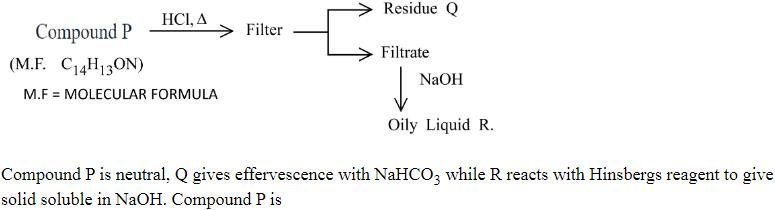
-
A.
N-methyl benzamide
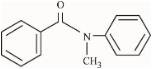
-
B.
2-methyl-N-phenyl benzamide
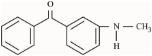
-
C.
2-methylbenzohydrazide
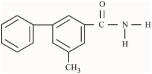
-
D.
p-methyl benzanilide
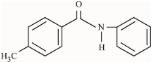
Correct answer & explanation hidden
Log in to view solution →- A. A-II, B-I, C-IV, D-III
- B. A-III, B-I, C-IV, D-II
- C. A-II, B-IV, C-I, D-III
- D. A-IV, B-II, C-I, D-III
Correct answer & explanation hidden
Log in to view solution →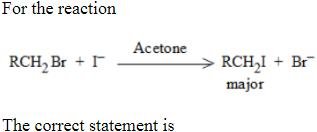
- A. The reaction can occur in acetic acid also.
- B. $Br^-$ can act as competing nucleophile.
- C. The solvent used in the reaction solvates the ions formed in rate determining step.
- D. The transition state formed in the above reaction is less polar than the localised anion.
Correct answer & explanation hidden
Log in to view solution →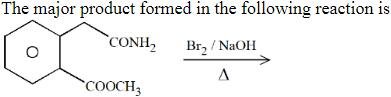
-
A.
Fused bicyclic lactam with one NH and one carbonyl
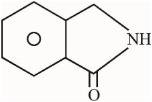
-
B.
Fused bicyclic anhydride-like lactone with two carbonyls and one O
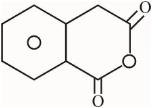
-
C.
Fused bicyclic imide-like lactam with two carbonyls and one NH
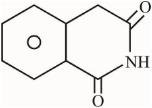
-
D.
Fused bicyclic ketone
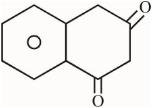
Correct answer & explanation hidden
Log in to view solution →- A. A-I, B-II, C-III, D-IV
- B. A-III, B-II, C-I, D-IV
- C. A-III, B-I, C-II, D-IV
- D. A-III, B-I, C-IV, D-II
Correct answer & explanation hidden
Log in to view solution →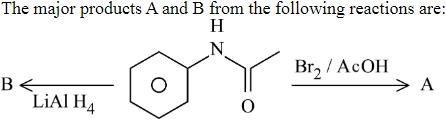
-
A.
A = brominated amide product; B = ethyl-substituted aniline derivative
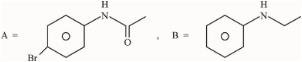
-
B.
A = tribrominated aromatic amide; B = amino-substituted cyclohexane derivative
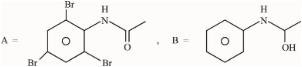
-
C.
A = tribrominated aromatic amide; B = aniline derivative
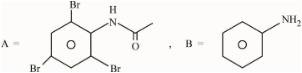
-
D.
A = brominated aromatic amide; B = hydroxyethyl-substituted aromatic amide
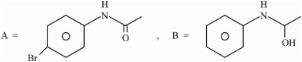
Correct answer & explanation hidden
Log in to view solution →- A. Polyacrylonitrile
- B. Polyamide
- C. Polyethene
- D. Polycarbonate
Correct answer & explanation hidden
Log in to view solution →- A. A-IV, B-I, C-III, D-II
- B. A-III, B-I, C-IV, D-II
- C. A-III, B-II, C-IV, D-I
- D. A-IV, B-II, C-III, D-I
Correct answer & explanation hidden
Log in to view solution →