
- A. only (S1) is true
- B. both (S1) and (S2) are true
- C. neither (S1) nor (S2) is true
- D. both (S1) and (S2) are incorrect
Correct answer & explanation hidden
Log in to view solution →- A. $\dfrac{\sqrt{119}}{12}$
- B. $\dfrac{\sqrt{129}}{12}$
- C. $\dfrac{3\sqrt{15}}{12}$
- D. $\dfrac{\sqrt{117}}{12}$
Correct answer & explanation hidden
Log in to view solution →- A. 1
- B. 2
- C. 3
Correct answer & explanation hidden
Log in to view solution →- A. 24
- B. 22
- C. 18
- D. 40
Correct answer & explanation hidden
Log in to view solution →- A. System has no solution for $\alpha=3,\ \beta=24$.
- B. System has infinitely many solutions for $\alpha=3,\ \beta=14$.
- C. System has a unique solution for $\alpha=3,\ \beta\ne 14$.
- D. $\alpha=-3,\ \beta=14$ के लिए समीकरण निकाय का अद्वितीय हल है
Correct answer & explanation hidden
Log in to view solution →- A. only (S2) is correct
- B. both (S1) and (S2) are incorrect
- C. both (S1) and (S2) are correct
- D. केवल (S1) सही है
Correct answer & explanation hidden
Log in to view solution →- A. 64ab=243
- B. 243ab=64
- C. 729ab=32
- D. 32ab=729
Correct answer & explanation hidden
Log in to view solution →- A. 578
- B. 580
- C. 582
- D. 576
Correct answer & explanation hidden
Log in to view solution →- A. $\frac{1}{\sqrt{2}}$
- B. $\sqrt{2}$
- C. $1$
- D. Cannot be determined from the image
Correct answer & explanation hidden
Log in to view solution →- A. 220
- B. 200
- C. 180
- D. 240
Correct answer & explanation hidden
Log in to view solution →- A. $\frac{\pi^2}{4}$
- B. $\frac{\pi^2}{2}$
- C. $\pi^2$
- D. $2\pi^2$
Correct answer & explanation hidden
Log in to view solution →- A. $e^{\sqrt{2}e^2}$
- B. $e^{2e\sqrt{2}}$
- C. $e^{2e^2}$
- D. $e^{e^2}$
Correct answer & explanation hidden
Log in to view solution →- A. $\frac{13}{4}$
- B. $\frac{5}{8}$
- C. $\frac{5}{4}$
- D. $\frac{13}{8}$
Correct answer & explanation hidden
Log in to view solution →- A. 310
- B. 620
- C. 1240
- D. 155
Correct answer & explanation hidden
Log in to view solution →- A. $\sqrt{69}$
- B. $\sqrt{74}$
- C. 9
- D. $\sqrt{54}$
Correct answer & explanation hidden
Log in to view solution →- A. 2
- B. 4
- C. 6
- D. -2
Correct answer & explanation hidden
Log in to view solution →- A. $2\,V$
- B. $3\,V$
- C. $6\,V$
- D. $V$
Correct answer & explanation hidden
Log in to view solution →- A. 3
- B. 2
- C. 1
- D. 4
Correct answer & explanation hidden
Log in to view solution →- A. only (S2) is True
- B. both (S1) and (S2) are True
- C. neither (S1) and (S2) is True
- D. only (S1) is True
Correct answer & explanation hidden
Log in to view solution →- A. 0.85
- B. 1.02
- C. 1.70
- D. 0.51
Correct answer & explanation hidden
Log in to view solution →
- A. $\sqrt{3}\,\text{m s}^{-1}$
- B. $1.5\sqrt{3}\,\text{m s}^{-1}$
- C. $2\sqrt{3}\,\text{m s}^{-1}$
- D. $\pi\,\text{m s}^{-1}$
Correct answer & explanation hidden
Log in to view solution →- A. $25\,\text{s}$
- B. $30\,\text{s}$
- C. $3\,\text{s}$
- D. $6\,\text{s}$
Correct answer & explanation hidden
Log in to view solution →- A. 50 N
- B. 80 N
- C. 100 N
- D. 40 N
Correct answer & explanation hidden
Log in to view solution →- A. For a planet revolving around the sun in an elliptical orbit, the total energy of the planet remains constant.
- B. The linear speed of a planet revolving around the sun remains constant.
- C. निम्नलिखित से गलत कथन चुनिए:
- D. जब एक पिंड की ओर गिरता है, पृथ्वी का पिंड की ओर विस्थापन नगण्य होता है।
Correct answer & explanation hidden
Log in to view solution →- A. 64 N
- B. 100 N
- C. पृथ्वी की सतह पर एक पिंड का भार 100 N है। इस पर लगने वाला गुरुत्वाकर्षण बल, जब पृथ्वी की त्रिज्या के एक चौथाई के बराबर एक ऊँचाई पर ले जाया जाता है, है:
- D. 25 N
Correct answer & explanation hidden
Log in to view solution →- A. A is correct but R is not correct
- B. A is not correct but R is correct
- C. नीचे दो कथन दिये गये हैं: एक का अभिकथन A तथा दूसरे का कारण R से चिन्हित किया गया है अभिकथन A: जब आप ट्यूब के एक सिरे दबाते हैं तो इसके दूसरे सिरे से अपेक्षाकृत बाहर आता है पारे के नियम का अंकरण होता है। कारण R: एक बंद अपरिवर्ती द्रव पर आरोपित दाब में एक परिवर्तक द्रव पर प्रत्येक भाग एवं बर्तन की अपनी दीवारों को बिना कम किये प्रायगित हो जाता है। उपरोक्त कथनों के संदर्भ में, नीचे दिये गये विकल्पों में से सर्वाधिक उपयुक्त उत्तर चुनिए:
- D. A और R दोनों सही हैं और R, A की सही व्याख्या है
Correct answer & explanation hidden
Log in to view solution →- A. 32°C
- B. 34°C
- C. 7 मिनट में एक वस्तु $60^\circ$C से $40^\circ$C तक ठंडी होती है। वातावरण का तापमान $10^\circ$C है। अगले 7 मिनट में वस्तु का तापमान होगा:
- D. 28°C
Correct answer & explanation hidden
Log in to view solution →- A. $v_0$
- B. $4v_0$
- C. एक आदर्श गैस का तापमान $200\,\text{K}$ से $800\,\text{K}$ तक बढ़ता है। यदि $200\,\text{K}$ पर गैस के वर्ग माध्य मूल चाल $v_0$ है, तो $800\,\text{K}$ पर गैस की वर्ग माध्य मूल चाल होगी:
- D. $\dfrac{v_0}{4}$
Correct answer & explanation hidden
Log in to view solution →- A. 1 : 4
- B. 4 : 1
- C. समान तापमान पर हाइड्रोजन गैस में ध्वनि की चाल एवं ऑक्सीजन गैस में ध्वनि की चाल का अनुपात है:
- D. 1 : 1
Correct answer & explanation hidden
Log in to view solution →- A. 12 V
- B. 15 V
- C. एक आयाम मॉडुलित तरंग के लिए न्यूनतम आयाम 3 V है, जबकि मॉडुलन गुणांक 60% है। मॉडुलित तरंग का अधिकतम आयाम है:
- D. 5 V
Correct answer & explanation hidden
Log in to view solution →- A. A is correct but R is not correct
- B. A is not correct but R is correct
- C. नीचे दो कथन दिये गये हैं: एक का अभिकथन A तथा दूसरे का कारण R से चिन्हित किया गया है अभिकथन A: एक p-n सन्धि में विसरण धारा, अपवाह धारा से अधिक होती है यदि सन्धि अधिकाधिक बायस हो। कारण R: एक p-n सन्धि में विसरण धारा n-तरफ से p-तरफ की ओर होती है यदि सन्धि अधिकाधिक बायस हो। उपरोक्त कथनों के संदर्भ में, नीचे दिये गये विकल्पों में से सर्वाधिक उपयुक्त उत्तर चुनिए:
- D. A और R दोनों सही हैं और R, A की सही व्याख्या है
Correct answer & explanation hidden
Log in to view solution →- A. $\sqrt{n}$
- B. $\frac{1}{n}$
- C. n
- D. $n^2$
Correct answer & explanation hidden
Log in to view solution →- A. 1
- B. 1.5
- C. 2
- D. 1.24
Correct answer & explanation hidden
Log in to view solution →- A. A और R दोनों सही हैं और R, A की सही व्याख्या है
- B. A is correct but R is not correct
- C. A is not correct but R is correct
- D. Both A and R are correct but R is NOT the correct explanation of A
Correct answer & explanation hidden
Log in to view solution →- A. $U_E = \frac{\varepsilon_0 E^2}{2},\ U_B = \frac{\mu_0 B^2}{2}$
- B. $U_E = \frac{E^2}{2\varepsilon_0},\ U_B = \frac{B^2}{2\mu_0}$
- C. $U_E = \frac{\varepsilon_0 E^2}{2},\ U_B = \frac{B^2}{2\mu_0}$
- D. $U_E = \frac{E^2}{2\varepsilon_0},\ U_B = \frac{\mu_0 B^2}{2}$
Correct answer & explanation hidden
Log in to view solution →- A. $2\sqrt{2}$ A
- B. $\frac{1}{\sqrt{2}}$ A
- C. 2A
- D. $\sqrt{2}$ A
Correct answer & explanation hidden
Log in to view solution →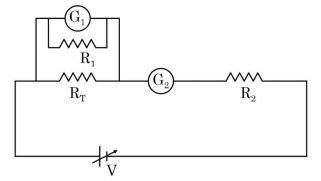
- A. 0.6 A
- B. 0.4 A
- C. 1.0 A
- D. 0.2 A
Correct answer & explanation hidden
Log in to view solution →- A. $\sqrt{\frac{8qE}{3m\ell}}$
- B. $\sqrt{\frac{4qE}{m\ell}}$
- C. $\sqrt{\frac{8qE}{m\ell}}$
- D. $\sqrt{\frac{4qE}{3m\ell}}$
Correct answer & explanation hidden
Log in to view solution →- A. 5.0 mL
- B. 7.5 mL
- C. 10.0 mL
- D. 2.5 mL
Correct answer & explanation hidden
Log in to view solution →- A. $6\pi a_0$
- B. $\dfrac{\pi a_0}{3}$
- C. $\dfrac{\pi a_0}{6}$
- D. $3\pi a_0$
Correct answer & explanation hidden
Log in to view solution →
- A. 2 3 III
- B. 3 2 II
- C. 2 3 I
- D. 3 2 II
Correct answer & explanation hidden
Log in to view solution →- A. Ga
- B. Cs
- C. Br
- D. Li
Correct answer & explanation hidden
Log in to view solution →- A. $\mathrm{H_2}$
- B. HCl
- C. NaOH
- D. $\mathrm{Cl_2}$
Correct answer & explanation hidden
Log in to view solution →- A. Polymeric, Dimeric, Monomeric
- B. Polymeric, Monomeric, Dimeric
- C. Monomeric, Dimeric, Polymeric
- D. द्विलकी, बहुलकी, एकलकी
Correct answer & explanation hidden
Log in to view solution →- A. $\mathrm{Ca^{2+}}$
- B. $\mathrm{Sr^{2+}}$
- C. $\mathrm{Ba^{2+}}$
- D. $\mathrm{Be^{2+}}$
Correct answer & explanation hidden
Log in to view solution →- A. $\mathrm{Al_2O_3}$
- B. $\mathrm{Ga_2O_3}$
- C. $\mathrm{Tl_2O_3}$
- D. $\mathrm{B_2O_3}$
Correct answer & explanation hidden
Log in to view solution →- A. both aqueous acidic and faintly alkaline
- B. both aqueous acidic and neutral
- C. During the reaction of the compound with thiosulphate solution as a mordant, a change of 3 marks occurs in the coordination number of the compound. Which of the following is correct?
- D. जलीय उदासीन
Correct answer & explanation hidden
Log in to view solution →- A. A is correct but R is not correct
- B. A is not correct but R is correct
- C. A and R are both correct and R, A both explain A.
- D. Both A and R are incorrect
Correct answer & explanation hidden
Log in to view solution →- A. DDT, Aldrin
- B. Aldrin, Sodium chlorate, Sodium arsenite
- C. Use of these substances in washing powders is common.
- D. हाइड्रॉक्साइड, सोडियम आर्सेनाइट, टेट्राक्लोरोएथेन
Correct answer & explanation hidden
Log in to view solution →- A. Potassium tris(oxalato)cobaltate(III)
- B. Potassium trioxalatocobalt(III)
- C. Potassium trioxalatocobaltate(III)
- D. पोटेशियम ट्रिस(ऑक्सालेटो)कोबाल्ट (III)
Correct answer & explanation hidden
Log in to view solution →- A. lead iodide
- B. lead nitrate
- C. A salt whose anion does not form a precipitate with $Pb^{2+}$ ions in solution
- D. लेड क्रोमेट
Correct answer & explanation hidden
Log in to view solution →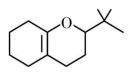
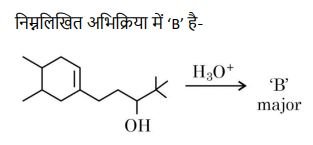
-
A.
Cyclized ether product formed by intramolecular attack
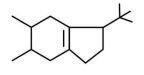
-
B.
An alkene-containing bicyclic hydrocarbon
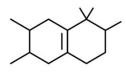
-
C.
A substituted cyclohexene product
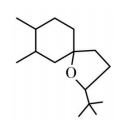
-
D.
Bicyclic ether formed via acid-catalyzed cyclization; major product B
Correct answer & explanation hidden
Log in to view solution →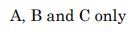
- A. A, B and C only
- B. B and D only
- C. A, B and D only
- D. Only statement C is correct
Correct answer & explanation hidden
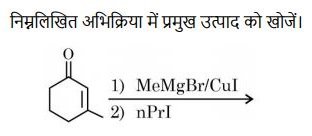
Log in to view solution →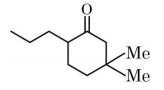
-
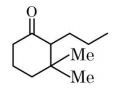
A.
2-Ethyl-6,6-dimethylcyclohexan-1-one
-
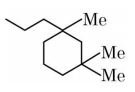
B.
2-Ethyl-6,6-dimethylcyclohexan-1-one isomer
-
C.
Alkylated cyclohexane ketone with propyl substituent and gem-dimethyl group
-
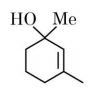
D.
A tertiary allylic alcohol: 1-hydroxy-1-methyl-3-methylcyclohexene
Correct answer & explanation hidden
Log in to view solution →- A. 3-Chlorophenol
- B. 3-Methylphenol
- C. Phenol
- D. 3-Nitrophenol
Correct answer & explanation hidden
Log in to view solution →
- A. $(A)$ – III, $(B)$ – I, $(C)$ – II, $(D)$ – IV
- B. $(A)$ – I, $(B)$ – III, $(C)$ – IV, $(D)$ – II
- C. $(A)$ – IV, $(B)$ – I, $(C)$ – III, $(D)$ – II
- D. $(A)$ – IV, $(B)$ – I, $(C)$ – II, $(D)$ – III
Correct answer & explanation hidden
Log in to view solution →- A. Both Statement I and Statement II are false
- B. Statement I is true but Statement II is false
- C. Statement I is false but Statement II is true
- D. Both Statement I and Statement II are true
Correct answer & explanation hidden
Log in to view solution →