Empowering Students with AI-Powered Assessments & Intelligent Learning

JEE Main 2023 (8 Apr, Shift 1)

60 questions from this JEE Main 2023 paper. Log in to view the correct answer and explanation for each question.

Q1 MATHS Unit 1: Sets Relations and Functions
Let the number of elements in sets $A$ and $B$ be five and two respectively. Then the number of subsets of $A \times B$ each having at least 3 and at most 6 elements is:
  • A. 792
  • B. 772
  • C. 752
  • D. 782

Correct answer & explanation hidden

Log in to view solution →
Q2 MATHS Unit 2: Complex Numbers and Quadratic Equations
If for $z = \alpha+i\beta$, $|z+2| = z+4(1+i)$, then $\alpha+\beta$ and $\alpha\beta$ are the roots of the equation
  • A. $x^2+3x-4=0$
  • B. $x^2+7x+12=0$
  • C. $x^2+2x-3=0$
  • D. $x^2+x-12=0$

Correct answer & explanation hidden

Log in to view solution →
Q3 MATHS Unit 2: Complex Numbers and Quadratic Equations
Let $\alpha, \beta, \gamma$ be the three roots of the equation $x^3+bx+c=0$. If $\beta\gamma=1=-\alpha$, then $b^3+2c^3-3\alpha^3-6\beta^3-8\gamma^3$ is equal to
  • A. $\dfrac{169}{8}$
  • B. $\dfrac{155}{8}$
  • C. 19
  • D. 21

Correct answer & explanation hidden

Log in to view solution →
Q4 MATHS Unit 3: Matrices and Determinants
Let $A=\begin{bmatrix}2&1&0\\1&2&-1\\0&-1&2\end{bmatrix}$. If $|\operatorname{adj}(\operatorname{adj}(\operatorname{adj}(2A)))|=(16)^n$, then $n$ is equal to
  • A. 10
  • B. 8
  • C. 12
  • D. 9

Correct answer & explanation hidden

Log in to view solution →
Q5 MATHS Unit 3: Matrices and Determinants
Let $P=\begin{bmatrix}\dfrac{\sqrt{3}}{2}&\dfrac{1}{2}\\[4pt]-\dfrac{1}{2}&\dfrac{\sqrt{3}}{2}\end{bmatrix}$, $A=\begin{bmatrix}1&1\\0&1\end{bmatrix}$ and $Q=PAP^{T}$. If $P^{T}Q^{2007}P=\begin{bmatrix}a&b\\c&d\end{bmatrix}$, then $2a+b-3c-4d$ is equal to
  • A. 2004
  • B. 2005
  • C. 2006
  • D. 2007

Correct answer & explanation hidden

Log in to view solution →
Q6 MATHS Unit 4: Permutations and Combinations
The number of arrangements of the letters of the word “INDEPENDENCE” in which all the vowels always occur together is
  • A. 14800
  • B. 33600
  • C. 16800
  • D. 18000

Correct answer & explanation hidden

Log in to view solution →
Q7 MATHS Unit 4: Permutations and Combinations
The number of ways, in which $5$ girls and $7$ boys can be seated at a round table so that no two girls sit together, is
  • A. $126(5!)^2$
  • B. $7(360)^2$
  • C. $7(720)^2$
  • D. 720

Correct answer & explanation hidden

Log in to view solution →
Q8 MATHS Unit 5: Binomial Theorem and its Simple Applications
If the coefficients of three consecutive terms in the expansion of $(1+x)^n$ are in the ratio $1:5:20$, then the coefficient of the fourth term is
  • A. 1827
  • B. 3654
  • C. 5481
  • D. 2436

Correct answer & explanation hidden

Log in to view solution →
Q9 MATHS Unit 7: Limit Continuity and Differentiability
Let $S_K = \frac{1+2+\dots+K}{K}$ and $\sum_{j=1}^{n} S_j^2 = \frac{n}{A}(Bn^2 + Cn + D)$, where $A,B,C,D \in \mathbb{N}$ and $A$ has least value. Then
  • A. $A+B+C+D$ is divisible by $5$
  • B. $A+B$ is divisible by $D$
  • C. $A+B=5(D-C)$
  • D. $A+C+D$ is not divisible by $B$

Correct answer & explanation hidden

Log in to view solution →
Q10 MATHS Unit 7: Limit Continuity and Differentiability
$\lim_{x\to 0}\left(\frac{1-\cos^2(3x)}{\cos^3(4x)}\right)\left(\frac{\sin^3(4x)}{\big(\log_e(2x+1)\big)^5}\right)$ is equal to ____
  • A. 9
  • B. 15
  • C. 18
  • D. 24

Correct answer & explanation hidden

Log in to view solution →
Q11 MATHS Unit 8: Integral Calculus
Let $I(x)=\int_{x}^{\infty}\frac{x+1}{x(1+x\,e^x)^2}\,dx$, $x>0$. If $\lim I(x)=0$, then $I(1)$ is equal to
  • A. $\frac{e+2}{e+1}-\log_e(e+1)$
  • B. $\frac{e+2}{e+1}+\log_e(e+1)$
  • C. $\frac{e+1}{e+2}-\log_e(e+1)$
  • D. $\frac{e+1}{e+2}+\log_e(e+1)$

Correct answer & explanation hidden

Log in to view solution →
Q12 MATHS Unit 10: Co-ordinate Geometry
The area of the region $\{(x,y): x^2\le y\le 8-x^2,\ y\le 7\}$ is
↻ Repeated question — also appeared in 2023 (1 set)
  • A. 18
  • B. 20
  • C. 21
  • D. 24

Correct answer & explanation hidden

Log in to view solution →
Q13 MATHS Unit 10: Co-ordinate Geometry
Let $C(\alpha,\beta)$ be the circumcenter of the triangle formed by the lines $4x+3y=69$, $4y-3x=17$, and $x+7y=61$. Then $(\alpha-\beta)^2+\alpha+\beta$ is equal to
  • A. 15
  • B. 16
  • C. 17
  • D. 18

Correct answer & explanation hidden

Log in to view solution →
Q14 MATHS Unit 10: Co-ordinate Geometry
Let $R$ be the focus of the parabola $y^2=20x$ and the line $y=mx+c$ intersect the parabola at two points $P$ and $Q$. Let the point $G(10,10)$ be the centroid of the triangle $PQR$. If $c-m=6$, then $(PQ)^2$ is
  • A. 296
  • B. 325
  • C. 317
  • D. 346

Correct answer & explanation hidden

Log in to view solution →
Q15 MATHS Unit 11: Three Dimensional Geometry
If the equation of the plane containing the line $x+2y+3z-4=0=2x+y-z+5$ and perpendicular to the plane $\vec r=(\hat i-\hat j)+\lambda(\hat i+\hat j+\hat k)+\mu(\hat i-2\hat j+3\hat k)$ is $ax+by+cz=4$, then $(a-b+c)$ is equal to
  • A. 18
  • B. 20
  • C. 22
  • D. 24

Correct answer & explanation hidden

Log in to view solution →
Q16 MATHS Unit 11: Three Dimensional Geometry
The shortest distance between the lines $\frac{x-4}{4}=\frac{y+2}{5}=\frac{z+3}{3}$ and $\frac{x-1}{3}=\frac{y-3}{4}=\frac{z-4}{2}$ is
  • A. $6\sqrt{3}$
  • B. $3\sqrt{6}$
  • C. $2\sqrt{6}$
  • D. $6\sqrt{2}$

Correct answer & explanation hidden

Log in to view solution →
Q17 MATHS Unit 12: Vector Algebra
If the points with position vectors $a\hat{i}+10\hat{j}+13\hat{k}$, $6\hat{i}+11\hat{j}+11\hat{k}$, $\frac{9}{2}\hat{i}+\beta\hat{j}-8\hat{k}$ are collinear, then $(19a-6\beta)^2$ is equal to
  • A. 16
  • B. 25
  • C. 36
  • D. 49

Correct answer & explanation hidden

Log in to view solution →
Q18 CHEMISTRY Unit 5: Solutions
In a bolt factory, machines $A$, $B$ and $C$ manufacture respectively $20\%$, $30\%$ and $50\%$ of the total bolts. Of their output $3$, $4$ and $2$ percent are respectively defective bolts. A bolt is drawn at random from the product. If the drawn bolt is defective, then the probability that it is manufactured by the machine $C$ is
  • A. $\frac{2}{7}$
  • B. $\frac{5}{14}$
  • C. $\frac{3}{7}$
  • D. $\frac{9}{28}$

Correct answer & explanation hidden

Log in to view solution →
Q19 MATHS Unit 14: Trigonometry
Let $f(x)=\frac{\sin x+\cos x-\sqrt{2}}{\sin x-\cos x}$, $x\in\left[0,\pi\right)-\left\{\frac{\pi}{4}\right\}$. Then $f\left(\frac{\pi}{12}\right)f\left(\frac{7\pi}{12}\right)$ is equal to
  • A. $-\frac{2}{3}$
  • B. $-\frac{1}{3\sqrt{3}}$
  • C. $\frac{2}{3\sqrt{3}}$
  • D. $\frac{2}{9}$

Correct answer & explanation hidden

Log in to view solution →
Q20 CHEMISTRY Unit 14: Some Basic Principles of Organic Chemistry
Negation of $(p\Rightarrow q)\Rightarrow(q\Rightarrow p)$ is
  • A. $p\vee(\sim q)$
  • B. $(\sim p)\vee q$
  • C. $q\wedge(\sim p)$
  • D. $(\sim q)\wedge p$

Correct answer & explanation hidden

Log in to view solution →
Q31 PHYSICS Unit 10: Oscillations and Waves
The engine of a train moving with speed $10\,\text{m s}^{-1}$ towards a platform sounds a whistle at frequency $400\,\text{Hz}$. The frequency heard by a passenger inside the train is: (neglect air speed. Speed of sound in air $=330\,\text{m s}^{-1}$)
  • A. 200 Hz
  • B. 388 Hz
  • C. 412 Hz
  • D. 400 Hz

Correct answer & explanation hidden

Log in to view solution →
Q32 PHYSICS Unit 8: Thermodynamics
An air bubble of volume $1\,\text{cm}^3$ rises from the bottom of a lake $40\,\text{m}$ deep to the surface at a temperature of $12^\circ\text{C}$. The atmospheric pressure is $1\times10^5\,\text{Pa}$, the density of water is $1000\,\text{kg m}^{-3}$ and $g=10\,\text{m s}^{-2}$. There is no difference in the temperature of water at the depth of $40\,\text{m}$ and on the surface. The volume of air bubble when it reaches the surface will be:
  • A. 2 cm$^3$
  • B. 3 cm$^3$
  • C. 4 cm$^3$
  • D. 5 cm$^3$

Correct answer & explanation hidden

Log in to view solution →
Q33 PHYSICS Unit 8: Thermodynamics
Given below are two statements: Statement I: If heat is added to a system, its temperature must increase. Statement II: If positive work is done by a system in a thermodynamic process, its volume must increase. In the light of the above statements, choose the correct answer from the options given below
  • A. Both Statement I and Statement II are true
  • B. Both Statement I and Statement II are false
  • C. Statement I is true but Statement II is false
  • D. Statement I is false but Statement II is true

Correct answer & explanation hidden

Log in to view solution →
Q34 PHYSICS Unit 7: Properties of Solids and Liquids
An aluminium rod with Young's modulus $Y=7.0\times10^{10}\,\text{N/m}^2$ undergoes elastic strain of $0.04\%$. The energy per unit volume stored in the rod in SI unit is:
  • A. 2800
  • B. 5600
  • C. 8400
  • D. 11200

Correct answer & explanation hidden

Log in to view solution →
Q35 PHYSICS Unit 6: Gravitation
Given below are two statements: Statement I: If $E$ be the total energy of a satellite moving around the earth, then its potential energy will be $\frac{E}{2}$. Statement II: The kinetic energy of a satellite revolving in an orbit is equal to the half the magnitude of total energy $E$. In the light of the above statements, choose the most appropriate answer from the options given below.
  • A. Both Statement I and Statement II are correct
  • B. Both Statement I and Statement II are incorrect
  • C. Statement I is correct but Statement II is incorrect
  • D. Statement I is incorrect but Statement II is correct

Correct answer & explanation hidden

Log in to view solution →
Q36 PHYSICS Unit 2: Kinematics
At any instant the velocity of a particle of mass $500\ \text{g}$ is $(2t\,\hat{i} + 3t^2\,\hat{j})\ \text{m s}^{-1}$. If the force acting on the particle at $t = 1\ \text{s}$ is $(\hat{i} + x\hat{j})\ \text{N}$. Then the value of $x$ will be:
  • A. 6
  • B. 4
  • C. 3
  • D. 2

Correct answer & explanation hidden

Log in to view solution →
Q37 PHYSICS Unit 3: Laws of Motion
Two forces having magnitude $A$ and $\frac{A}{2}$ are perpendicular to each other. The magnitude of their resultant is:
  • A. $\frac{5A}{2}$
  • B. $\frac{\sqrt{5}A}{2}$
  • C. $\frac{\sqrt{5}A}{4}$
  • D. $\frac{\sqrt{5}A^2}{2}$

Correct answer & explanation hidden

Log in to view solution →
Q38 PHYSICS Unit 6: Gravitation
The weight of a body on the earth is $400\ \text{N}$. Then weight of the body when taken to a depth half of the radius of the earth will be:
  • A. Zero
  • B. $100\ \text{N}$
  • C. $200\ \text{N}$
  • D. $300\ \text{N}$

Correct answer & explanation hidden

Log in to view solution →
Q39 PHYSICS Unit 2: Kinematics
Two projectiles A and B are thrown with initial velocities of $40\ \text{m/s}$ and $60\ \text{m/s}$ at angles $30^\circ$ and $60^\circ$ with the horizontal respectively. The ratio of their ranges respectively is $(g = 10\ \text{m/s}^2)$
  • A. $1:1$
  • B. $2:\sqrt{3}$
  • C. $4:9$
  • D. $\sqrt{3}:2$

Correct answer & explanation hidden

Log in to view solution →
Q40 PHYSICS Unit 1: Units and Measurements
A cylindrical wire of mass $(0.4 \pm 0.01)\ \text{g}$ has length $(8 \pm 0.04)\ \text{cm}$ and radius $(6 \pm 0.03)\ \text{mm}$. The maximum error in its density will be:
  • A. 1%
  • B. 3.5%
  • C. 4%
  • D. 5%

Correct answer & explanation hidden

Log in to view solution →
Q41 PHYSICS Unit 6: Gravitation
A TV transmitting antenna is 98 m high and the receiving antenna is at the ground level. If the radius of the earth is 6400 km, the surface area covered by the transmitting antenna is approximately:
  • A. $4868\ \text{km}^2$
  • B. $1549\ \text{km}^2$
  • C. $3942\ \text{km}^2$
  • D. $1240\ \text{km}^2$

Correct answer & explanation hidden

Log in to view solution →
Q42 PHYSICS Unit 19: Electronic Devices
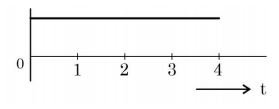
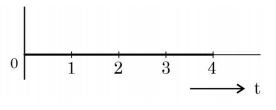
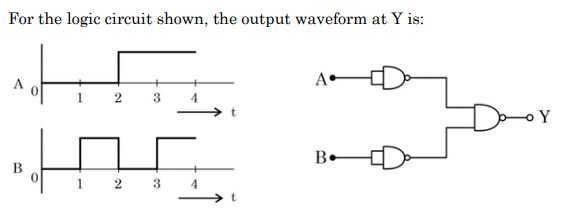
For the logic circuit shown, the output waveform at $Y$ is:
Question 42 image
  • A. Waveform that goes high from $t=1$ onward Choice A image
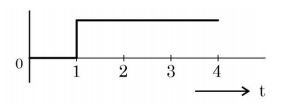
  • B. Waveform that goes high until $t=1$ and then low Choice B image
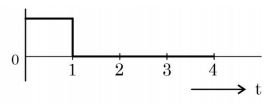
  • C. Constant high waveform Choice C image
  • D. Constant low waveform Choice D image

Correct answer & explanation hidden

Log in to view solution →
Q43 PHYSICS Unit 18: Atoms and Nuclei
For a nucleus $^A_ZX$ having mass number $A$ and atomic number $Z$
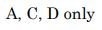
  • A. A, B, C, D only
  • B. B, C only
  • C. C, D only
  • D. B, C, E only

Correct answer & explanation hidden

Log in to view solution →
Q44 PHYSICS Unit 17: Dual Nature of Matter and Radiation
Proton (P) and electron (e) will have same de-Broglie wavelength when the ratio of their momentum is (assume, $m_p = 1849\,m_e$):
  • A. $1:1849$
  • B. $1:43$
  • C. $43:1$
  • D. $1:1$

Correct answer & explanation hidden

Log in to view solution →
Q45 PHYSICS Unit 16: Optics
In a reflecting telescope, a secondary mirror is used to:
  • A. remove spherical aberration
  • B. move the eyepiece outside the telescopic tube
  • C. make chromatic aberration zero
  • D. reduce the problem of mechanical support

Correct answer & explanation hidden

Log in to view solution →
Q46 PHYSICS Unit 11: Electrostatics
Dimension of $\dfrac{1}{\mu_0\epsilon_0}$ should be equal to
  • A. $L/T$
  • B. $T/L$
  • C. $L^2/T^2$
  • D. $T^2/L$

Correct answer & explanation hidden

Log in to view solution →
Q47 PHYSICS Unit 13: Magnetic Effects of Current and Magnetism
Certain galvanometers have a fixed core made of non magnetic metallic material. The function of this metallic material is
  • A. to oscillate the coil in magnetic field for longer period of time
  • B. to produce large deflecting torque on the coil
  • C. to make the magnetic field radial
  • D. to bring the coil to rest quickly

Correct answer & explanation hidden

Log in to view solution →
Q48 PHYSICS Unit 13: Magnetic Effects of Current and Magnetism
A charge particle moving in magnetic field $B$, has the components of velocity along $B$ as well as perpendicular to $B$. The path of the charge particle will be
  • A. straight along the direction of magnetic field $B$
  • B. circular path
  • C. helical path with the axis along magnetic field $B$
  • D. helical path with the axis perpendicular to the direction of magnetic field $B$

Correct answer & explanation hidden

Log in to view solution →
Q49 PHYSICS Unit 12: Current Electricity
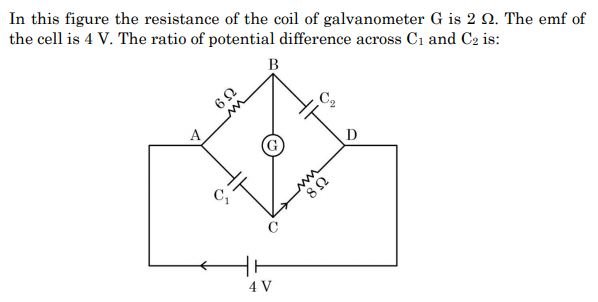
In this figure the resistance of the coil of galvanometer $G$ is $2\ \Omega$. The emf of the cell is $4\ \text{V}$. The ratio of potential difference across $C_1$ and $C_2$ is:
Question 49 image
  • A. $\dfrac{4}{5}$
  • B. 1
  • C. $\dfrac{5}{4}$
  • D. $\dfrac{3}{4}$

Correct answer & explanation hidden

Log in to view solution →
Q50 PHYSICS Unit 11: Electrostatics
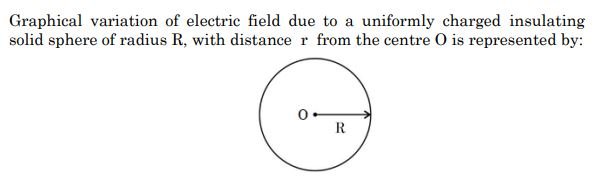
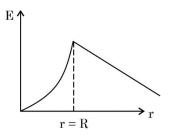
Graphical variation of electric field due to a uniformly charged insulating solid sphere of radius $R$, with distance $r$ from the centre $O$ is represented by:
Question 50 image
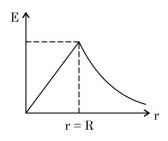
  • A. Graph starting from zero, rising linearly up to $r=R$, then falling nonlinearly Choice A image
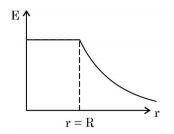
  • B. Graph constant up to $r=R$, then falling nonlinearly Choice B image
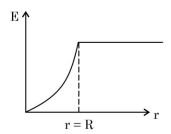
  • C. Graph rising nonlinearly up to $r=R$, then constant Choice C image
  • D. Graph rising nonlinearly up to $r=R$, then falling linearly Choice D image
Correct answer & explanation hidden

Log in to view solution →
Q61 CHEMISTRY Unit 7: Redox Reactions and Electrochemistry
$2\,\mathrm{IO_3^-} + x\,\mathrm{I^-} + 12\,\mathrm{H^+} \rightarrow 6\,\mathrm{I_2} + 6\,\mathrm{H_2O}$ What is the value of $x$?
  • A. 2
  • B. 10
  • C. 6
  • D. 12

Correct answer & explanation hidden

Log in to view solution →
Q62 CHEMISTRY Unit 7: Redox Reactions and Electrochemistry
The reaction $\frac{1}{2}\,\mathrm{H_2(g)} + \mathrm{AgCl(s)} \rightleftharpoons \mathrm{H^+(aq)} + \mathrm{Cl^-(aq)} + \mathrm{Ag(s)}$ occurs in which of the given galvanic cell.
  • A. $\mathrm{Ag|AgCl(s)|KCl(sol^\prime)|AgNO_3|Ag}$
  • B. $\mathrm{Pt|H_2(g)|HCl(sol^\prime)|AgNO_3(sol^\prime)|Ag}$
  • C. $\mathrm{Pt|H_2(g)|HCl(sol^\prime)|AgCl(s)|Ag}$
  • D. $\mathrm{Pt|H_2(g)|KCl(sol^\prime)|AgCl(s)|Ag}$

Correct answer & explanation hidden

Log in to view solution →
Q63 CHEMISTRY Unit 5: Solutions
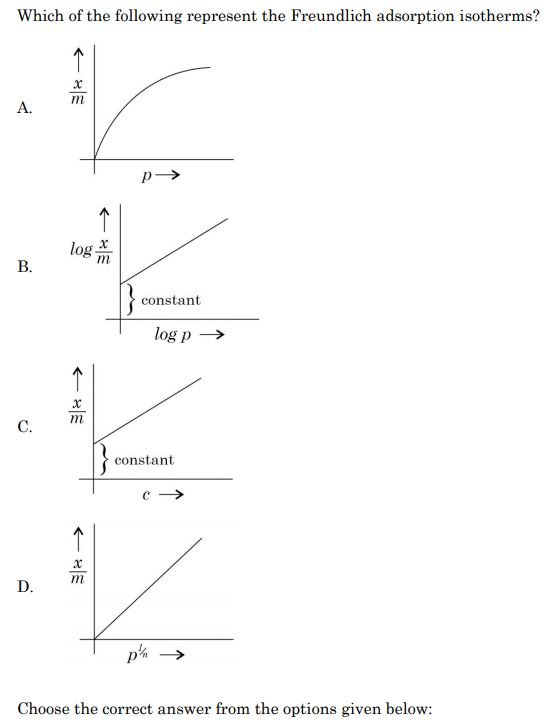
Which of the following represent the Freundlich adsorption isotherms?
Question 63 image
  • A. Graph of $\frac{x}{m}$ vs $p$ showing saturation-type rise Choice A image
  • B. Graph of $\log\!\left(\frac{x}{m}\right)$ vs $\log p$ showing a straight line with non-zero intercept Choice B image
  • C. Graph of $\frac{x}{m}$ vs $c$ showing a straight line with non-zero intercept Choice C image
  • D. Graph of $\frac{x}{m}$ vs $p^{1/n}$ showing a straight line through origin Choice D image
Correct answer & explanation hidden

Log in to view solution →
Q64 CHEMISTRY Unit 9: Classification of Elements and Periodicity in Properties
The correct order of electronegativity for given elements is:
  • A. $\mathrm{C > P > At > Br}$
  • B. $\mathrm{Br > C > At > P}$
  • C. $\mathrm{P > Br > C > At}$
  • D. $\mathrm{Br > P > At > C}$

Correct answer & explanation hidden

Log in to view solution →
Q65 CHEMISTRY Unit 11: d- and f-Block Elements
Which of the following metals can be extracted through alkali leaching technique?
  • A. Au
  • B. Cu
  • C. Pb
  • D. Sn

Correct answer & explanation hidden

Log in to view solution →
Q66 CHEMISTRY Unit 17: Organic Compounds Containing Oxygen
The water gas on reacting with cobalt as a catalyst forms
  • A. Methanal
  • B. Methanol
  • C. Methanoic acid
  • D. Ethanol

Correct answer & explanation hidden

Log in to view solution →
Q67 CHEMISTRY Unit 13: Purification and Characterisation of Organic Compounds
What is the purpose of adding gypsum to cement?
  • A. To give a hard mass
  • B. To facilitate the hydration of cement
  • C. To slow down the process of setting
  • D. To speed up the process of setting

Correct answer & explanation hidden

Log in to view solution →
Q68 CHEMISTRY Unit 9: Classification of Elements and Periodicity in Properties
Given below are two statements: Statement I: Lithium and Magnesium do not form superoxide Statement II: The ionic radius of $\mathrm{Li^+}$ is larger than ionic radius of $\mathrm{Mg^{2+}}$ In the light of the above statements, choose the most appropriate answer from the options given below:
  • A. Both Statement I and Statement II are correct
  • B. Both Statement I and Statement II are incorrect
  • C. Statement I is correct but Statement II is incorrect
  • D. Statement I is incorrect but Statement II is correct

Correct answer & explanation hidden

Log in to view solution →
Q69 CHEMISTRY Unit 12: Coordination Compounds
Which halogen is known to cause the reaction given below: $$2\,Cu^{2+} + 4\,X^- \rightarrow Cu_2X_2(s) + X_2$$
  • A. All halogens
  • B. Only Iodine
  • C. Only Bromine
  • D. Only Chlorine

Correct answer & explanation hidden

Log in to view solution →
Q70 CHEMISTRY Unit 12: Coordination Compounds
Which of the following complex is octahedral, diamagnetic and the most stable?
  • A. $K_3[Co(CN)_6]$
  • B. $[Co(H_2O)_6]Cl_2$
  • C. $[Ni(NH_3)_6]Cl_2$
  • D. $Na_3[CoCl_6]$

Correct answer & explanation hidden

Log in to view solution →
Q71 CHEMISTRY Unit 6: Equilibrium
Match List I with List II: List I (Species) | List II (Maximum allowed concentration in ppm in drinking water) ---|--- A. $F^-$ | I. $< 50$ ppm B. $SO_4^{2-}$ | II. $< 5$ ppm C. $NO_3^-$ | III. $< 2$ ppm D. Zn | IV. $< 500$ ppm Choose the correct answer from the options given below:
  • A. A-I, B-II, C-III, D-IV
  • B. A-IV, B-III, C-II, D-I
  • C. A-II, B-I, C-III, D-IV
  • D. A-III, B-II, C-I, D-IV

Correct answer & explanation hidden

Log in to view solution →
Q72 CHEMISTRY Unit 12: Coordination Compounds
The correct order of spin only magnetic moments for the following complex ions is
  • A. $[Fe(CN)_6]^{3-} < [CoF_6]^{3-} < [MnBr_4]^{2-} < [Mn(CN)_6]^{3-}$
  • B. $[Fe(CN)_6]^{3-} < [Mn(CN)_6]^{3-} < [CoF_6]^{3-} < [MnBr_4]^{2-}$
  • C. $[CoF_6]^{3-} < [MnBr_4]^{2-} < [Fe(CN)_6]^{3-} < [Mn(CN)_6]^{3-}$
  • D. $[MnBr_4]^{2-} < [CoF_6]^{3-} < [Fe(CN)_6]^{3-} < [Mn(CN)_6]^{3-}$

Correct answer & explanation hidden

Log in to view solution →
Q73 CHEMISTRY Unit 16: Organic Compounds Containing Halogens
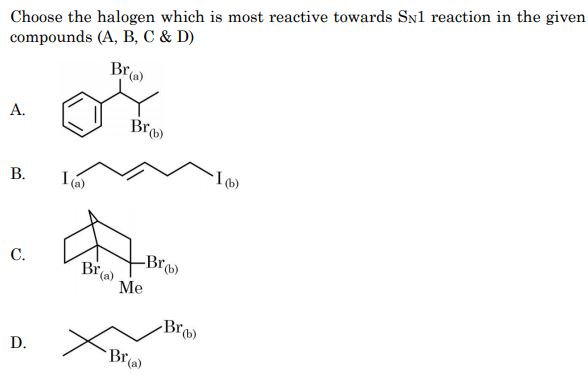
Choose the halogen which is most reactive towards $S_N1$ reaction in the given compounds (A, B, C & D).
Question 73 image
  • A. A – $Br_{(a)}$ ; B – $I_{(a)}$ ; C – $Br_{(b)}$ ; D – $Br_{(a)}$
  • B. A – $Br_{(a)}$ ; B – $I_{(a)}$ ; C – $Br_{(a)}$ ; D – $Br_{(a)}$
  • C. A – $Br_{(b)}$ ; B – $I_{(a)}$ ; C – $Br_{(a)}$ ; D – $Br_{(a)}$
  • D. A – $Br_{(b)}$ ; B – $I_{(b)}$ ; C – $Br_{(a)}$ ; D – $Br_{(b)}$

Correct answer & explanation hidden

Log in to view solution →
Q74 CHEMISTRY Unit 17: Organic Compounds Containing Oxygen
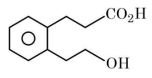
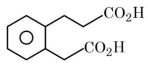
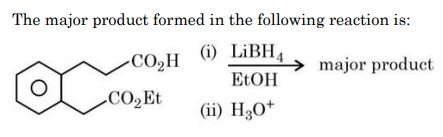
The major product formed in the following reaction is: $$\text{(fused aromatic di-ester/acid)} \xrightarrow[(ii)\ H_3O^+]{(i)\ LiBH_4,\ EtOH} \text{major product}$$
Question 74 image
  • A. Diol product with both side chains reduced to $OH$ Choice A image
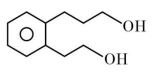
  • B. Monoalcohol retaining one $CO_2Et$ group Choice B image
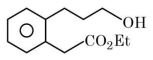
  • C. Hydroxy acid product Choice C image
  • D. Dicarboxylic acid product Choice D image

Correct answer & explanation hidden

Log in to view solution →
Q75 CHEMISTRY Unit 17: Organic Compounds Containing Oxygen
Given below are two statements: One is labelled as Assertion A and the other is labelled as Reason R. Assertion A: Butan-1-ol has higher boiling point than ethoxyethane. Reason R: Extensive hydrogen bonding leads to stronger association of molecules. In the light of the above statements, choose the correct answer from the options given below:
  • A. Both A and R are true and R is the correct explanation of A
  • B. Both A and R are true but R is not the correct explanation of A
  • C. A is true but R is false
  • D. A is false but R is true

Correct answer & explanation hidden

Log in to view solution →
Q76 CHEMISTRY Unit 16: Organic Compounds Containing Halogens
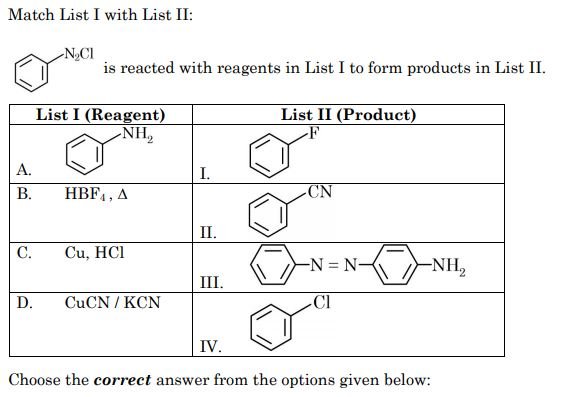
Match List I with List II: The compound shown reacts with reagents in List I to form products in List II. List I (Reagent) | List II (Product) ---|--- A. aniline | I. fluorobenzene B. $HBF_4$, $\Delta$ | II. benzonitrile C. $Cu$, HCl | III. azobenzene derivative with $-NH_2$ substituent D. $CuCN$ / KCN | IV. chlorobenzene Choose the correct answer from the options given below:
Question 76 image
  • A. A-IV, B-III, C-II, D-I
  • B. A-III, B-I, C-IV, D-II
  • C. A-I, B-III, C-IV, D-II
  • D. A-III, B-I, C-II, D-IV

Correct answer & explanation hidden

Log in to view solution →
Q77 CHEMISTRY Unit 19: Biomolecules
Sulphur $(S)$ containing amino acids from the following are: (a) isoleucine (b) cysteine (c) lysine (d) methionine (e) glutamic acid
  • A. a, b, c
  • B. b, d
  • C. b, c, e
  • D. a, d

Correct answer & explanation hidden

Log in to view solution →
Q78 CHEMISTRY Unit 19: Biomolecules
Match List I with List II: List I A. Saccharin B. Aspartame C. Altame D. Sucralose List II I. High potency sweetener II. First artificial sweetening agent III. Stable at cooking temperature IV. Unstable at cooking temperature Choose the correct answer from the options given below:
  • A. A-II, B-IV, C-I, D-III
  • B. A-II, B-IV, C-III, D-I
  • C. A-II, B-III, C-IV, D-I
  • D. A-IV, B-III, C-I, D-II

Correct answer & explanation hidden

Log in to view solution →
Q79 CHEMISTRY Unit 20: Principles Related to Practical Chemistry
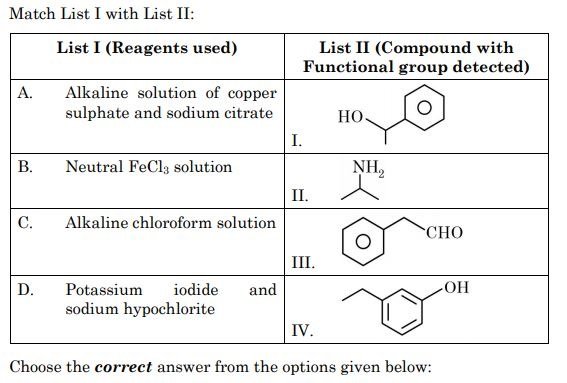
Match List I with List II: List I (Reagents used) A. Alkaline solution of copper sulphate and sodium citrate B. Neutral $\mathrm{FeCl_3}$ solution C. Alkaline chloroform solution D. Potassium iodide and sodium hypochlorite List II (Compound with functional group detected) I. II. III. IV. Choose the correct answer from the options given below:
Question 79 image
  • A. A-II, B-IV, C-III, D-I
  • B. A-IV, B-I, C-II, D-III
  • C. A-III, B-IV, C-I, D-II
  • D. A-III, B-IV, C-II, D-I

Correct answer & explanation hidden

Log in to view solution →
Q80 CHEMISTRY Unit 11: d- and f-Block Elements
In chromyl chloride, the number of $d$-electrons present on chromium is same as in (Given at no. of Ti: 22, V: 23, Cr: 24, Mn: 25, Fe: 26)
  • A. $\mathrm{Mn\ (VII)}$
  • B. $\mathrm{Fe\ (III)}$
  • C. $\mathrm{V\ (IV)}$
  • D. $\mathrm{Ti\ (III)}$

Correct answer & explanation hidden

Log in to view solution →