
- A. 20
- B. 14
- C. 25
- D. 24
The nth term is given by $a_n = 4n + 5$. To find the 5th term, substitute $n = 5$: $a_5 = 4(5) + 5 = 20 + 5 = 25$. Thus, option (c) is correct.
- A. 5
- B. 6
- C. 4
- D. – 6
Given the equation $5x^2 = 2(2x + 3)$, expand the right side: $5x^2 = 4x + 6$. Moving all terms to the left gives the standard form: $5x^2 - 4x - 6 = 0$. The constant term is $-6$. Thus, option (d) is correct.
- A. Intersecting lines
- B. Coincident lines
- C. Parallel lines
- D. Perpendicular lines
For equations $a_1x + b_1y + c_1 = 0$ and $a_2x + b_2y + c_2 = 0$, we compare the ratios: $\frac{a_1}{a_2} = \frac{1}{3}$ and $\frac{b_1}{b_2} = \frac{-2}{4} = -\frac{1}{2}$. Since $\frac{1}{3} \neq -\frac{1}{2}$, the lines are intersecting. Thus, option (a) is correct.
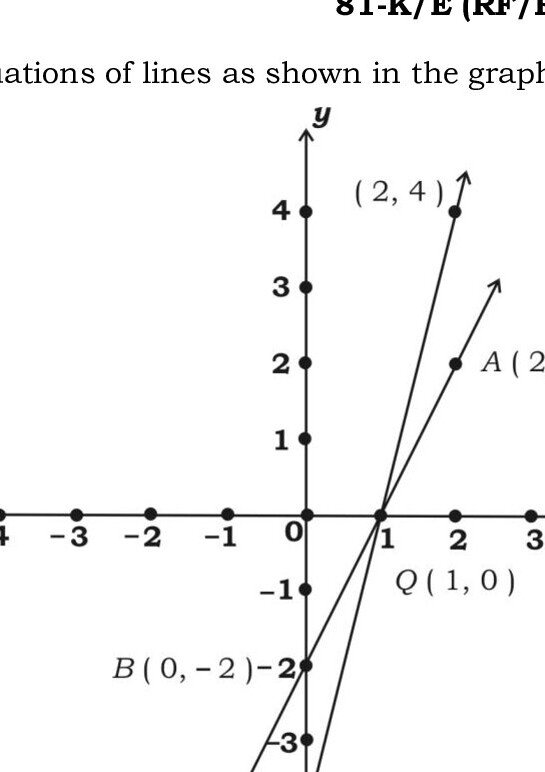
- A. x + y = 1 and 2x – y = 1
- B. 2x + y = 2 and x + y = 2
- C. 2x – y = 2 and 4x – y = 4
- D. y – x = 0 and x – y = 1
From the graph, Line 1 passes through $(1, 0)$ and $(0, -2)$. Using the intercept form $\frac{x}{a} + \frac{y}{b} = 1$, we get $\frac{x}{1} + \frac{y}{-2} = 1$, which simplifies to $2x - y = 2$. Line 2 passes through $(1, 0)$ and $(2, 4)$. Its slope is $\frac{4-0}{2-1} = 4$. Using $y - y_1 = m(x - x_1)$, $y - 0 = 4(x - 1) \implies y = 4x - 4 \implies 4x - y = 4$. Thus, option (c) is correct.
- A. \frac{a_1}{a_2} = \frac{b_1}{b_2} \neq \frac{c_1}{c_2}
- B. \frac{a_1}{a_2} = \frac{b_1}{b_2} = \frac{c_1}{c_2}
- C. \frac{a_1}{a_2} \neq \frac{b_1}{b_2}
- D. \frac{a_1}{b_2} = \frac{b_1}{a_2}
A pair of linear equations represents parallel lines if and only if the ratios of the coefficients of $x$ and $y$ are equal, but the ratio of the constants is different, i.e., $\frac{a_1}{a_2} = \frac{b_1}{b_2} \neq \frac{c_1}{c_2}$. Thus, option (a) is correct.
- A. 2 and 3
- B. 3 and 2
- C. 4 and 6
- D. 1 and 2
Solution hidden
Log in to view solution →- A. 1, – 1, – 2, ..........
- B. 1, 5, 9, ..............
- C. 2, – 2, 2, – 2, ............
- D. 1, 2, 4, 8, ..........
Solution hidden
Log in to view solution →- A. 23
- B. – 23
- C. – 17
- D. 17
Solution hidden
Log in to view solution →- A. 27
- B. 126
- C. 29
- D. 25
Solution hidden
Log in to view solution →- A. 7
- B. 7/2
- C. – 7
- D. -7/2
Solution hidden
Log in to view solution →- A. $q^2 - 4pr$
- B. $q^2 + 4pr$
- C. $p^2 - 4pr$
- D. $p^2 + 4qr$
Solution hidden
Log in to view solution →Solution hidden
Log in to view solution →- A. 14
- B. – 6
- C. – 7
- D. 7
Solution hidden
Log in to view solution →- A. $x = \frac{-b \pm \sqrt{b^2 - 4ac}}{2a}$
- B. $x = \frac{-b \pm \sqrt{b^2 + 4ac}}{2a}$
- C. $x = \frac{-b - \sqrt{b^2 - 4ac}}{2a}$
- D. $x = \frac{-b + \sqrt{b^2 - 4ac}}{2a}$
Solution hidden
Log in to view solution →- A. – 3, 2
- B. 3, – 2
- C. – 3, – 2
- D. 3, 2
Solution hidden
Log in to view solution →- A. 7 and 20
- B. 13 and 14
- C. 1 and 26
- D. – 13 and – 14
Solution hidden
Log in to view solution →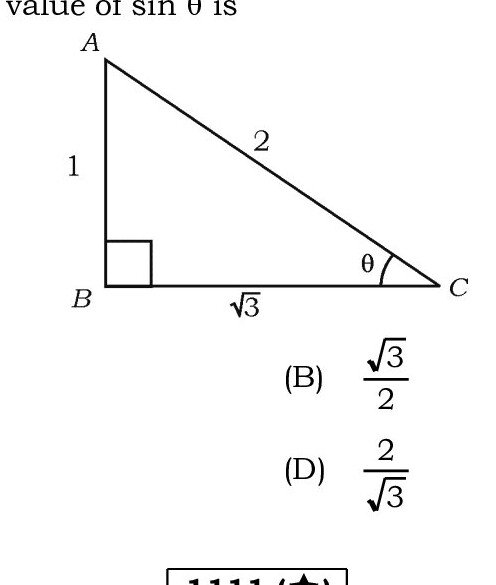
- A. 1/2
- B. √3/2
- C. √3
- D. 2/√3
Solution hidden
Log in to view solution →- A. 1
- B. – 1
- C. 2
Solution hidden
Log in to view solution →- A. 4 + tan2
- B. 4 + cot2
- C. 2 + cot2
- D. 3 + cot2
Solution hidden
Log in to view solution →- A. 10 m
- B. 30 m
- C. 3√10 m
- D. 30√3 m
Solution hidden
Log in to view solution →- A. 2
- B. 1
- C. – 1/2
- D. √3/2
Solution hidden
Log in to view solution →- A. ( (x1+x2)/2, (y1+y2)/2 )
- B. ( (x1-x2)/2, (y1-y2)/2 )
- C. ( (x1+y1)/3, (x2+y2)/3 )
- D. ( (x1+x2)/3, (y1+y2)/3 )
Solution hidden
Log in to view solution →- A. $\sqrt{(x_2 - x_1)^2 + (y_2 - y_1)^2}$
- B. $\sqrt{(x_1 - x_2)^2 - (y_1 - y_2)^2}$
- C. $\sqrt{(x_2 + x_1)^2 + (y_2 - y_1)^2}$
- D. $\sqrt{(x_1 + x_2)^2 + (y_1 + y_2)^2}$
Solution hidden
Log in to view solution →- A. the mean
- B. the mode
- C. the median
- D. the range
Solution hidden
Log in to view solution →- A. 16
- B. 5
- C. 1.6
- D. 4
Solution hidden
Log in to view solution →- A. 3 Median = 2 Mean + Mode
- B. 3 Mean = 2 Median + Mode
- C. Mean = 3 Median + Mode
- D. Mode = 3 Mean + 2 Median
Solution hidden
Log in to view solution →- A. two times the volume of the cylinder
- B. half the volume of the cylinder
- C. 3 times the volume of the cylinder
- D. equal to the volume of the cylinder
Solution hidden
Log in to view solution →- A. $\frac{\text{Upper limit} - \text{lower limit}}{2}$
- B. $\frac{\text{Upper limit} \times \text{lower limit}}{3}$
- C. $\frac{\text{Upper limit} + \text{lower limit}}{2}$
- D. $\frac{\text{Upper limit} + \text{lower limit}}{3}$
Solution hidden
Log in to view solution →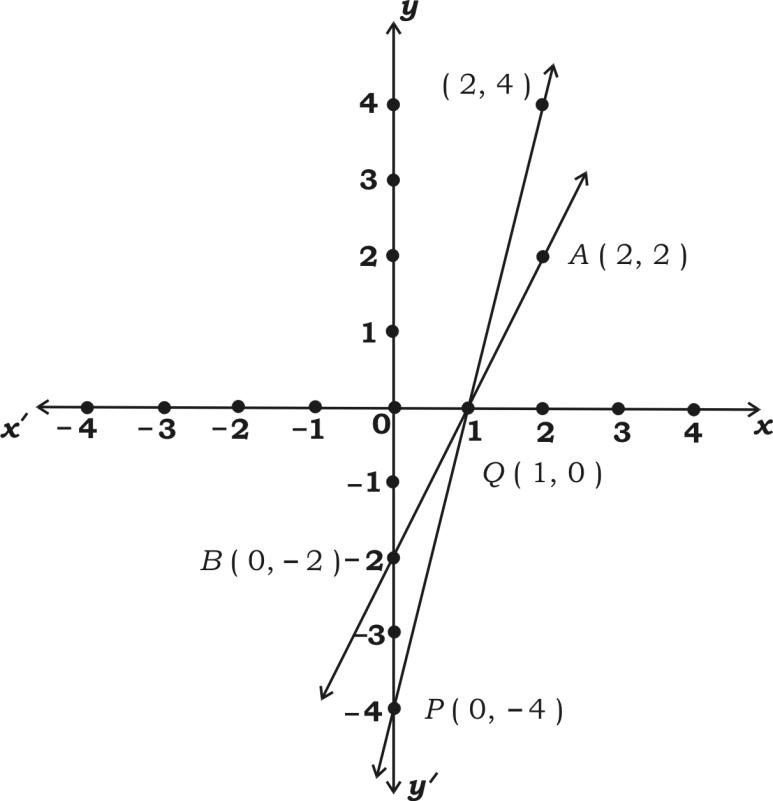
- A. $\frac{AX}{AB} = \frac{AC}{AY}$
- B. $\frac{AX}{BX} = \frac{AY}{CY}$
- C. $\frac{AX}{BX} = \frac{XY}{AY}$
- D. $\frac{AB}{BX} = \frac{AC}{AY}$
Solution hidden
Log in to view solution →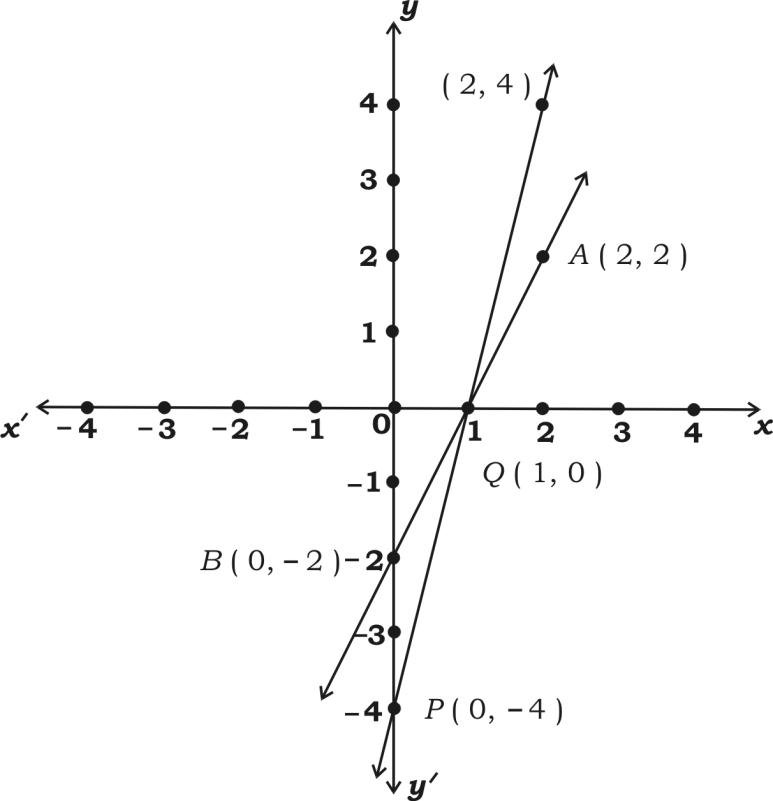
- A. 26 cm
- B. 23 cm
- C. 4.2 cm
- D. 8.4 cm
Solution hidden
Log in to view solution →- A. 12 cm
- B. 15 cm
- C. 10 cm
- D. 8 cm
Solution hidden
Log in to view solution →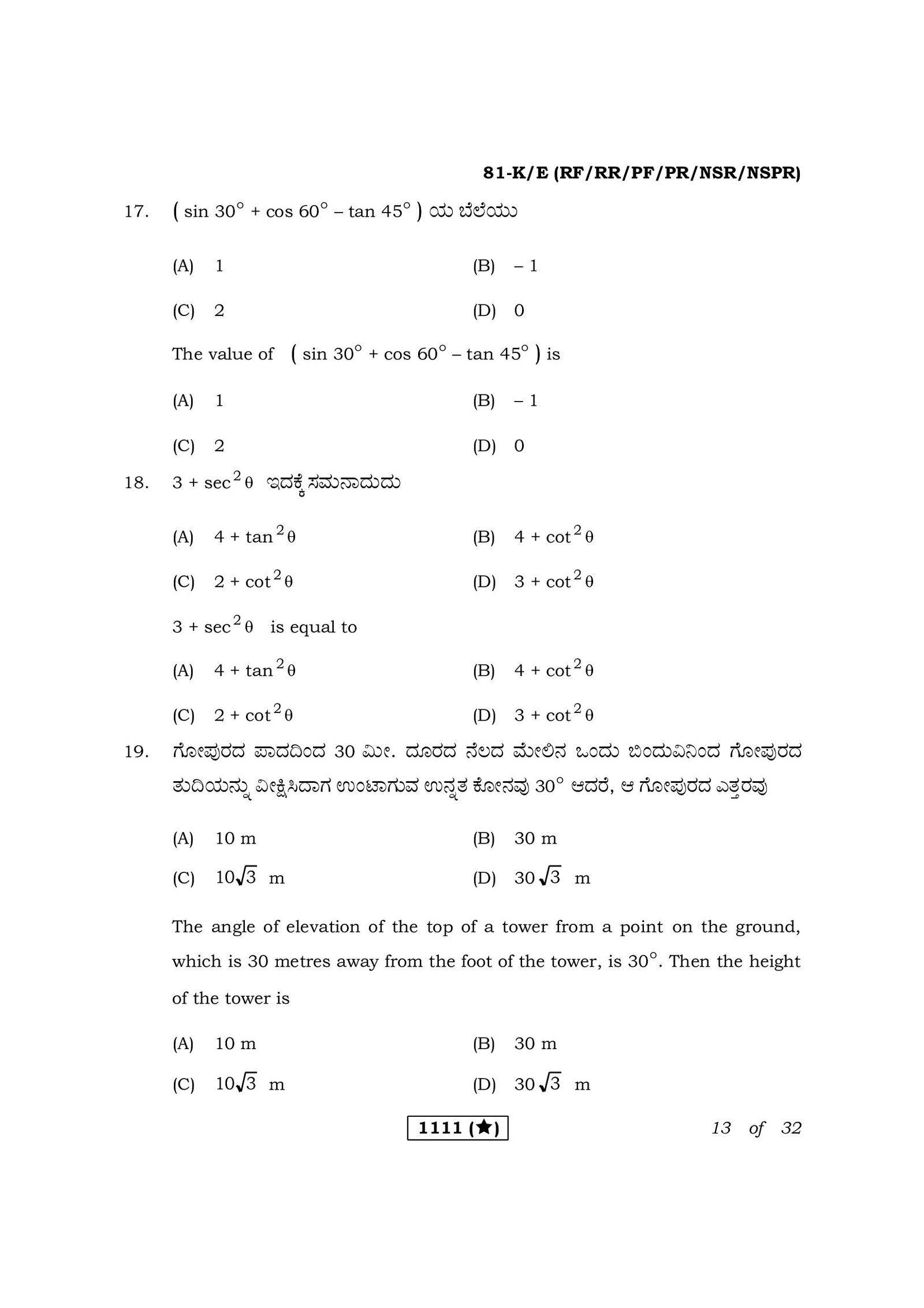
- A. 10 cm
- B. 6.4 cm
- C. 4.8 cm
- D. 3.6 cm
Solution hidden
Log in to view solution →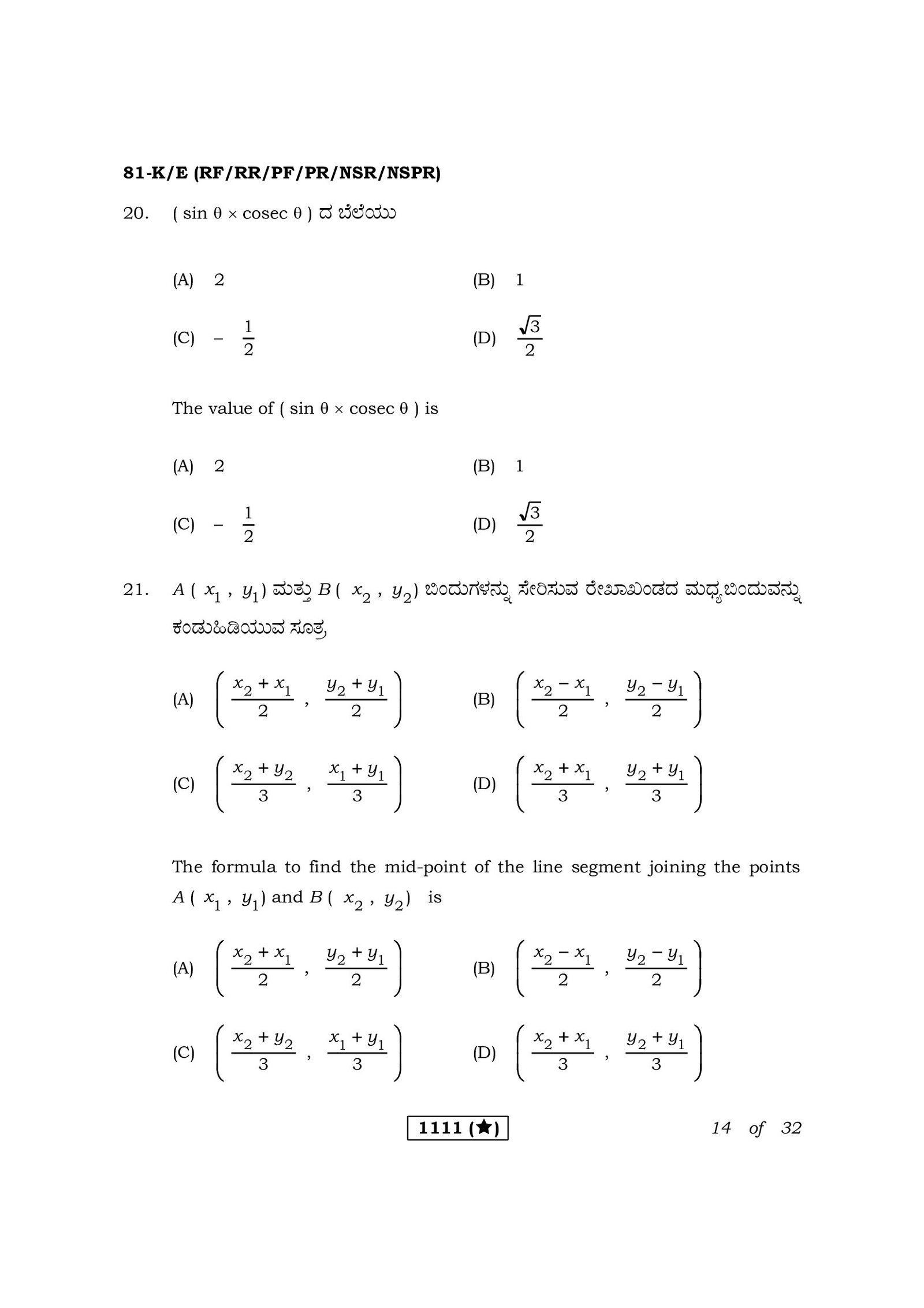
- A. 4 cm
- B. 2 cm
- C. $2\sqrt{3}$ cm
- D. $4\sqrt{3}$ cm
Solution hidden
Log in to view solution →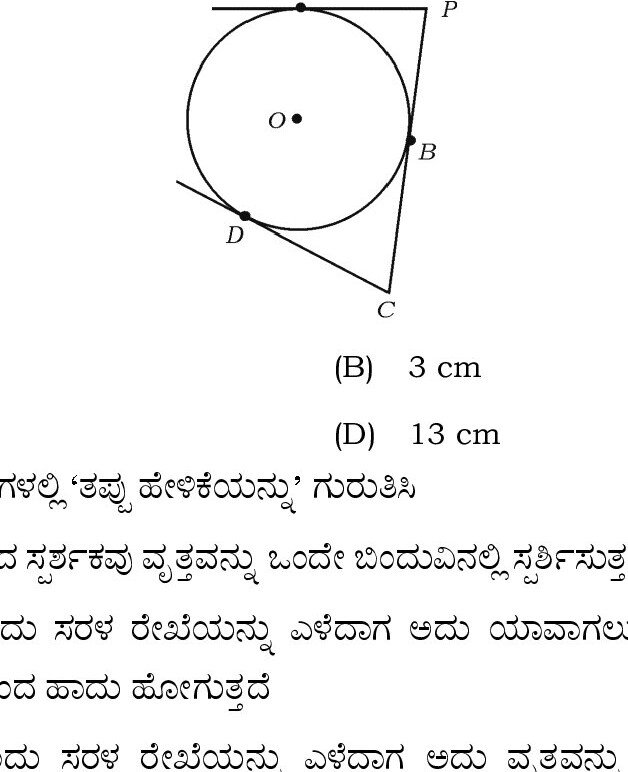
- A. 5 \text{ cm}
- B. 3 \text{ cm}
- C. 8 \text{ cm}
- D. 13 \text{ cm}
Solution hidden
Log in to view solution →- A. (A) a tangent to a circle touches the circle exactly at one point
- B. (B) when a straight line is drawn to a circle it always passes through a point on the circle
- C. (C) the point common to the circle and its tangent is called the point of contact
- D. (D) the tangent drawn at any point to a circle is perpendicular to the radius drawn at the point of contact
Solution hidden
Log in to view solution →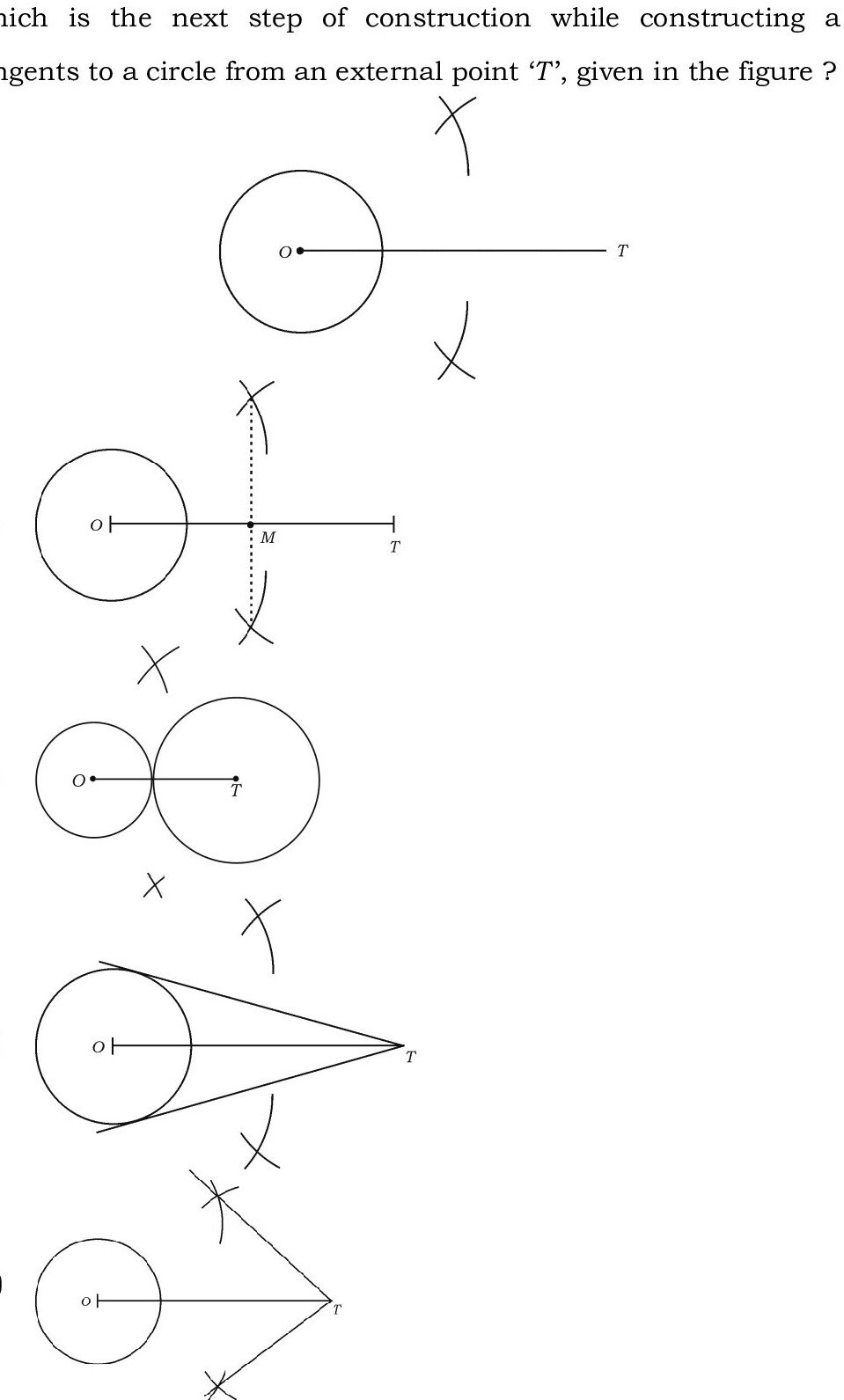
- A. (A)
- B. (B)
- C. (C)
- D. (D)
Solution hidden
Log in to view solution →- A. 49 cm
- B. 14 cm
- C. 21 cm
- D. 7 cm
Solution hidden
Log in to view solution →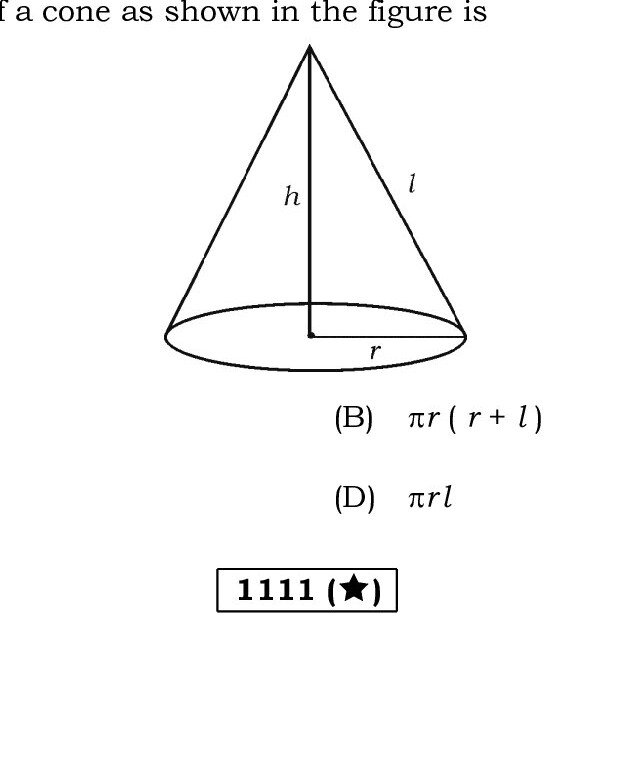
- A. \pi r^2 h
- B. \pi r ( r + l )
- C. \frac{1}{3} \pi r^2 h
- D. \pi rl
Solution hidden
Log in to view solution →- A. (\pi r^2 + 2\pi rh) \text{ cm}^2
- B. 2\pi rh \text{ cm}^2
- C. \frac{1}{3} \pi r^2 h \text{ cm}^3
- D. (\pi r^2 + h) \text{ cm}^2
Solution hidden
Log in to view solution →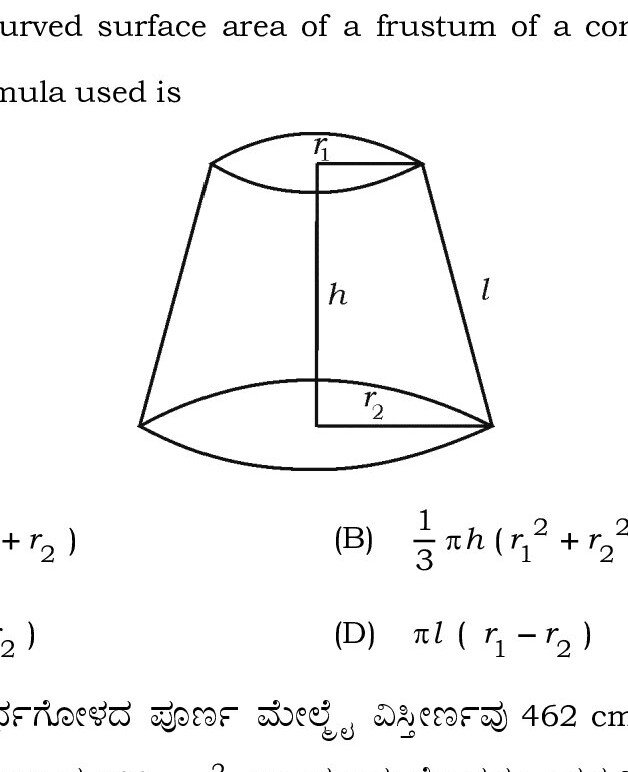
- A. \frac{1}{3} \pi l (r_1 + r_2)
- B. \frac{1}{3} \pi h (r_1^2 + r_2^2 + r_1 r_2)
- C. \pi l (r_1 + r_2)
- D. \pi l (r_1 - r_2)
Solution hidden
Log in to view solution →- A. 308 \text{ cm}^2
- B. 231 \text{ cm}^2
- C. 154 \text{ cm}^2
- D. 1078 \text{ cm}^2
Solution hidden
Log in to view solution →