The first 5 questions are solved below. Log in as a CLASS 10th student to reveal solutions for the rest of this paper.
Log In →
Q19
short answer
Find the sum of arithmetic progression 7, 11, 15, ...... to 16 terms using formula.
Solution
Given AP: 7, 11, 15, ...
First term $a = 7$, common difference $d = 11 - 7 = 4$, and number of terms $n = 16$.
The sum of $n$ terms is given by: $S_n = \frac{n}{2} [2a + (n-1)d]$
Substituting the values:
$S_{16} = \frac{16}{2} [2(7) + (16-1)4]$
$S_{16} = 8 [14 + (15 \times 4)]$
$S_{16} = 8 [14 + 60]$
$S_{16} = 8 \times 74 = 592$
The sum of the first 16 terms is 592.
Q19
short answer
Find how many terms of the arithmetic progression 3, 6, 9, .... must be added to get the sum 165.
Solution
Given AP: 3, 6, 9, ...
Here, $a = 3$, $d = 3$, and $S_n = 165$.
Using the sum formula $S_n = \frac{n}{2} [2a + (n-1)d]$:
$165 = \frac{n}{2} [2(3) + (n-1)3]$
$330 = n [6 + 3n - 3]$
$330 = n [3n + 3]$
$330 = 3n^2 + 3n$
Divide by 3: $n^2 + n - 110 = 0$
$(n + 11)(n - 10) = 0$
$n = -11$ (not possible as terms cannot be negative) or $n = 10$.
Therefore, 10 terms must be added.
Q20
short answer
Find the value of the discriminant of the equation $4x^2 - 12x + 9 = 0$ and hence write the nature of the roots.
Solution
For the quadratic equation $4x^2 - 12x + 9 = 0$:
Here, $a = 4, b = -12, c = 9$.
Discriminant $D = b^2 - 4ac$
$D = (-12)^2 - 4(4)(9)$
$D = 144 - 144 = 0$
Since the discriminant is 0, the roots of the equation are real and equal.
Q21
short answer
Find the roots of the equation $x^2 - 3x + 1 = 0$ using quadratic formula.
Solution
For $x^2 - 3x + 1 = 0$, $a = 1, b = -3, c = 1$.
The quadratic formula is $x = \frac{-b \pm \sqrt{b^2 - 4ac}}{2a}$.
$x = \frac{-(-3) \pm \sqrt{(-3)^2 - 4(1)(1)}}{2(1)}$
$x = \frac{3 \pm \sqrt{9 - 4}}{2}$
$x = \frac{3 \pm \sqrt{5}}{2}$
So, the roots are $x = \frac{3 + \sqrt{5}}{2}$ and $x = \frac{3 - \sqrt{5}}{2}$.
Q22
short answer
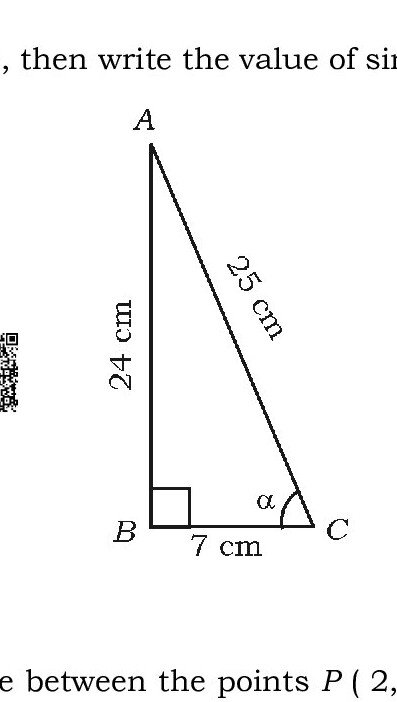
In the figure ABC is a right angled triangle. If AB = 24 cm, BC = 7 cm and AC = 25 cm, then write the value of $\sin \alpha$ and $\cos \alpha$.
Solution
In triangle ABC, for angle $\alpha$ (at vertex C):
Opposite side = $AB = 24$ cm
Adjacent side = $BC = 7$ cm
Hypotenuse = $AC = 25$ cm
$\sin \alpha = \frac{\text{Opposite}}{\text{Hypotenuse}} = \frac{AB}{AC} = \frac{24}{25}$
$\cos \alpha = \frac{\text{Adjacent}}{\text{Hypotenuse}} = \frac{BC}{AC} = \frac{7}{25}$
Q23
short answer
Find the distance between the points P ( 2, 3 ) and Q ( 4, 1 ) using distance formula.
Q23
short answer
Find in what ratio the point P ( – 4, 6 ) divides the line segment joining the points A ( – 6, 10 ) and B ( 3, – 8 ).
Q24
short answer
Draw a line segment of length 8·4 cm and divide it in the ratio 1 : 3 by geometric construction.
Q25
short answer
Find the arithmetic progression whose third term is 16 and its 7th term exceeds the 5th term by 12.
Q26
short answer
The sum of the reciprocals of Rehman’s age ( in years ) 3 years ago and his age 5 years from now is $1/3$. Find his present age.
Q26
short answer
A train travels 360 km at a uniform speed. If the speed had been 5 km/h more, it would have taken 1 hour less for the same journey. Find the speed of the train.
Q27
short answer
Evaluate : $$\frac{2 \cos (90^{\circ} - 30^{\circ}) + \tan 45^{\circ} - \sqrt{3} \csc 60^{\circ}}{\sqrt{3} \sec 30^{\circ} + 2 \cos 60^{\circ} + \cot 45^{\circ}}$$
Q28
long answer
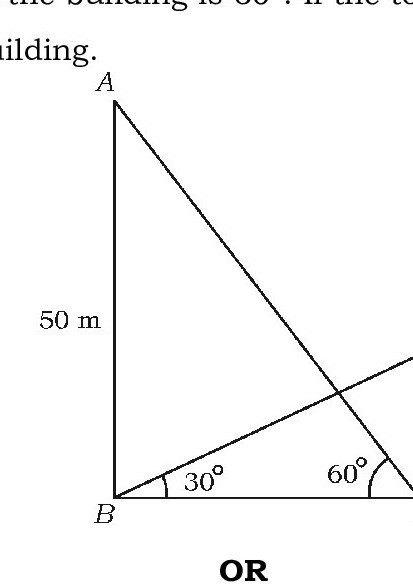
A tower and a building are standing vertically on the same level ground. The angle of elevation of the top of a building from the foot of the tower is 30° and the angle of elevation of the top of the tower from the foot of the building is 60°. If the tower is 50 m high, find the height of the building.
Q28
long answer
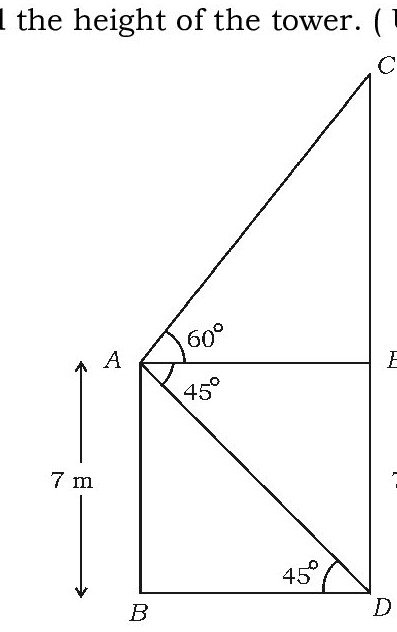
A cable tower and a building are standing vertically on the same level ground. From the top of the building which is 7 m high, the angle of elevation of the cable tower is 60° and the angle of depression of its foot is 45°. Find the height of the tower. ( Use $\sqrt{3} = 1·73$ )
Q29
short answer
Find the value of ‘k’ if the points P ( 2, 3 ), Q ( 4, k ) and R ( 6, – 3 ) are collinear.
Q29
short answer
A circle whose centre is at P ( 2, 3 ) passes through the points A ( 4, 3 ) and B ( x, 5 ). Then find the value of ‘x’.
Q30
short answer
Find the mean of the following scores by direct method :
Class-interval Frequency
5 — 15 1
15 — 25 3
25 — 35 5
35 — 45 4
45 — 55 2
Q30
short answer
Find the median of the following scores :
Class-interval Frequency
0 — 20 6
20 — 40 9
40 — 60 10
60 — 80 8
80 — 100 7
Q31
short answer
The following table gives the information of heights of 60 students of class X of a school. Draw a ‘less than type’ ogive for the given data :
Height of students ( in cms ) Number of students ( Cumulative frequency )
Less than 130 04
Less than 140 12
Less than 150 30
Less than 160 45
Less than 170 56
Less than 180 60
Q32
short answer
Prove that “the lengths of tangents drawn from an external point to a circle are equal”.
Q33
short answer
Draw a pair of tangents to a circle of radius 3 cm which are inclined to each other at an angle of 60°.
Q34
long answer
Find the solution of the pair of linear equations by graphical method :
2x – y = 7
x – y = 2
Q35
long answer
Construct a triangle ABC with sides BC = 6 cm, AB = 5 cm and AC = 4·5 cm. Then construct a triangle whose sides are $4/3$ of the corresponding sides of the triangle ABC.
Q36
long answer
ABCD is a square of side 14 cm. A circle is drawn inside it which just touches the mid-points of sides of the square, as shown in the figure. If P, Q, R and S are the mid-points of the sides of the square, and PQ, QR, RS and SP are the arcs of the circle, then find the area of the shaded region.

Q37
long answer
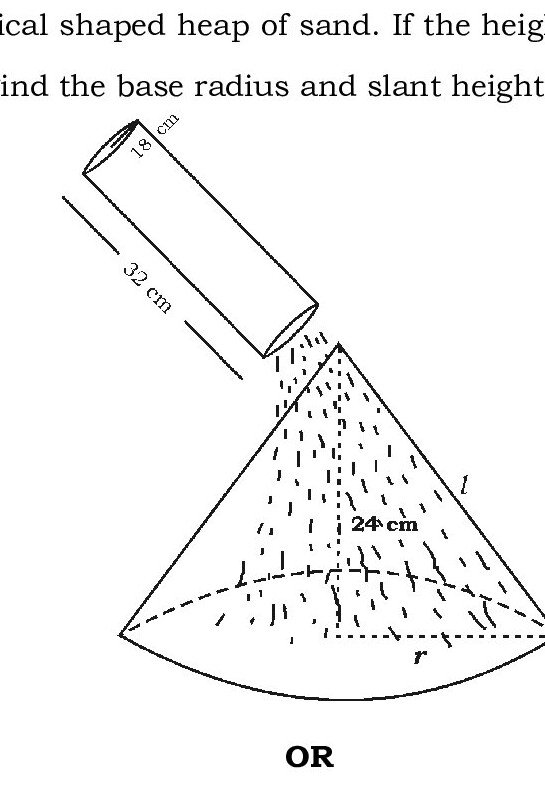
Sand is filled in a cylindrical vessel of height 32 cm and radius of its base is 18 cm. This sand is completely poured on the level ground to form a conical shaped heap of sand. If the height of the conical heap is 24 cm. Find the base radius and slant height of the conical heap.
Q37
long answer
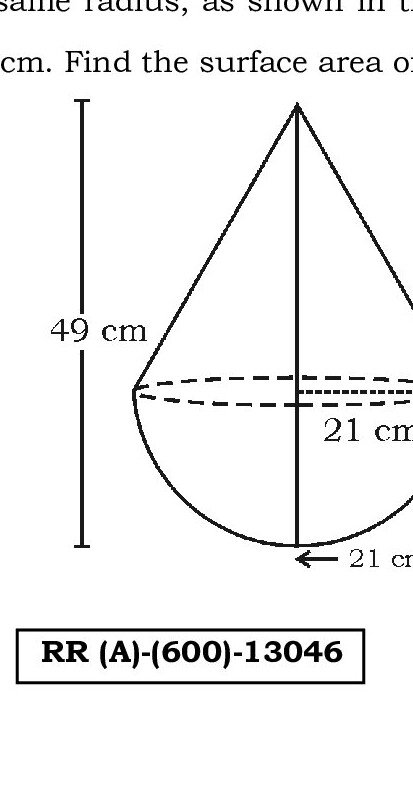
A toy is in the form of a cone of radius 21 cm, mounted on a hemisphere of same radius, as shown in the figure. The total height of the toy is 49 cm. Find the surface area of the toy.
Q38
long answer
Prove that “if in two triangles, corresponding angles are equal, then their corresponding sides are in the same ratio ( or proportion ) and hence the two triangles are similar”.
