The first 5 questions are solved below. Log in as a CLASS 10th student to reveal solutions for the rest of this paper.
Log In →
Q1
mcq
1 mark
The product of HCF and LCM of two numbers 15 and 20 is
Correct Answer: C —
Solution
For any two positive integers a and b, the relationship is HCF(a, b) * LCM(a, b) = a * b. Here, 15 * 20 = 300.
Q2
mcq
1 mark
If $\alpha$ and $\beta$ are the zeroes of the quadratic polynomial $p(x) = ax^2 + bx + c$, then $\alpha\beta$ is
-
A.
$\frac{b}{a}$
-
B.
$-\frac{b}{a}$
-
C.
$-\frac{c}{a}$
-
D.
$\frac{c}{a}$
Correct Answer: D —
Solution
According to the relationship between zeroes and coefficients of a quadratic polynomial ax^2 + bx + c, the product of the zeroes is given by the constant term divided by the coefficient of x^2, which is c/a.
Q3
mcq
1 mark
If $\sin \theta = \frac{4}{5}$, then the value of $\sqrt{1 - \cos^2 \theta}$ is
-
A.
$\frac{16}{25}$
-
B.
$\frac{4}{5}$
-
C.
$\frac{5}{4}$
-
D.
$\frac{9}{25}$
Correct Answer: B —
Solution
Using the identity sin^2 θ + cos^2 θ = 1, we know that sqrt(1 - cos^2 θ) = sqrt(sin^2 θ) = sin θ. Since sin θ = 4/5, the value is 4/5.
Q4
mcq
1 mark
The probability of a sure event is
Correct Answer: A —
Solution
By the definition of probability, an event that is certain to occur (a sure event) has a probability of 1.
Q5
mcq
1 mark
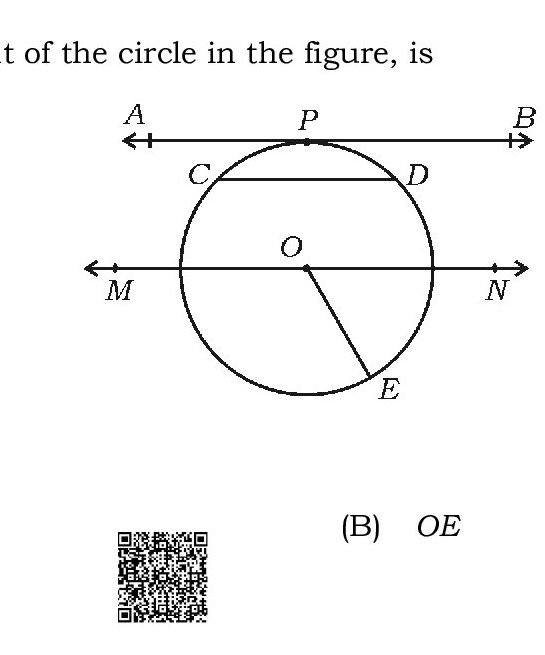
The secant of the circle in the figure, is
Correct Answer: A —
Solution
A secant of a circle is a line that intersects the circle at two distinct points. Looking at the figure, line MN passes through the circle at two points, making it a secant line.
Q6
mcq
1 mark
The volume of the frustum of a cone whose base radii are $r_1$ and $r_2$ and height 'h', is
-
A.
$\frac{1}{3} \pi h (r_1^2 + r_2^2 + r_1 \cdot r_2)$
-
B.
$\frac{1}{3} \pi h (r_1^2 + r_2^2 - r_1 \cdot r_2)$
-
C.
$\frac{1}{3} \pi h (r_1^2 + r_2^2 + r_1 \cdot r_2)$
-
D.
$\frac{1}{3} \pi h (r_1^2 - r_2^2 - r_1 \cdot r_2)$
Q7
mcq
1 mark
If 2, x, 26 are in Arithmetic progression, then the value of x is
Q8
mcq
1 mark
If $\tan(90^{\circ} - \theta) = \sqrt{3}$, then the value of $\cot \theta$ is
-
A.
$\frac{1}{\sqrt{3}}$
-
B.
1
-
D.
$\sqrt{3}$
Q9
short answer
1 mark
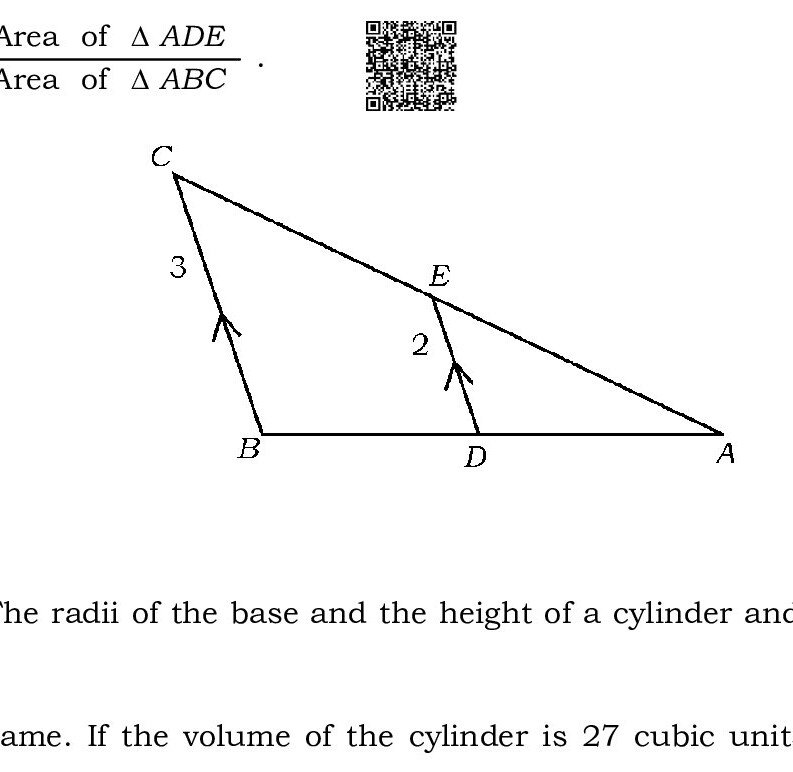
In the figure, $\Delta ADE \sim \Delta ABC$ and $DE : BC = 2 : 3$. Find $\frac{\text{Area of } \Delta ADE}{\text{Area of } \Delta ABC}$.
Q10
short answer
1 mark
The radii of the base and the height of a cylinder and a cone are same. If the volume of the cylinder is 27 cubic units, then find the volume of the cone.
Q11
short answer
1 mark
If $200 = 2^m \times 5^n$, then find the values of m and n.
Q12
short answer
1 mark
Find the number of solutions of the pair of linear equations $2x - 3y + 4 = 0$ and $3x + 5y + 8 = 0$.
Q13
short answer
1 mark
In an Arithmetic progression, sum of the first six terms and sum of the first five terms are 78 and 55 respectively. Then find the sixth term of the progression.
Q14
short answer
1 mark
Write the degree of the polynomial $p(x) = x(x^2 + 3) + 5x^2 + 7$.
Q15
short answer
1 mark
If the value of discriminant of a quadratic equation is zero, then write the nature of roots of the quadratic equation.
Q16
short answer
1 mark
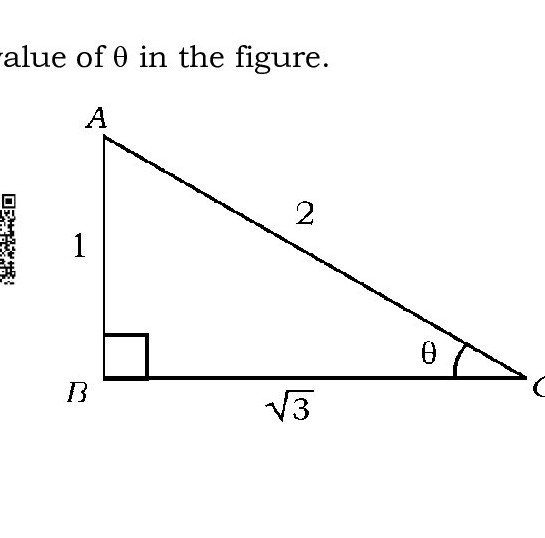
Find the value of $\theta$ in the figure.
Q17
short answer
2 marks
Prove that $3 + \sqrt{2}$ is an irrational number.
Q18
short answer
2 marks
Solve the given pair of linear equations by Elimination method:
$2x + y = 8$
$3x - y = 7$
Q19
short answer
2 marks
Find the sum of first 20 terms of the Arithmetic progression 1, 5, 9, .... using formula.
Q20
short answer
2 marks
Find the roots of the quadratic equation $2x^2 - 3x - 1 = 0$ using quadratic formula.
Q21
short answer
2 marks
Prove that $\frac{\cos \theta - \sin \theta \cdot \cos \theta}{\cos \theta + \sin \theta \cdot \cos \theta} = \frac{\text{cosec} \theta - 1}{\text{cosec} \theta + 1}$.
OR
Prove that $\frac{\sin 30^{\circ} + \cos 60^{\circ}}{\text{cosec} 30^{\circ} - \cot 45^{\circ}} = \sin 90^{\circ}$.
Q22
short answer
2 marks
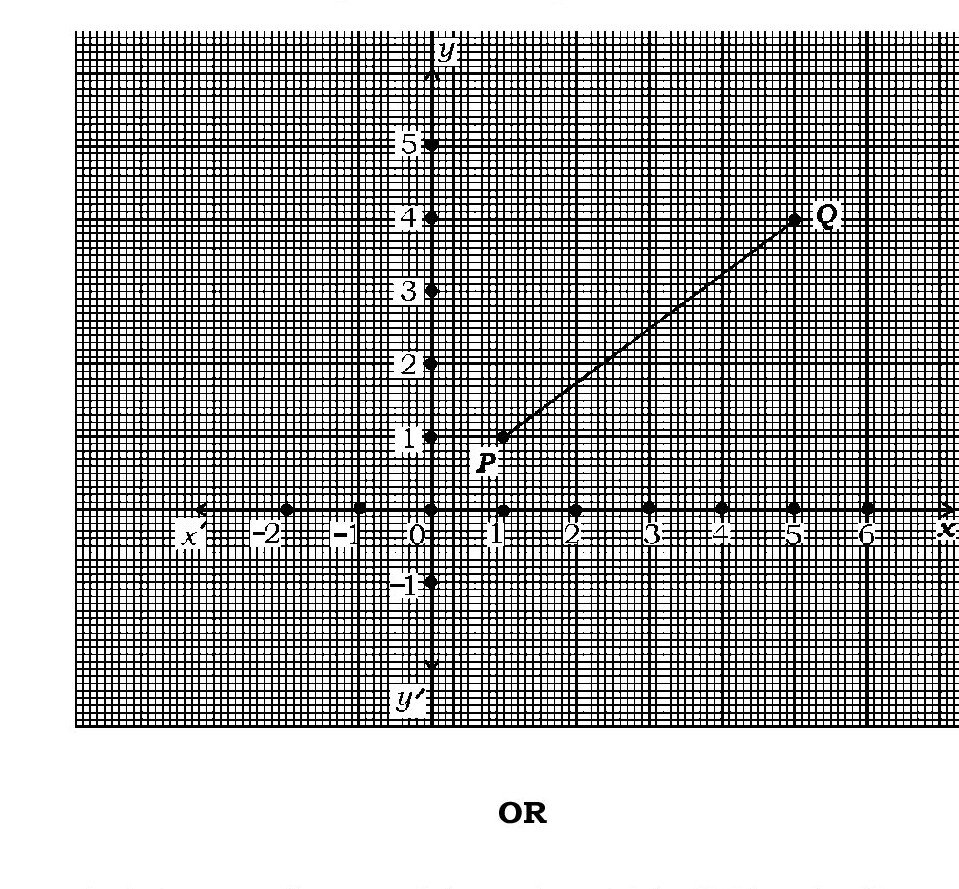
Find the coordinates of the point P and Q in the given graph and hence find the length of PQ using distance formula.
OR
Find the coordinates of the point which divides the line segment joining the points (4, -3) and (8, 5) in the ratio 3 : 1 internally.
Q23
short answer
A basket contains 36 mangoes. $\frac{1}{4}$th of them are rotten and others are good. If one mango is drawn at random from the basket, then find the probability of getting a good mango.
Q24
short answer
2 marks
Draw a circle of radius $3.5$ cm and construct a pair of tangents to the circle such that the angle between the tangents is $60^\circ$.
Q25
long answer
3 marks
Divide $p(x) = x^3 + 3x^2 + 4x + 5$ by $g(x) = x^2 - x + 1$ and find the quotient $[q(x)]$ and remainder $[r(x)]$.
OR
When the polynomial $p(x) = x^3 + 4x^2 + 5x - 2$ is divided by the polynomial $g(x)$, the quotient $[q(x)]$ and remainder $[r(x)]$ are $x^2 - x + 2$ and 4 respectively. Find $g(x)$.
Q26
long answer
3 marks
Find the mean for the following data:
Class-interval: 2-6, 7-11, 12-16, 17-21, 22-26
Frequency: 2, 4, 5, 3, 1
OR
Find the mode for the following data:
Class-interval: 1-5, 5-9, 9-13, 13-17, 17-21
Frequency: 1, 3, 7, 10, 9
Q27
long answer
3 marks
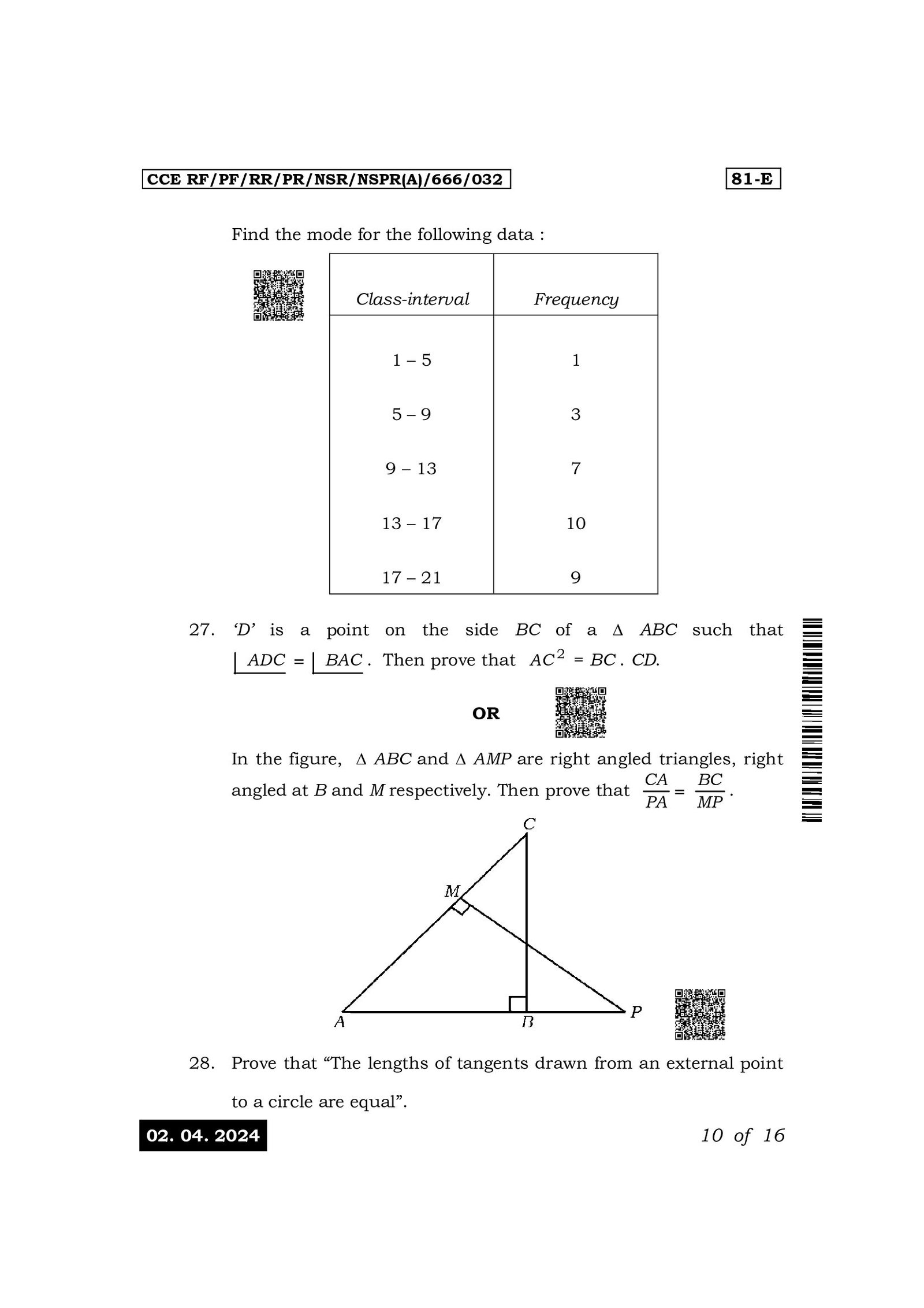
'D' is a point on the side BC of a $\Delta ABC$ such that $\angle BAC = \angle ADC$. Then prove that $AC^2 = BC \cdot CD$.
OR
In the figure, $\Delta ABC$ and $\Delta AMP$ are right angled triangles, right angled at $B$ and $M$ respectively. Then prove that $\frac{CA}{PA} = \frac{BC}{MP}$.
Q28
long answer
3 marks
Prove that "The lengths of tangents drawn from an external point to a circle are equal".
Q29
long answer
3 marks
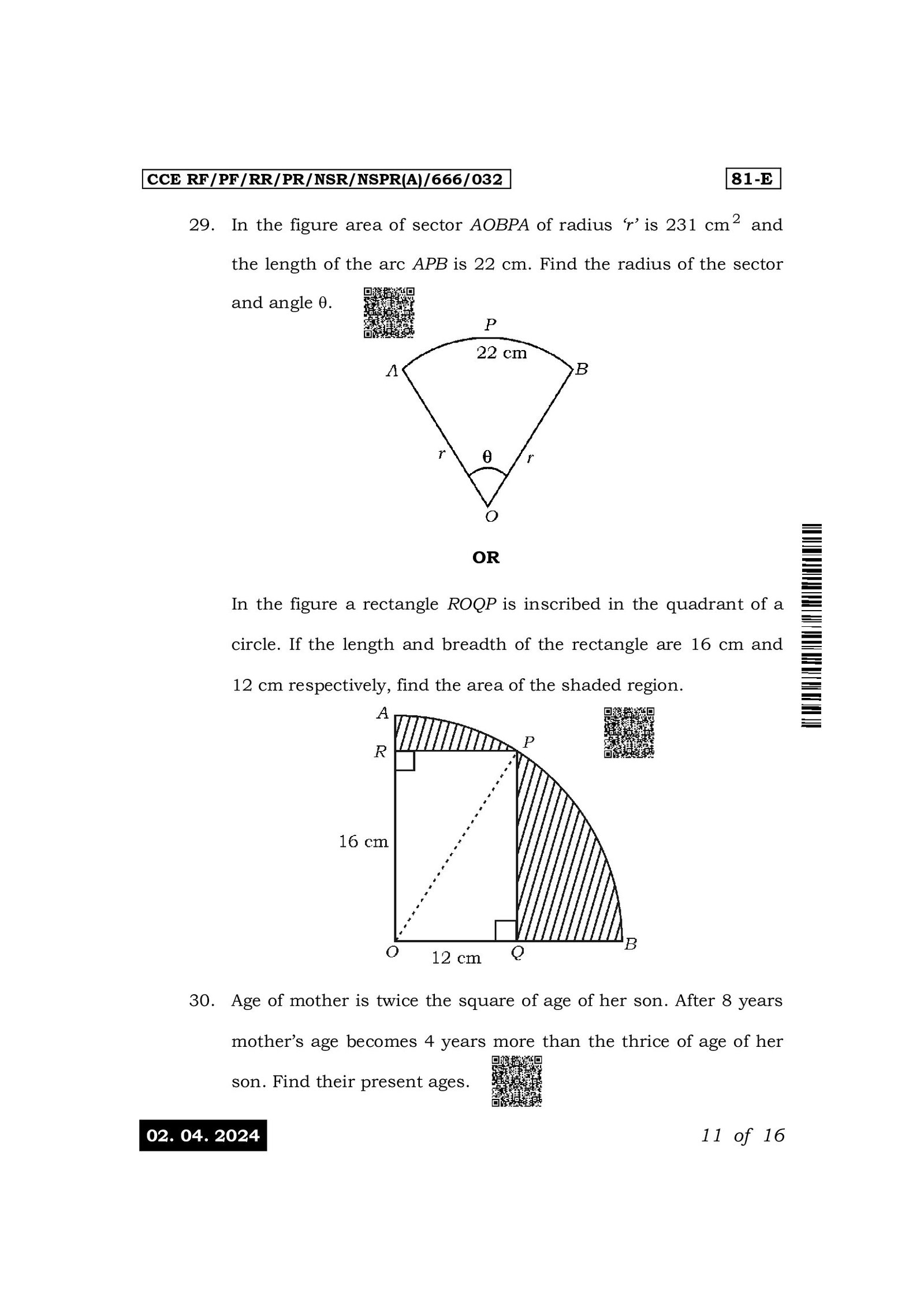
In the figure area of sector AOBPA of radius 'r' is $231 \text{ cm}^2$ and the length of the arc APB is 22 cm. Find the radius of the sector and angle $\theta$.
OR
In the figure a rectangle ROQP is inscribed in the quadrant of a circle. If the length and breadth of the rectangle are 16 cm and 12 cm respectively, find the area of the shaded region.
Q30
long answer
3 marks
Age of mother is twice the square of age of her son. After 8 years mother’s age becomes 4 years more than the thrice of age of her son. Find their present ages.
Q31
long answer
3 marks
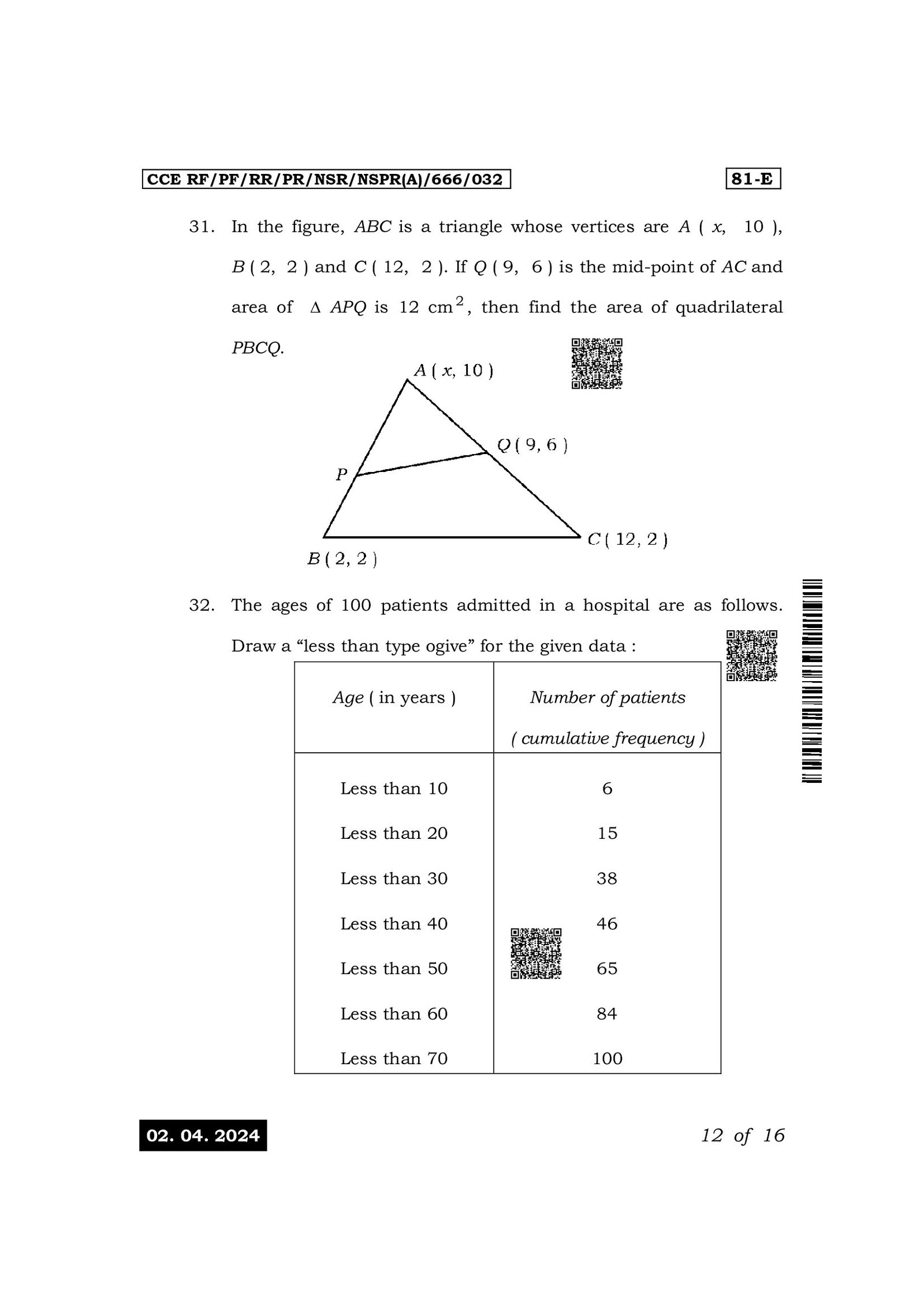
In the figure, ABC is a triangle whose vertices are A $(x, 10)$, B $(2, 2)$ and C $(12, 2)$. If Q $(9, 6)$ is the mid-point of AC and area of $\Delta APQ$ is $12 \text{ cm}^2$, then find the area of quadrilateral PBCQ.
Q32
long answer
3 marks
The ages of 100 patients admitted in a hospital are as follows. Draw a “less than type ogive” for the given data :
Age ( in years ): Less than 10, Less than 20, Less than 30, Less than 40, Less than 50, Less than 60, Less than 70
Number of patients ( cumulative frequency ): 6, 15, 38, 46, 65, 84, 100
Q33
long answer
3 marks
Construct a triangle with sides 6 cm, 8 cm and 9 cm and then construct another triangle whose sides are $\frac{2}{3}$ of the corresponding sides of the first triangle.
Q34
long answer
4 marks
Find the solution of the given pair of linear equations by graphical method :
$2x + y = 8$
$x + y = 5$
Q35
long answer
4 marks
In an Arithmetic progression the sum of first $n$ terms is 210 and the sum of first $(n - 1)$ terms is 171. If the first term of the Arithmetic progression is 3, then find the Arithmetic progression and find its 20th term.
OR
The sum of interior angles of a polygon of 'n' sides is $(n - 2) 180^\circ$. If the interior angles of a pentagon are in Arithmetic progression and its least angle is $72^\circ$, then find all the interior angles of the pentagon.
Q35
long answer
In an Arithmetic progression the sum of first $n$ terms is 210 and the sum of first $(n - 1)$ terms is 171. If the first term of the Arithmetic progression is 3, then find the Arithmetic progression and find its 20$^{th}$ term.
Q35
long answer
OR
The sum of interior angles of a polygon of ‘n’ sides is $(n - 2) 180^{\circ}$. If the interior angles of a pentagon are in Arithmetic progression and its least angle is 72$^{\circ}$, then find all the interior angles of the pentagon.
Q36
long answer
4 marks
In the figure the poles AB and CD of different heights are standing vertically on a level ground. From a point P on the line joining the foots of the poles on the level ground, the angles of elevation to the tops of the poles are found to be complementary. The height of CD and the distance PD are $20\sqrt{3}$ m and 20 m respectively. If BP is 10 m, then find the length of the pole AB and the distance AC between the tops of the poles.

Q37
long answer
4 marks
Prove : "Basic proportionality theorem" or "Thales theorem".
Q38
long answer
5 marks
An insect control device made of a cylinder, a frustum of a cone and a hemisphere attached to each other is as shown in the figure. Sticky liquid is completely filled in the hemispherical part. If the radii of hemisphere and cylinder are 21 cm and 14 cm respectively and total height of the device is 60 cm and height of the cylinder is 15 cm, then calculate the curved surface area of the device and also find the quantity of the sticky liquid in the hemisphere.

