The first 5 questions are solved below. Log in as a CLASS 10th student to reveal solutions for the rest of this paper.
Log In →
Q1
mcq
1 mark
LCM of 2 and 3 is
Correct Answer: D —
Solution
The least common multiple (LCM) of two prime numbers is their product. Since 2 and 3 are prime numbers, their LCM is $2 \times 3 = 6$. Therefore, option (D) is correct.
Q2
mcq
1 mark
If the lines represented by the equations $a_1x + b_1y + c_1 = 0$ and $a_2x + b_2y + c_2 = 0$ are coincident, then the correct relation is
-
A.
$\frac{a_1}{a_2} = \frac{b_1}{b_2} = \frac{c_1}{c_2}$
-
B.
$\frac{a_1}{a_2} \neq \frac{b_1}{b_2}$
-
C.
$\frac{a_1}{a_2} = \frac{b_1}{b_2} \neq \frac{c_1}{c_2}$
-
D.
$\frac{a_1}{a_2} \neq \frac{b_1}{b_2} = \frac{c_1}{c_2}$
Correct Answer: A —
Solution
For two linear equations $a_1x + b_1y + c_1 = 0$ and $a_2x + b_2y + c_2 = 0$, the lines are coincident if they represent the same line, which occurs when their coefficients are proportional: $\frac{a_1}{a_2} = \frac{b_1}{b_2} = \frac{c_1}{c_2}$. Thus, (A) is the correct relation.
Q3
mcq
1 mark
The quadratic equation in the following is
-
A.
$x^3 - 6x$
-
B.
$p(x) = x^2 + 7x$
-
C.
$3x = 9$
-
D.
$x^2 + 3x + 4 = 0$
Correct Answer: D —
Solution
A quadratic equation must be of the form $ax^2 + bx + c = 0$ where $a \neq 0$. Option (D) fits this standard form. Option (A) is a cubic expression, (B) is a quadratic polynomial but not an equation, and (C) is a linear equation.
Q4
mcq
1 mark
In the following, the shapes which are always similar, are
-
A.
any two equilateral triangles
-
B.
square and rectangle
-
C.
square and rhombus
-
D.
any two trapeziums
Correct Answer: A —
Solution
Two polygons are similar if their corresponding angles are equal and their corresponding sides are proportional. Any two equilateral triangles have all angles equal to $60^\circ$ and sides in a fixed ratio, making them always similar. Other shapes listed do not share constant similarity.
Q5
mcq
1 mark
The volume of a sphere of radius ‘r’ units is
-
A.
$\frac{2}{3}\pi r^3$ cubic units
-
B.
$\frac{4}{3}\pi r^3$ cubic units
-
C.
$\frac{1}{3}\pi r^3$ cubic units
-
D.
$\frac{3}{2}\pi r^3$ cubic units
Correct Answer: B —
Solution
The standard formula for the volume $V$ of a sphere with radius $r$ is derived via calculus as $V = \frac{4}{3}\pi r^3$. Option (B) correctly represents this formula.
Q6
mcq
1 mark
The distance of a point P (x, y) from the origin is
-
A.
$\sqrt{x^2 - y^2}$
-
B.
$\sqrt{x + y}$
-
C.
$\sqrt{x^2 + y^2}$
-
D.
$\sqrt{x - y}$
Q7
mcq
1 mark
The common difference of the arithmetic progression -1, -3, -5 ... is
Q8
mcq
1 mark
In the given figure ‘O’ is the centre of the circle and the length of the arc APB is $4\pi$ cm. If OB = 9 cm, then the measure of angle $\theta$ is
-
A.
60°
-
B.
80°
-
C.
85°
-
D.
70°
Q9
short answer
1 mark
Write the degree of a linear polynomial.
Q10
short answer
1 mark
Write the formula to find the total surface area of a cube of edge ‘a’ units.
Q11
short answer
1 mark
In the given frequency distribution table, write the modal class:
Class-interval: 1-3, 3-5, 5-7, 7-9
Frequency: 4, 8, 2, 2
Q12
short answer
1 mark
Write the probability of an impossible event.
Q13
short answer
1 mark
How many solutions do the pair of linear equations $2x + 3y - 9 = 0$ and $3x + 2y - 6 = 0$ has?
Q14
short answer
1 mark
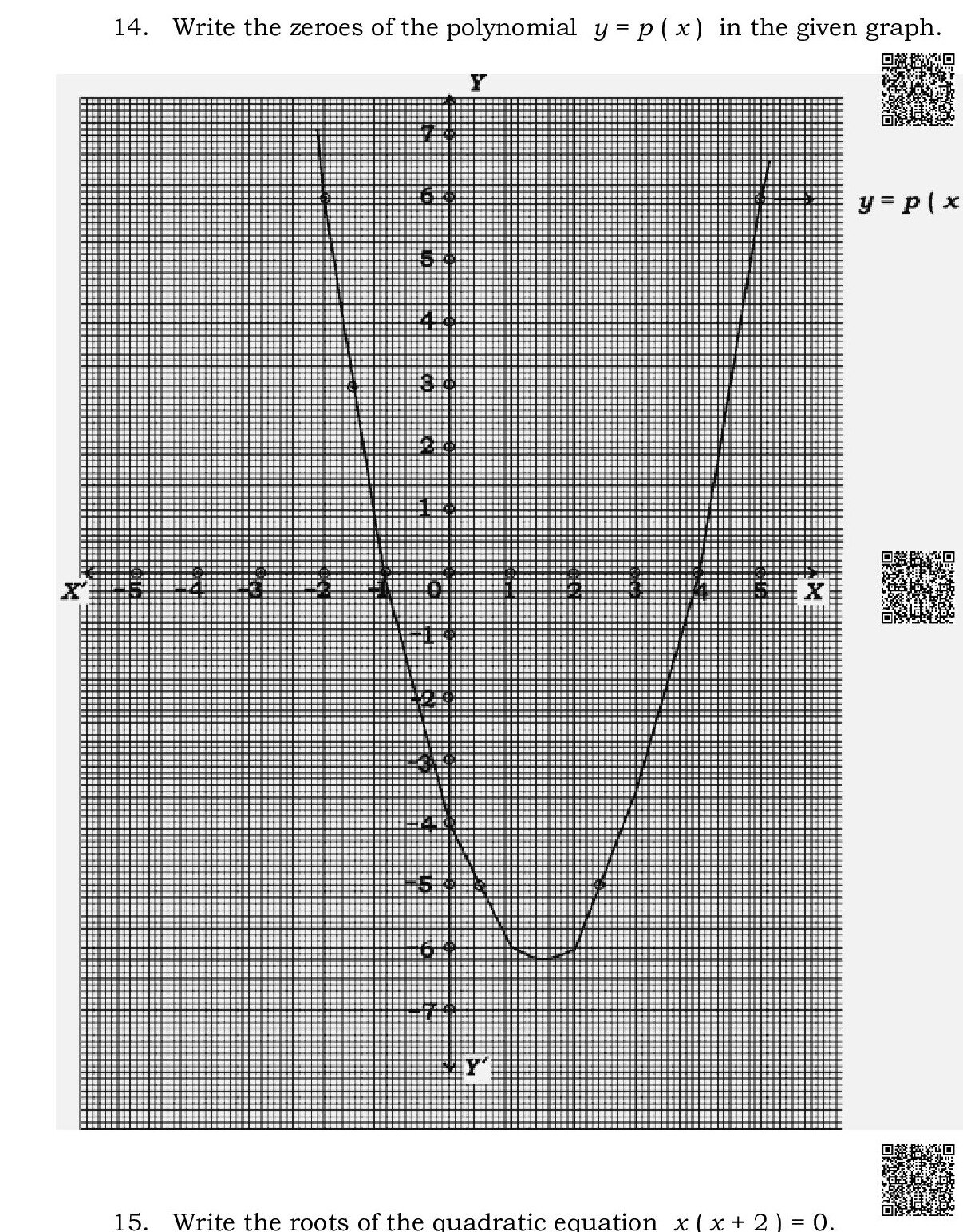
Write the zeroes of the polynomial $y = p(x)$ in the given graph.
Q15
short answer
1 mark
Write the roots of the quadratic equation $x(x + 2) = 0$.
Q16
short answer
1 mark
In the given figure, write the similarity criterion used to show that $\Delta ABC \sim \Delta QRP$.

Q17
short answer
2 marks
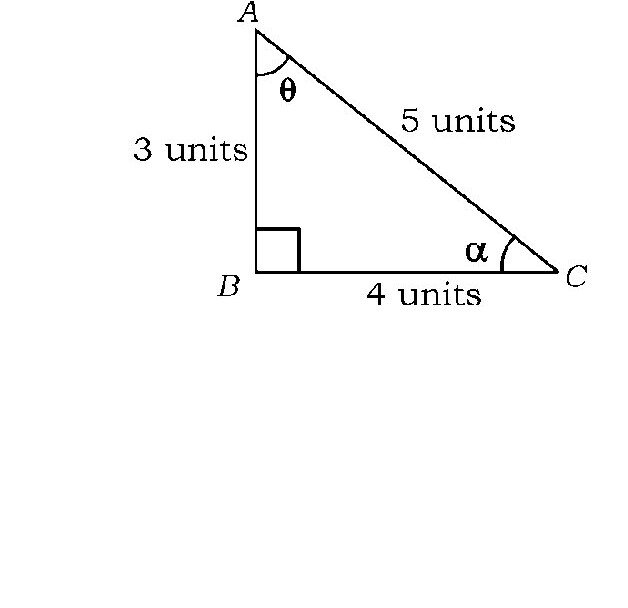
In the given figure, $\angle ABC = 90^{\circ}$. Write the values of the following:
i) $\sin \alpha$
ii) $\tan \theta$
Q18
long answer
2 marks
Prove that $6 + \sqrt{2}$ is an irrational number.
OR
The HCF and LCM of two positive integers are respectively 4 and 60. If one of the integers is 20, then find the other integer.
Q18
long answer
Prove that $6 + \sqrt{2}$ is an irrational number.
Q18
long answer
The HCF and LCM of two positive integers are respectively 4 and 60. If one of the integers is 20, then find the other integer.
Q19
long answer
2 marks
Solve the given pair of linear equations by elimination method:
$2x + y = 10$
$x - y = 2$
Q20
long answer
2 marks
Find the roots of the quadratic equation $x^2 + 8x + 12 = 0$.
OR
Find the discriminant of the quadratic equation $x^2 + 4x + 5 = 0$ and hence write the nature of the roots.
Q20
short answer
Find the discriminant of the quadratic equation $x^2 + 4x + 5 = 0$ and hence write the nature of the roots.
Q21
long answer
2 marks
Find the sum of first 20 terms of the arithmetic progression 5, 9, 13, ... using formula.
Q22
long answer
2 marks
In the given figure, PA and PB are tangents to the circle with centre ‘O’. If PA = 4 cm and $\angle APO = 40^{\circ}$, then find the measure of $\angle AOB$ and length of PB.

Q23
long answer
2 marks
According to Fundamental Theorem of Arithmetic, if $40 = x^y \cdot z$, then find the values of x, y and z.
Q24
long answer
2 marks
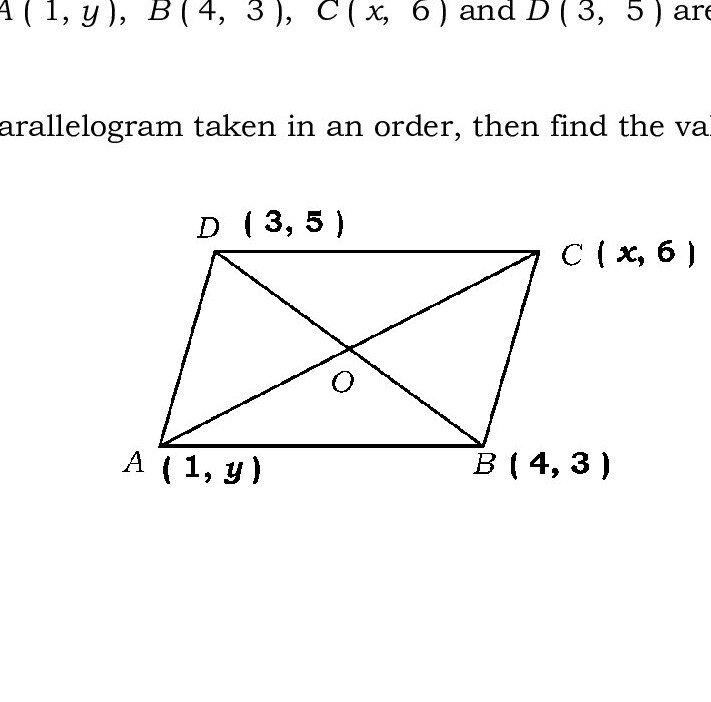
If A(1, y), B(4, 3), C(x, 6) and D(3, 5) are the vertices of a parallelogram taken in an order, then find the values of x and y.
Q25
short answer
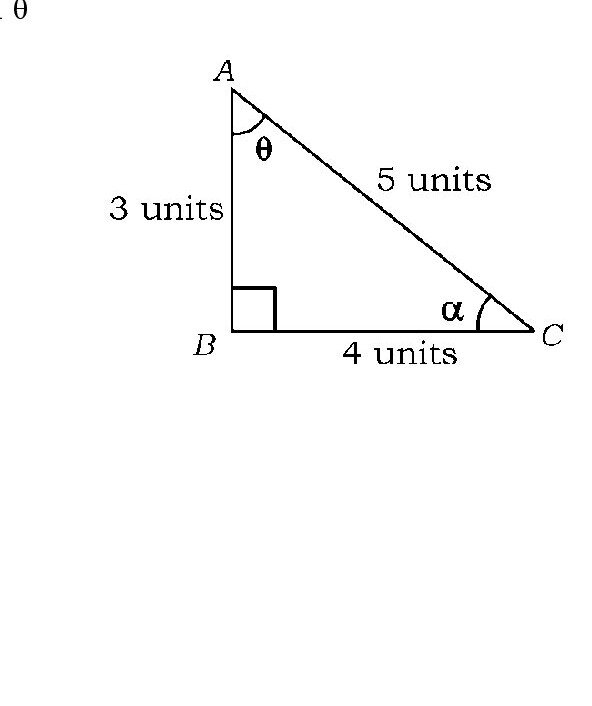
In the given figure, $\angle ABC = 90^\circ$. Write the value of $\sin \alpha$.
Q25
long answer
Find the zeroes of the quadratic polynomial $p(x) = x^2 + 7x + 10$ and verify the relationship between the zeroes and the coefficients.
Q26
long answer
Prove that “The tangent at any point of a circle is perpendicular to the radius through the point of contact”.
Q27
long answer
Prove that : $\frac{\cos A}{1 + \sin A} + \frac{1 + \sin A}{\cos A} = 2 \sec A$.
Q27
long answer
Find the value of : $\frac{5 \cos^2 60^\circ + 4 \sec^2 30^\circ - \tan^2 45^\circ}{\sin^2 30^\circ + \cos^2 30^\circ}$
Q28
long answer
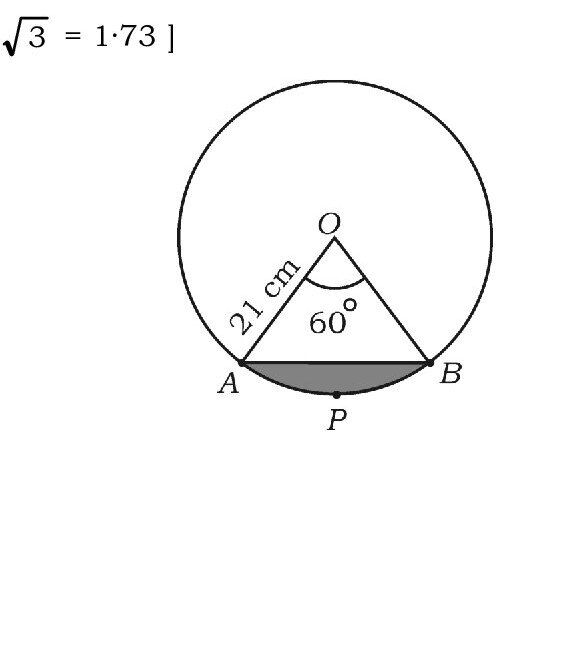
In the given figure ‘O’ is the centre of the circle of radius 21 cm. If $\angle AOB = 60^\circ$, then find the area of the segment APB. [ Take $\sqrt{3} = 1.73$ ]
Q29
long answer
Find the coordinates of a point which divides the line segment joining the points (– 1, 7) and (4, – 3) internally in the ratio 2 : 3.
Q29
long answer
Find a relation between x and y such that the point (x, y) is equidistant from the points (3, 6) and (– 3, 4)
Q30
long answer
Find the mean for the following data :
Class-interval | Frequency
10 – 20 | 2
20 – 30 | 3
30 – 40 | 6
40 – 50 | 5
50 – 60 | 4
Q30
long answer
Find the median for the following data :
Class-interval | Frequency
15 – 20 | 4
20 – 25 | 5
25 – 30 | 10
30 – 35 | 5
35 – 40 | 6
Q32
long answer
The difference between the altitude and base of a right angled triangle is 5 cm. If the area of the triangle is 150 cm$^2$, then find the base and altitude of the triangle.
Q32
long answer
The sum of the squares of two consecutive even positive integers is 164. Find the integers.
Q33
long answer
Two line segments AB and CD intersect each other at a point ‘O’. Join AC and BD such that AC || BD and prove that $\Delta AOC \sim \Delta BOD$.
Q34
long answer
Find the solution of the given pair of linear equations by graphical method :
$x + 2y = 8$
$x + y = 5$
Q35
long answer
Prove that “If a line is drawn parallel to one side of a triangle to intersect the other two sides in distinct points, the other two sides are divided in the same ratio”.
Q36
long answer
A solid consisting of a right circular cone of height 120 cm and radius 60 cm standing on a hemisphere of radius 60 cm is placed upright in a right circular cylinder full of water such that it touches the bottom as shown in the figure. If the radius of the cylinder is 60 cm and height is 180 cm, then find the volume of water left in the cylinder in terms of $\pi$.
Q36
long answer
A solid is made of a cylinder with a hemispherical depression having the same radius (‘r’ cm) as that of cylinder at the top end as shown in the figure. The volume of the hemispherical depression is 18000 $\pi$ cm$^3$. If the height of the cylinder is 145 cm, then find the total surface area of the solid.
Q37
long answer
An arithmetic progression consists of 16 terms. The sum of all its terms is 768. If the last term of the progression is 93, then find the arithmetic progression. Also show that the sum of all the terms of this progression is equal to 3 times the sum of first 16 odd natural numbers using formula.
Q38
short answer
A box contains 20 cards numbered from 1 to 20. One card is drawn randomly from the box. Find the probability of getting a card bearing a perfect square number.
Q38
long answer
A pole and a tower are standing vertically on a level ground. The height of the pole is 6 m and the angle of elevation to the top of the pole from the bottom of the tower is 30°. The angle of elevation to the top of the tower from the top of the pole is 60° as shown in the figure. Find the height of the tower (CD). Also find the distance (AC) between the top of the pole and the top of the tower.
