The first 5 questions are solved below. Log in as a CLASS 10th student to reveal solutions for the rest of this paper.
Log In →
Q1
mcq
1 mark
If $a_n$, $S_n$ and $S_{n-1}$ represent $n^{th}$ term, sum of first $n$ terms and sum of first $(n-1)$ terms of an arithmetic progression respectively, then the correct relation among the following is
-
A.
$S_n + a_n = S_{n-1}$
-
B.
$a_n = S_n - S_{n-1}$
-
C.
$a_n = S_n - S_{n-1}$
-
D.
$S_{n-1} = a_n - S_n$
Correct Answer: B —
Solution
By definition, the sum of the first $n$ terms is $S_n = a_1 + a_2 + ... + a_{n-1} + a_n$. Since $S_{n-1} = a_1 + a_2 + ... + a_{n-1}$, subtracting $S_{n-1}$ from $S_n$ leaves only $a_n$. Thus, $a_n = S_n - S_{n-1}$. Options A and D are algebraic rearrangements that do not hold true, and C is identical to B (though B is the standard representation).
Q2
mcq
1 mark
The angle between the tangent at a point of a circle and radius through the point of contact is
-
A.
30°
-
B.
60°
-
C.
90°
-
D.
180°
Correct Answer: C —
Solution
According to the theorem on tangents to a circle, the tangent at any point of a circle is perpendicular to the radius through the point of contact. Therefore, the angle between them is always 90°.
Q3
mcq
1 mark
The lines represented by a pair of linear equations in two variables having no solution are
-
A.
Parallel
-
B.
Coincident
-
C.
Intersecting
-
D.
Perpendicular
Correct Answer: A —
Solution
For a system of linear equations in two variables, having no solution corresponds to the lines being parallel, meaning they never intersect at any point. Coincident lines have infinitely many solutions, and intersecting lines have a unique solution.
Q4
mcq
1 mark
Volume of a cuboid whose length is ‘l’ unit, breadth is ‘b’ unit and height is ‘h’ unit, is
-
A.
$l + b + h$ cubic units
-
B.
$2(b + h)l$ cubic units
-
C.
$2(lb + bh + hl)$ cubic units
-
D.
$lbh$ cubic units
Correct Answer: D —
Solution
The volume of a cuboid is calculated as the product of its length, breadth, and height. Thus, Volume = $l \times b \times h = lbh$ cubic units. Other options correspond to perimeter or surface area formulas.
Q5
mcq
1 mark
Which of the following can be the probability of an event?
-
A.
$1/5$
-
B.
$1.5$
-
C.
$5/2$
-
D.
$-5$
Correct Answer: A —
Solution
The probability $P(E)$ of an event must satisfy $0 \leq P(E) \leq 1$. Option A ($1/5 = 0.2$) is within this range. Option B ($1.5$) and C ($2.5$) are greater than 1, and option D ($-5$) is less than 0, so none of those can be probabilities.
Q6
mcq
1 mark
The value of $\sec^2 \theta - \tan^2 \theta$ is
Q7
mcq
1 mark
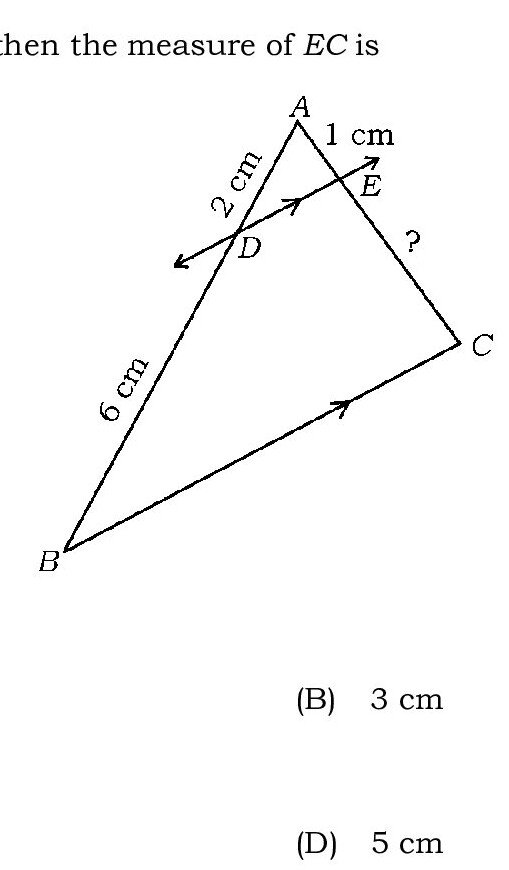
In the figure, $DE \parallel BC$. If $AD = 2 \text{ cm}$, $AE = 1 \text{ cm}$ and $BD = 6 \text{ cm}$ then the measure of $EC$ is
-
A.
2 cm
-
B.
3 cm
-
C.
4 cm
-
D.
5 cm
Q8
mcq
1 mark
The mean and mode of a data are 7.5 and 6 respectively. The median for this data is
Q9
short answer
1 mark
Write the LCM of 5 and 7.
Q10
short answer
1 mark
Write the roots of the quadratic equation $ax^2 + bx + c = 0, a \neq 0$.
Q11
short answer
1 mark
Write the formula to find the area of a sector of a circle with radius ‘r’ and angle $\theta$ (with degree measure).
Q12
short answer
1 mark
Write the formula to find the total surface area of a solid hemisphere having radius ‘r’ units.
Q13
short answer
1 mark
Write the distance of a point $P(x, y)$ from the origin.
Q14
short answer
1 mark
What is the sum of the probabilities of all the elementary events of an experiment?
Q15
short answer
1 mark
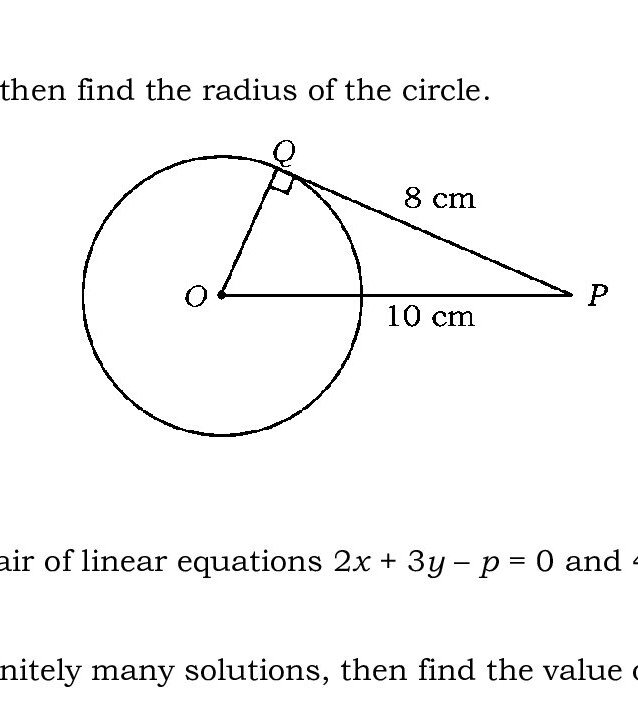
The length of the tangent drawn from a point ‘P’ to the circle with centre ‘O’ is 8 cm. If the distance of point ‘P’ from the centre is 10 cm, then find the radius of the circle.
Q16
short answer
1 mark
If the pair of linear equations $2x + 3y - p = 0$ and $4x + 6y - 18 = 0$ has infinitely many solutions, then find the value of ‘p’.
Q17
short answer
2 marks
Prove that $6 + \sqrt{2}$ is an irrational number.
Q18
short answer
2 marks
Solve the given pair of linear equations by elimination method.
$x + 2y = 7$
$x + y = 5$
Q19
short answer
2 marks
Find the roots of the quadratic equation $x^2 + 5x + 6 = 0$ by factorisation method.
OR
Find the nature of the roots of the quadratic equation $x^2 + 5x + 4 = 0$.
Q20
short answer
2 marks
Find the sum of first 20 terms of the arithmetic progression 1, 4, 7, ... using formula.
Q21
short answer
2 marks
In the figure, $\angle B = 90^\circ$ and $\angle ACB = \theta$. Write the values of $\sin \theta$ and $\cot \theta$.
Q22
short answer
2 marks
A ( 2, 4 ) and B ( 2, 8 ) are the end points of the diameter AB of a circle with centre ‘O’. Find the coordinates of the centre of the circle.
Q23
short answer
2 marks
The length and breadth of a rectangular field are 147 m and 56 m respectively. Calculate the maximum length of a rod that can be used to measure both length and breadth exactly. How many times this rod has to be used to measure the length of the field?
Q24
short answer
2 marks
A box contains 6 blue and some red marbles. The probability of picking a blue marble from the box is $\frac{3}{8}$. Find the number of red marbles in the box and also find the probability of picking a red marble from the box. OR The six faces of a die show the numbers as given below: 1, 2, 3, 4, 1, 5. This die is rolled once. Find the probability of getting a perfect square number.
Q25
long answer
3 marks
Find the zeros of the polynomial $p(x) = (x - 2)(x - 1)$ and verify the relationship between the zeros and the coefficients.
Q26
long answer
3 marks
Prove that “The lengths of tangents drawn from an external point to a circle are equal”.
Q27
long answer
3 marks
Prove that $(1 + \tan \theta)^2 + (1 + \cot \theta)^2 = (\sec \theta + \text{cosec } \theta)^2$. OR Prove that $\frac{\sin^2 30^\circ + \cos^2 60^\circ - \tan^2 30^\circ}{\cot^2 60^\circ} = \frac{1}{\text{cosec } 30^\circ}$.
Q28
long answer
3 marks
Find the mean for the following data:
Class-interval: 0-10, 10-20, 20-30, 30-40, 40-50
Frequency: 2, 3, 3, 1, 1
OR
Find the mode for the following data:
Class-interval: 0-5, 5-10, 10-15, 15-20, 20-25
Frequency: 4, 10, 6, 4, 5
Q29
long answer
3 marks
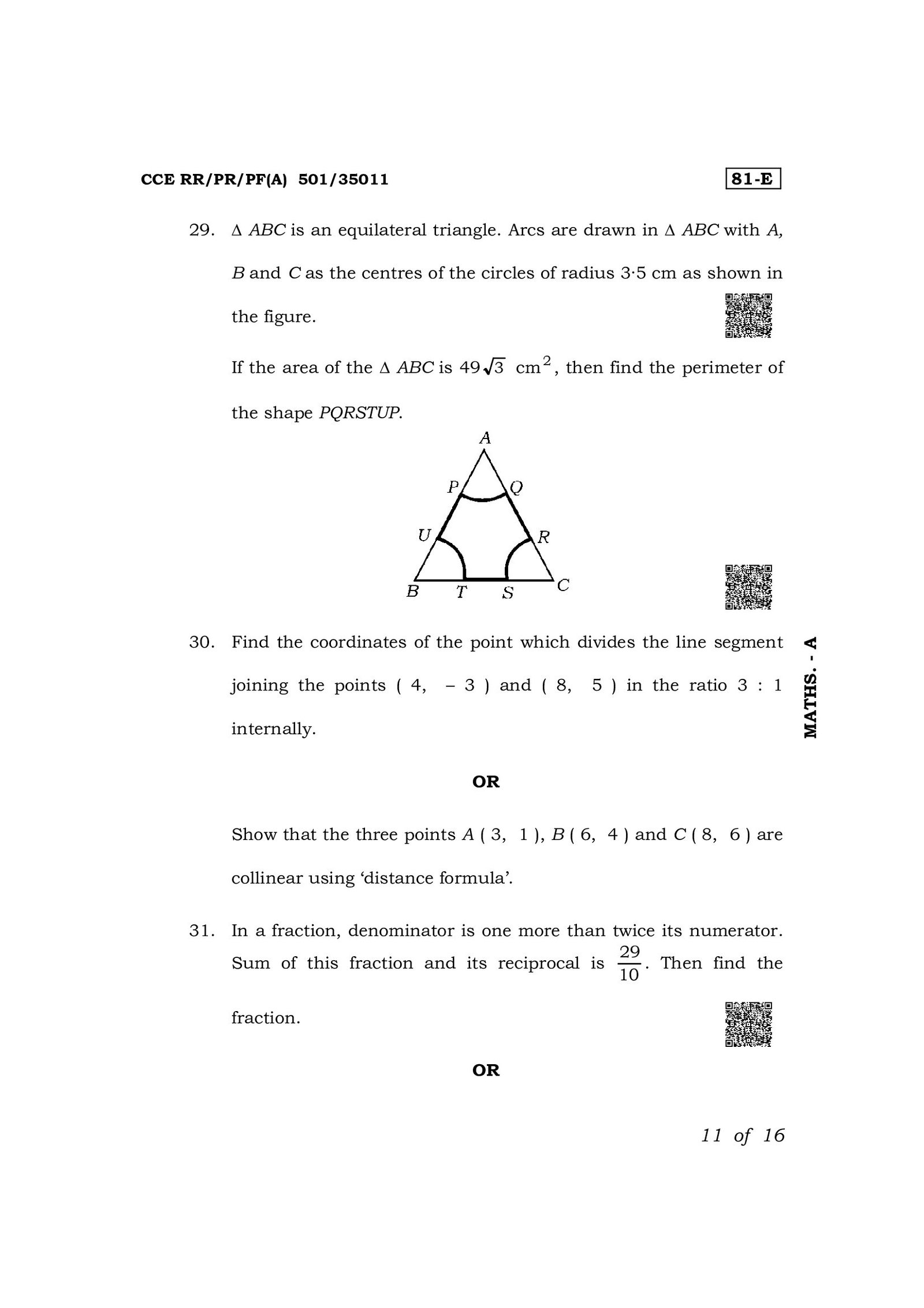
$\Delta ABC$ is an equilateral triangle. Arcs are drawn in $\Delta ABC$ with $A, B$ and $C$ as the centres of the circles of radius 3.5 cm as shown in the figure. If the area of the $\Delta ABC$ is $49\sqrt{3} \text{ cm}^2$, then find the perimeter of the shape $PQRSTUP$.
Q30
long answer
3 marks
Find the coordinates of the point which divides the line segment joining the points $(4, -3)$ and $(8, 5)$ in the ratio 3 : 1 internally. OR Show that the three points $A(3, 1), B(6, 4)$ and $C(8, 6)$ are collinear using ‘distance formula’.
Q31
long answer
3 marks
In a fraction, denominator is one more than twice its numerator. Sum of this fraction and its reciprocal is $\frac{29}{10}$. Then find the fraction. OR Some students planned to visit a museum. The total cost of food for them was Rs. 300. But 4 of them were unable to visit the museum and therefore the cost of food for each student was increased by Rs. 20. Find the number of students who visited the museum.
Q32
long answer
3 marks
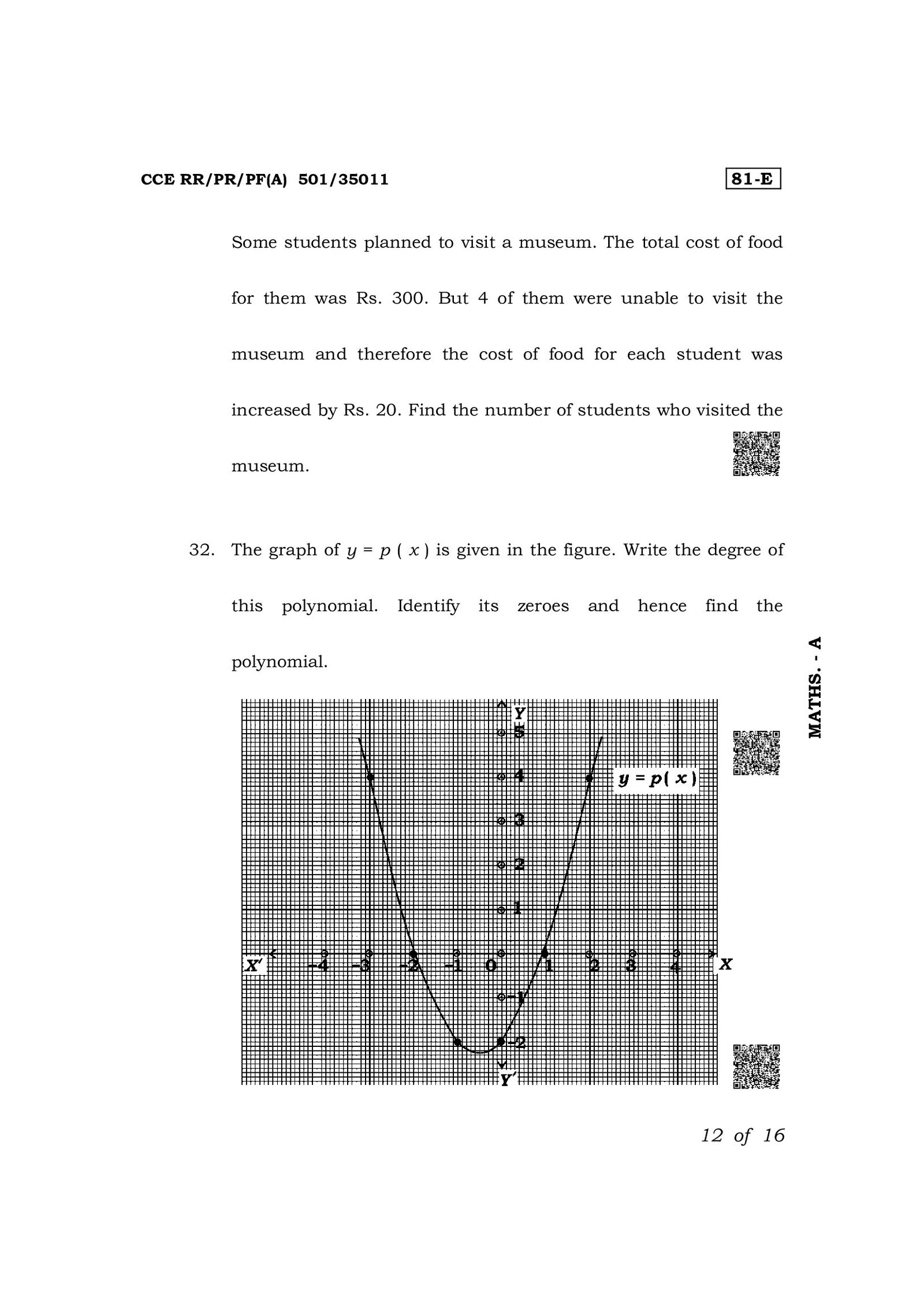
The graph of $y = p(x)$ is given in the figure. Write the degree of this polynomial. Identify its zeroes and hence find the polynomial.
Q33
long answer
3 marks
In $\Delta ABC$, a line is drawn parallel to $BC$. Let this line intersect $AB$ at $P$ and $AC$ at $Q$. Draw the figure and prove that $\Delta APQ \sim \Delta ABC$.
Q34
long answer
4 marks
Find the solution of the given pair of linear equations by graphical method:
$x + 2y = 8$
$x + y = 6$
Q35
long answer
4 marks
In an Arithmetic progression 7th term is five times its 2nd term and the 5th term is 1 less than twice the 3rd term. Write the Arithmetic progression. Find the 15th term of this progression using formula.
Q36
long answer
4 marks
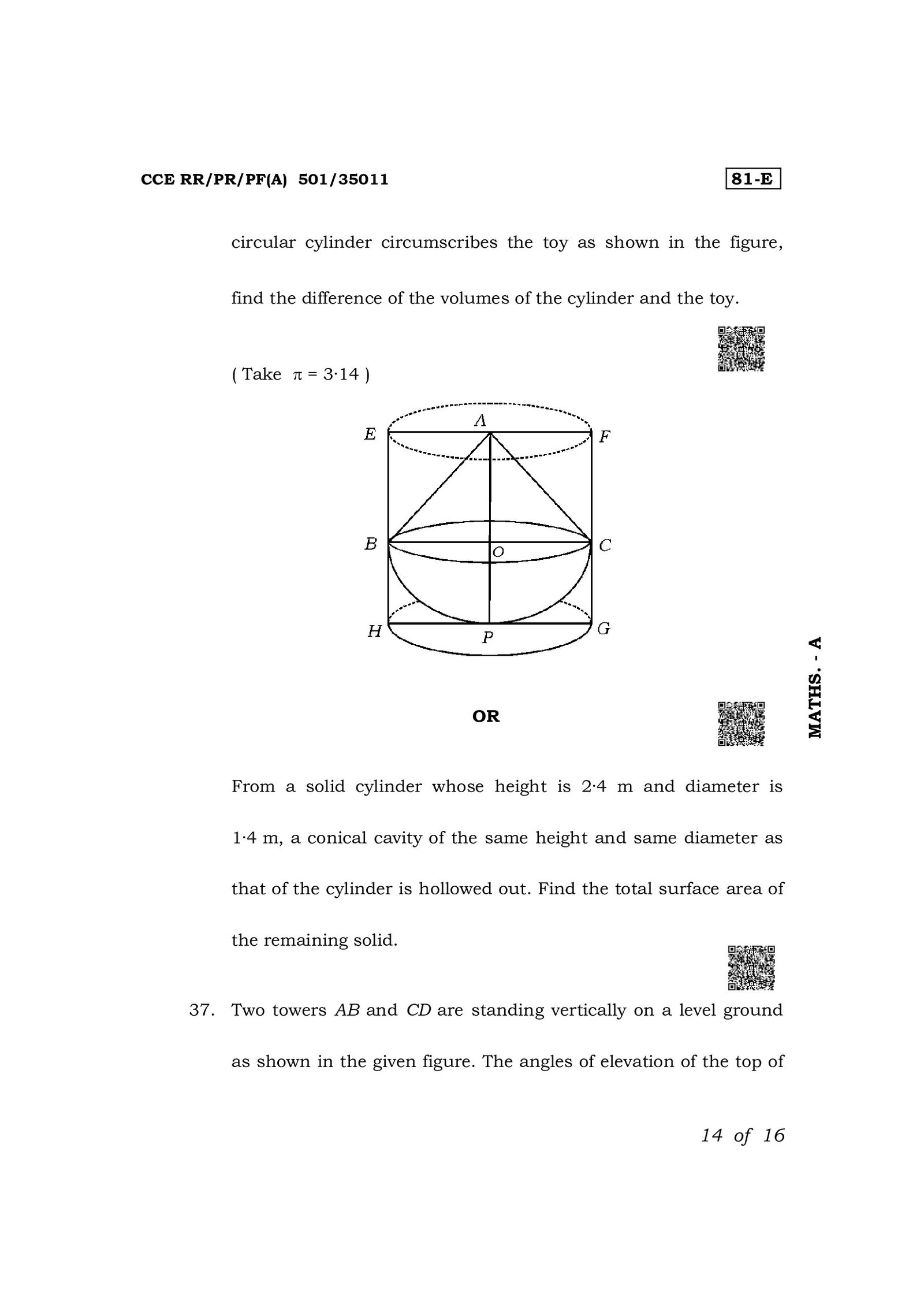
A solid toy is in the form of a hemisphere surmounted by a right circular cone. The height of the cone is 2 cm and the diameter of the base is 4 cm. Determine the volume of the toy. If a right circular cylinder circumscribes the toy as shown in the figure, find the difference of the volumes of the cylinder and the toy. (Take $\pi = 3.14$) OR From a solid cylinder whose height is 2.4 m and diameter is 1.4 m, a conical cavity of the same height and same diameter as that of the cylinder is hollowed out. Find the total surface area of the remaining solid.
Q36
long answer
4 marks
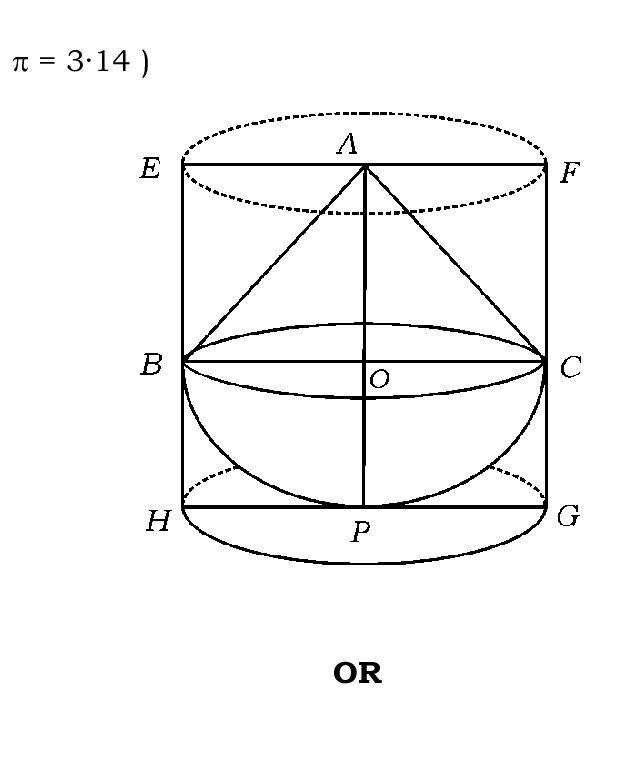
A solid toy is in the form of a hemisphere surmounted by a right circular cone. The height of the cone is 2 cm and the diameter of the base is 4 cm. Determine the volume of the toy. If a right circular cylinder circumscribes the toy as shown in the figure, find the difference of the volumes of the cylinder and the toy. ( Take $\pi = 3.14$ )
Q37
long answer
4 marks
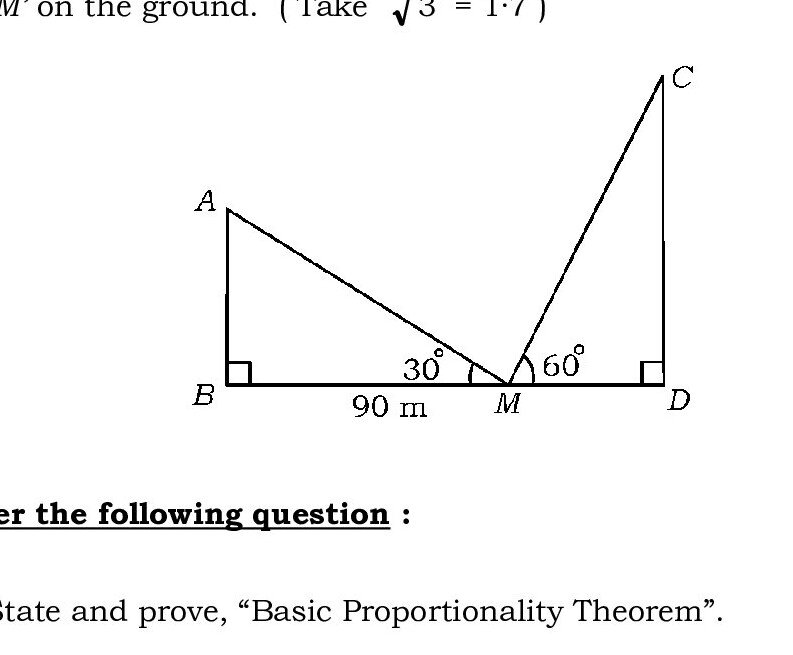
Two towers AB and CD are standing vertically on a level ground as shown in the given figure. The angles of elevation of the top of the towers AB and CD from a point ‘M’ on the line BD joining the foot of the towers are found to be $30^{\circ}$ and $60^{\circ}$ respectively. The distance of the foot of the tower AB from the point ‘M’ is $90\text{ m}$. The height of the tower CD is double the height of the tower AB. Calculate the height of the two towers, distance between the towers and also distance from the top of the towers to the point ‘M’ on the ground. ( Take $\sqrt{3} = 1.7$ )
Q38
long answer
4 marks
From a solid cylinder whose height is $2.4\text{ m}$ and diameter is $1.4\text{ m}$, a conical cavity of the same height and same diameter as that of the cylinder is hollowed out. Find the total surface area of the remaining solid.
Q38
long answer
5 marks
State and prove, “Basic Proportionality Theorem”. [ “Thales Theorem” ]
