The first 5 questions are solved below. Log in as a CLASS 10th student to reveal solutions for the rest of this paper.
Log In →
Q1
mcq
1 mark
The degree of the polynomial $p(x) = x^{3} - 7x^{2} + 5x + 1$ is
Correct Answer: C —
Solution
The degree of a polynomial is the highest power of the variable present in the expression. In $p(x) = x^{3} - 7x^{2} + 5x + 1$, the highest power is 3. Thus, the degree is 3.
Q2
mcq
1 mark
The roots of the equation $(x + 2)(x - 3) = 0$ are
-
A.
$-2$ and $-3$
-
B.
$-2$ and $3$
-
C.
$2$ and $3$
-
D.
$2$ and $-3$
Correct Answer: B —
Solution
For the equation $(x + 2)(x - 3) = 0$, the roots are found by setting each factor equal to zero: $x + 2 = 0 \implies x = -2$ and $x - 3 = 0 \implies x = 3$. Therefore, the roots are $-2$ and $3$.
Q3
mcq
1 mark
The formula to find the sum of first 'n' natural numbers is
-
A.
$S_{n} = \frac{n}{2}$
-
B.
$S_{n} = n(n + 1)$
-
C.
$S_{n} = n^{2}$
-
D.
$S_{n} = \frac{n(n + 1)}{2}$
Correct Answer: D —
Solution
The sum of the first 'n' natural numbers is given by the arithmetic series formula $S_{n} = \frac{n(n + 1)}{2}$. This is a standard formula derived from the sum of an arithmetic progression with first term $a=1$ and common difference $d=1$.
Q4
mcq
1 mark
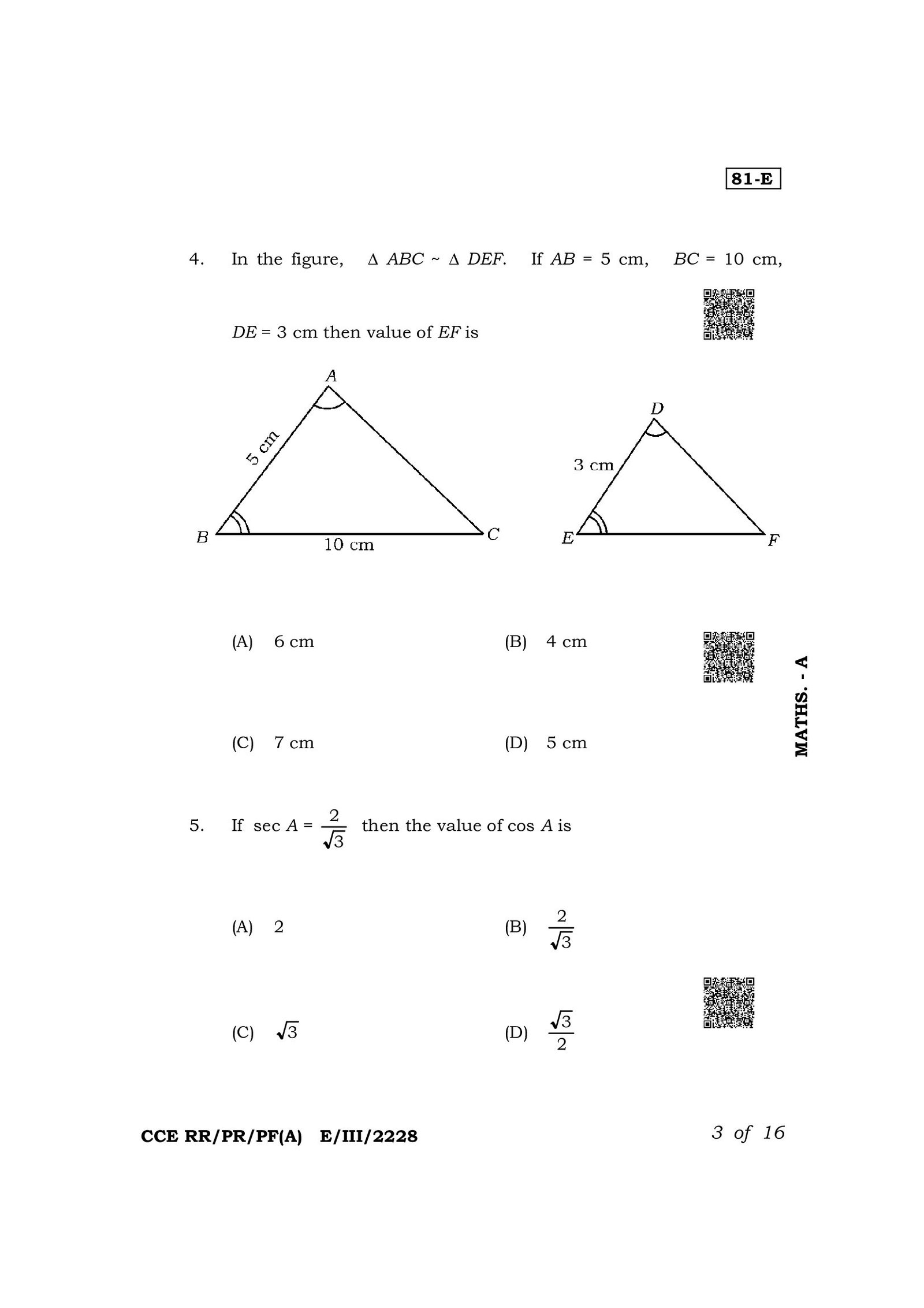
In the figure, $\Delta ABC \sim \Delta DEF$. If $AB = 5$ cm, $BC = 10$ cm, $DE = 3$ cm then value of $EF$ is
-
A.
6 cm
-
B.
4 cm
-
C.
7 cm
-
D.
5 cm
Correct Answer: A —
Solution
Since $\Delta ABC \sim \Delta DEF$, the ratio of their corresponding sides must be equal: $\frac{AB}{DE} = \frac{BC}{EF}$. Substituting the given values: $\frac{5}{3} = \frac{10}{EF}$. Solving for $EF$: $5 \times EF = 10 \times 3 \implies 5 \times EF = 30 \implies EF = \frac{30}{5} = 6$ cm.
Q5
mcq
1 mark
If $\sec A = \frac{2}{\sqrt{3}}$ then the value of $\cos A$ is
-
A.
2
-
B.
$\frac{2}{\sqrt{3}}$
-
C.
$\sqrt{3}$
-
D.
$\frac{\sqrt{3}}{2}$
Correct Answer: D —
Solution
Since $\cos A$ is the reciprocal of $\sec A$, we have $\cos A = \frac{1}{\sec A}$. Given $\sec A = \frac{2}{\sqrt{3}}$, therefore $\cos A = \frac{1}{2/\sqrt{3}} = \frac{\sqrt{3}}{2}$.
Q6
mcq
1 mark
The formula to find the total surface area of a solid hemisphere of radius 'r' is
-
A.
$\pi r^{2}$
-
B.
$2\pi r^{2}$
-
C.
$3\pi r^{2}$
-
D.
$4\pi r^{2}$
Q7
mcq
1 mark
Diagonals of a parallelogram bisect each other at the point $(2, -3)$. If the coordinates of the point of one end of a diagonal are $(1, 4)$ then the coordinates of the point of the other end of the same diagonal are
-
A.
$(3, 10)$
-
B.
$(3, -10)$
-
C.
$(-3, 10)$
-
D.
$(-3, -10)$
Q8
mcq
1 mark
If $P(E) = 0.05$, then the probability of 'not E' is
-
A.
0.95
-
B.
0.05
-
C.
1
-
D.
0.9
Q9
short answer
1 mark
How many solutions does the pair of linear equations $3x + 5y + 8 = 0$ and $6x + 10y + 16 = 0$ have?
Q10
short answer
1 mark
Find the zeroes of the polynomial $p(x) = x^{2} - 5$.
Q11
short answer
1 mark
Write the quadratic equation $ax^{2} + c = -bx$ in the standard form.
Q12
short answer
1 mark
The nth term of an arithmetic progression is $2n + 3$. Find the common difference of the progression.
Q13
short answer
1 mark
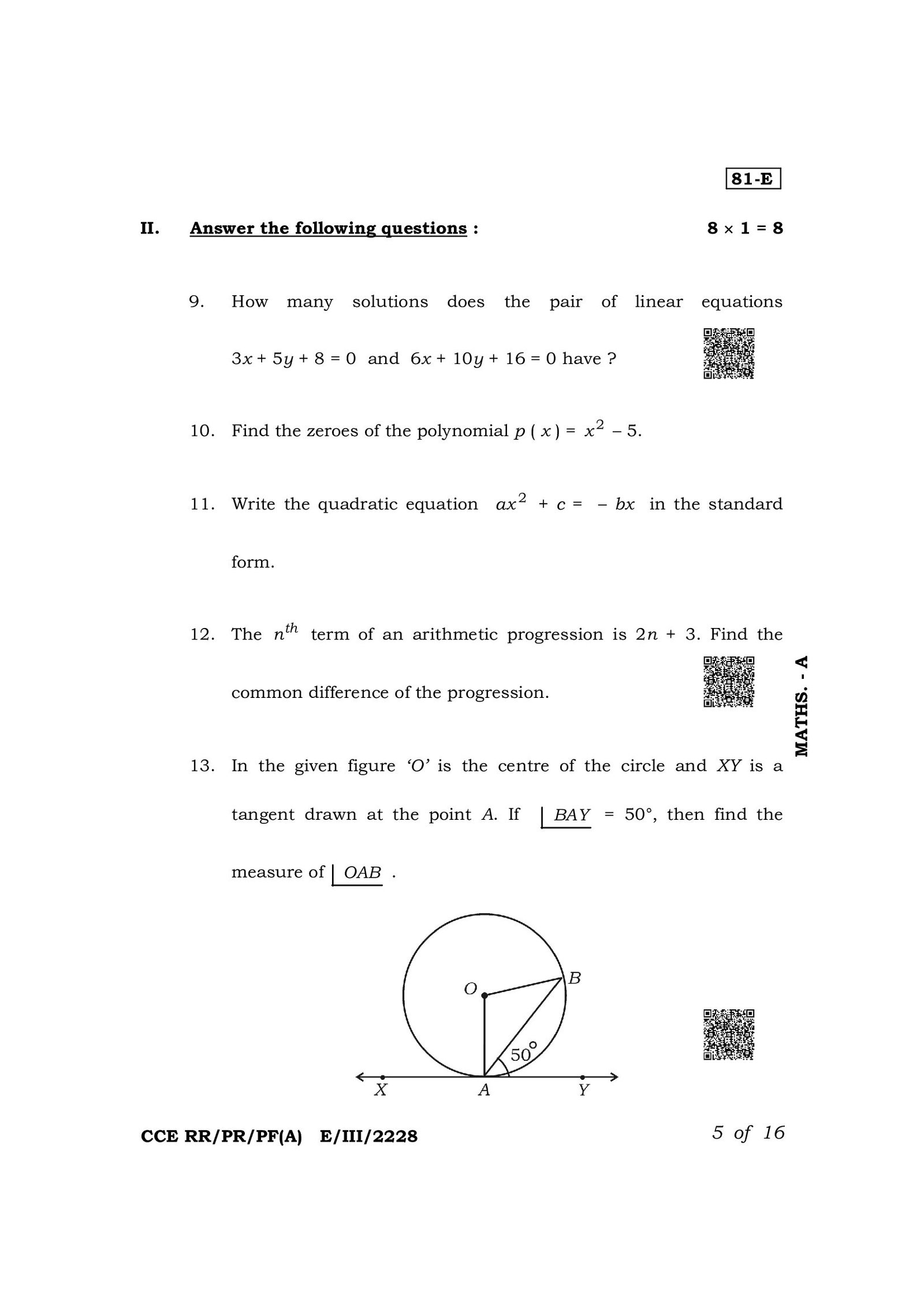
In the given figure 'O' is the centre of the circle and XY is a tangent drawn at the point A. If $\angle BAY = 50^{\circ}$, then find the measure of $\angle OAB$.
Q14
short answer
1 mark
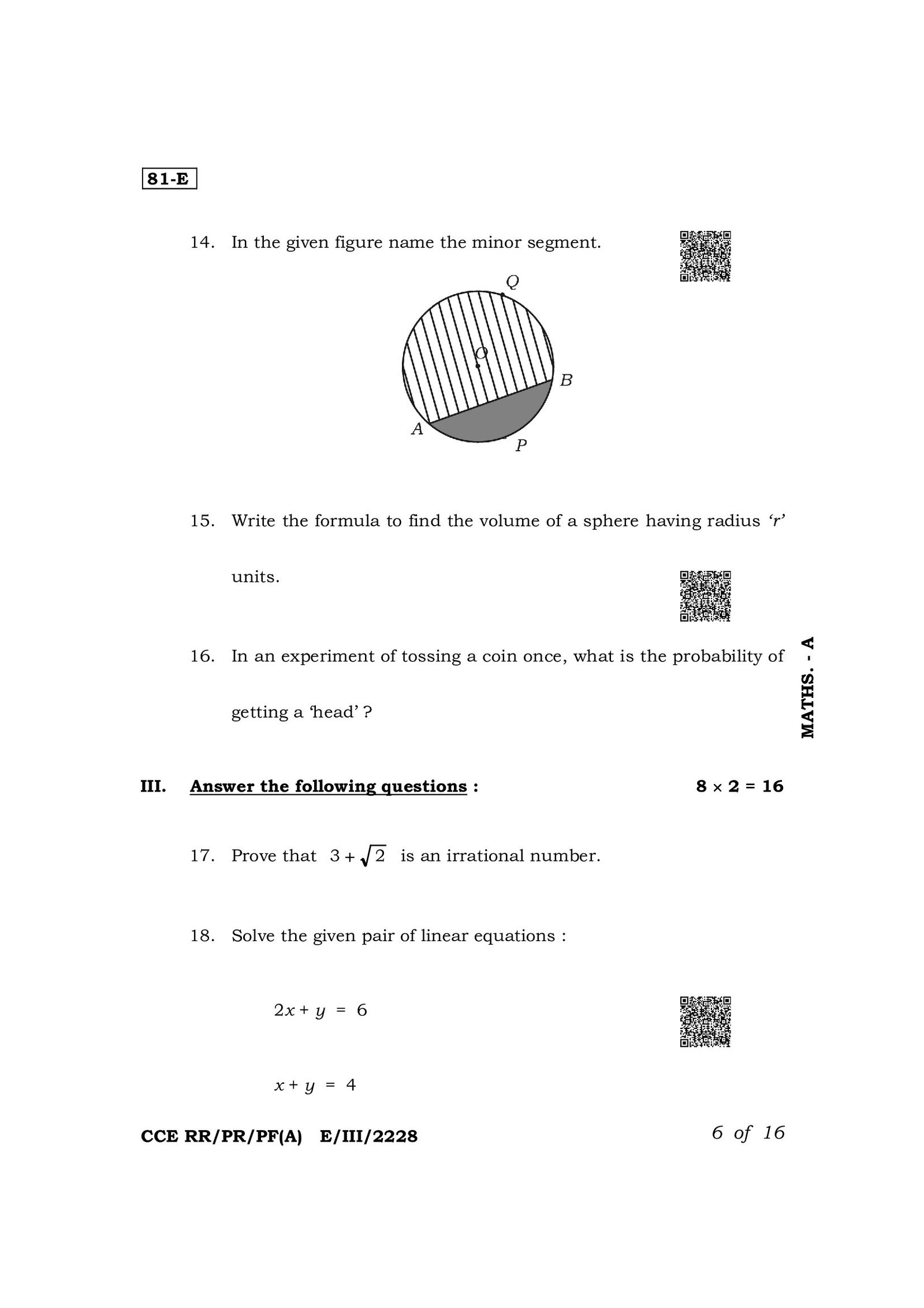
In the given figure name the minor segment.
Q15
short answer
1 mark
Write the formula to find the volume of a sphere having radius 'r' units.
Q16
short answer
1 mark
In an experiment of tossing a coin once, what is the probability of getting a 'head'?
Q17
short answer
2 marks
Prove that $3 + \sqrt{2}$ is an irrational number.
Q18
short answer
2 marks
Solve the given pair of linear equations: $2x + y = 6$, $x + y = 4$
Q19
short answer
2 marks
Find the roots of the quadratic equation $x^{2} + 10x + 21 = 0$.
Q20
short answer
2 marks
Find the value of the discriminant of the quadratic equation $x^{2} + 6x + 9 = 0$ and write the nature of roots.
Q20
short answer
2 marks
Find the sum of first 16 terms of the arithmetic progression $1, 5, 9, ...$ using formula.
Q21
short answer
2 marks
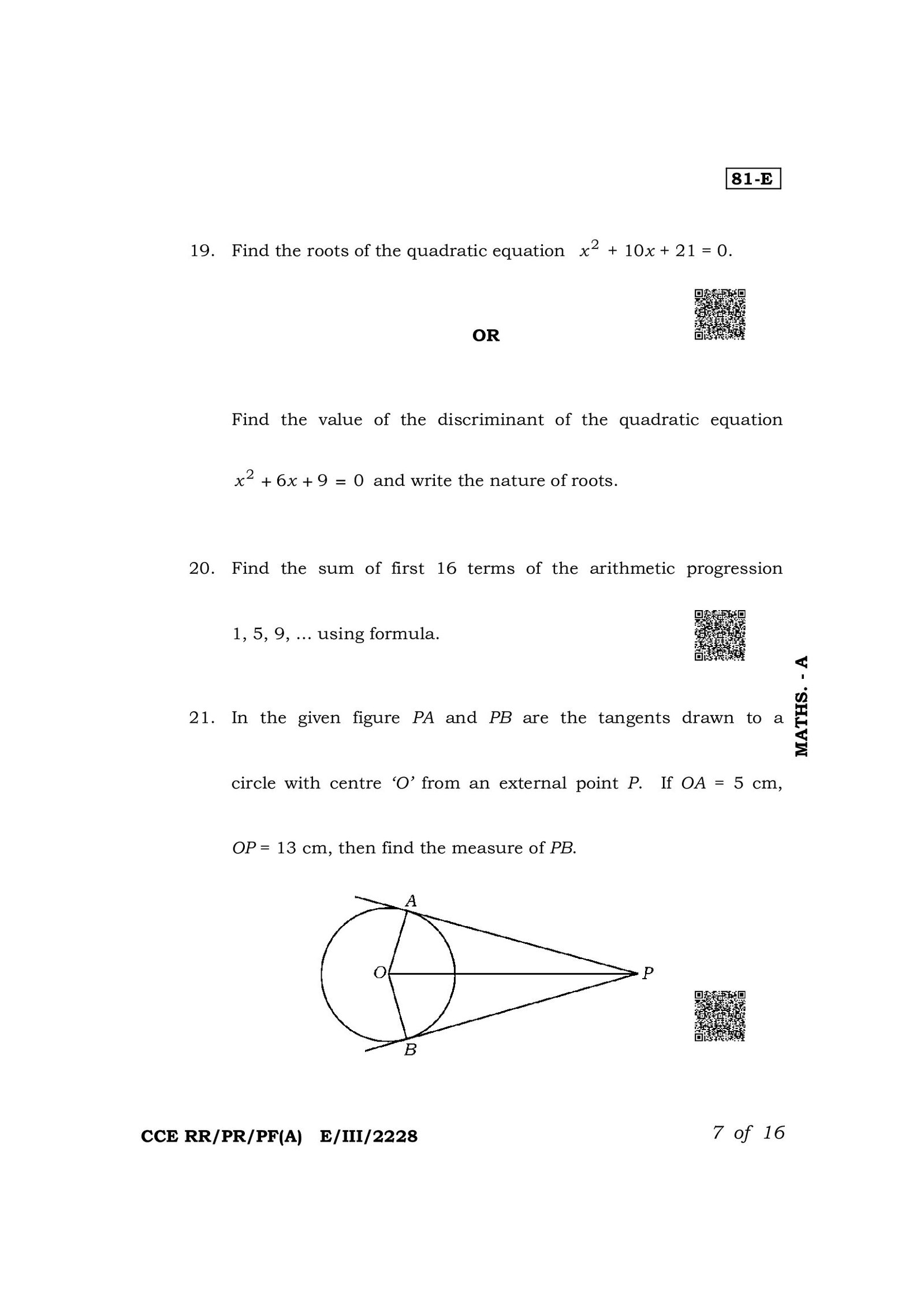
In the given figure PA and PB are the tangents drawn to a circle with centre 'O' from an external point P. If $OA = 5$ cm, $OP = 13$ cm, then find the measure of $PB$.
Q22
short answer
2 marks
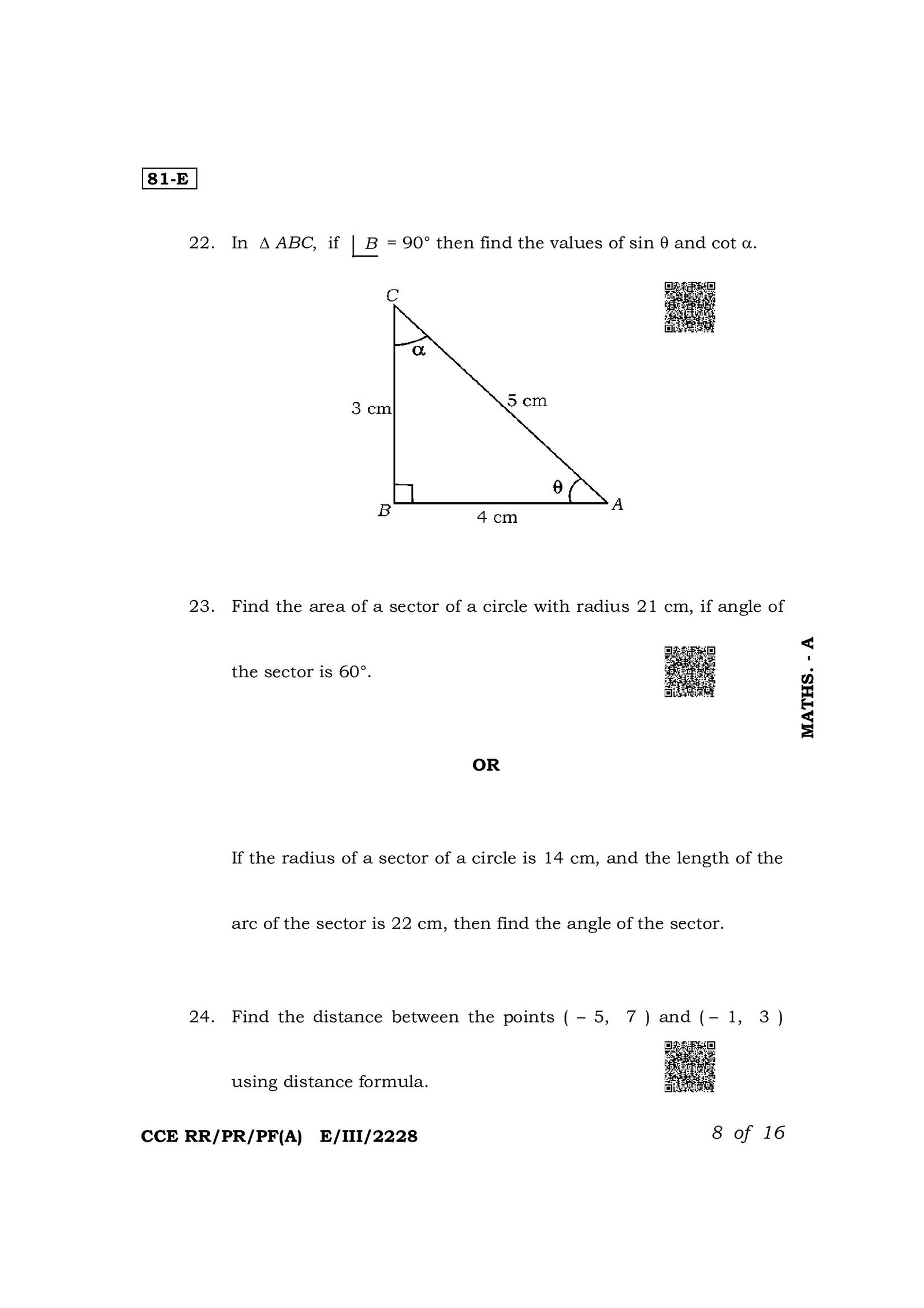
In $\Delta ABC$, if $\angle B = 90^{\circ}$ then find the values of $\sin \theta$ and $\cot \alpha$.
Q23
short answer
2 marks
Find the area of a sector of a circle with radius 21 cm, if angle of the sector is $60^{\circ}$.
Q24
short answer
2 marks
Find the distance between the points $(-5, 7)$ and $(-1, 3)$ using distance formula.
Q25
short answer
2 marks
If the radius of a sector of a circle is 14 cm, and the length of the arc of the sector is 22 cm, then find the angle of the sector.
Q25
long answer
3 marks
Find the LCM and HCF of the numbers 510 and 92 by prime factorization method and also verify that the product of LCM and HCF of those numbers is equal to the product of the numbers.
Q26
long answer
3 marks
Find the zeroes of the quadratic polynomial $p(x) = x^2 + 7x + 10$ and verify the relationship between the zeroes and the coefficients.
Q26
long answer
3 marks
If the sum and product of the zeroes of a quadratic polynomial are – 6 and 8 respectively, then find the quadratic polynomial, also find the zeroes of the polynomial.
Q27
long answer
3 marks
Denominator of a fraction is 2 more than its numerator. If the sum of the fraction and its reciprocal is $\frac{34}{15}$, then find the fraction.
Q28
long answer
3 marks
In $\Delta ABC$, X and Y are any points on AB and AC respectively such that $\angle AYX = \angle ABC$. Prove that $\frac{AY}{AB} = \frac{YX}{BC}$.
Q28
long answer
3 marks
ABC is an equilateral triangle. AD is the perpendicular drawn to BC. Prove that $\Delta ABD \sim \Delta ACD$.
Q29
long answer
3 marks
Prove that “The lengths of tangents drawn from an external point to a circle are equal”.
Q30
long answer
3 marks
Evaluate : $\frac{\sin 30^\circ + \tan 45^\circ - \text{cosec } 60^\circ}{\sec 30^\circ + \cos 60^\circ + \cot 45^\circ}$
Q30
long answer
3 marks
Prove that : $\sqrt{\frac{1 + \cos ec A}{1 - \cos ec A}} = \sec A + \tan A$.
Q31
long answer
3 marks
Find the ratio in which y-axis divides the line segment joining the points $( 5, – 6 )$ and $( – 1, – 4 )$. Find the co-ordinates of the point of intersection also.
Q32
long answer
3 marks
The marks distribution of 30 students in a mathematics examination are given in the table below. Find the mode of this data. (Table omitted)
Q32
long answer
3 marks
The following frequency distribution gives the monthly consumption of electricity of 68 consumers of a locality. Find the median of this data : (Table omitted)
Q33
long answer
3 marks
A box contains 5 red marbles, 8 white marbles and 4 green marbles. One marble is taken out of the box at random. What is the probability that the marble taken out will be i) a red marble ii) not a green marble?
Q34
long answer
4 marks
Find the solution of the given pair of linear equations by graphical method :
$2x + y = 8$
$x + y = 5$
Q35
long answer
4 marks
Prove that “If a line is drawn parallel to one side of a triangle to intersect the other two sides in distinct points, the other two sides are divided in the same ratio”.
Q36
long answer
4 marks
An arithmetic progression having ‘positive common difference’ consists of 20 terms. The sum of its first term and last term is 59. The difference of its 8th term and 6th term is 6. Write the arithmetic progression and also calculate the 10th term of the progression.
Q36
long answer
4 marks
In an arithmetic progression, the sum of first three terms is 24. The sum of 2nd, 4th and 6th terms is zero. Find which term of this arithmetic progression is – 24.
Q37
long answer
4 marks
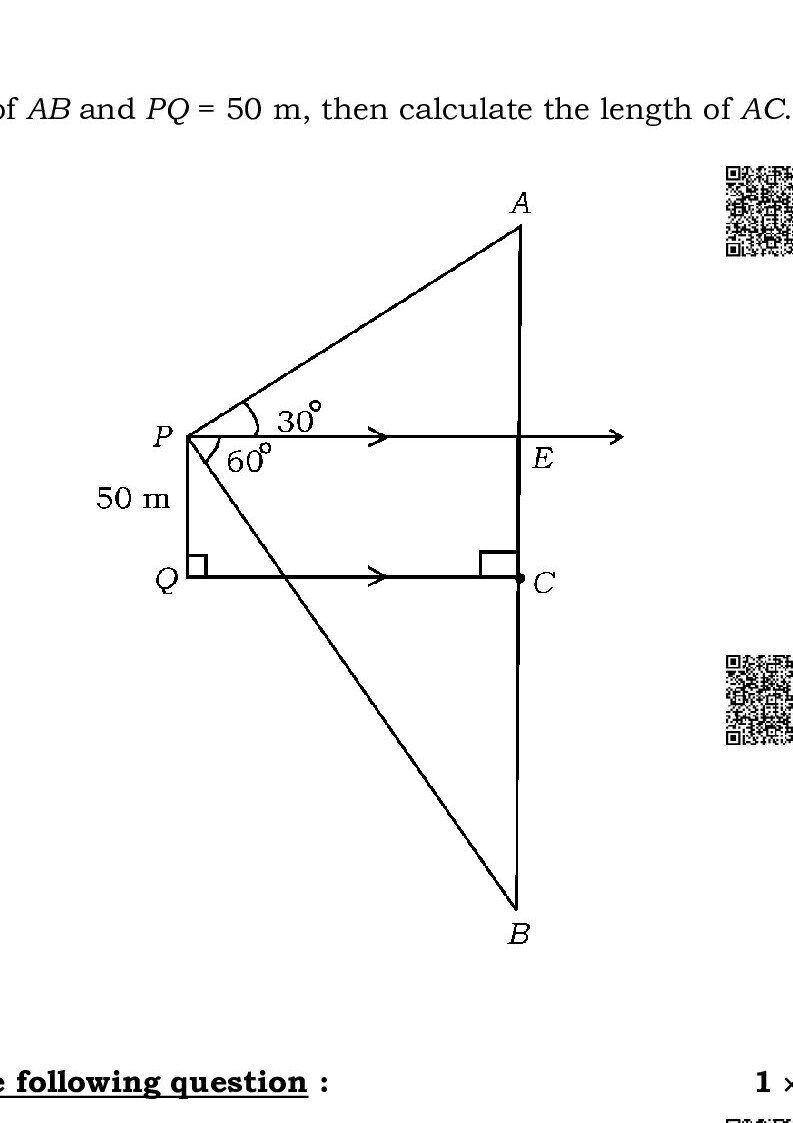
In the given figure the angle of elevation from point ‘P’ to the point ‘A’ is found to be $30^\circ$ and the angle of depression to the point ‘B’ from the same point is found to be $60^\circ$. If ‘C’ is the mid-point of AB and PQ = 50 m, then calculate the length of AC.
Q38
long answer
5 marks
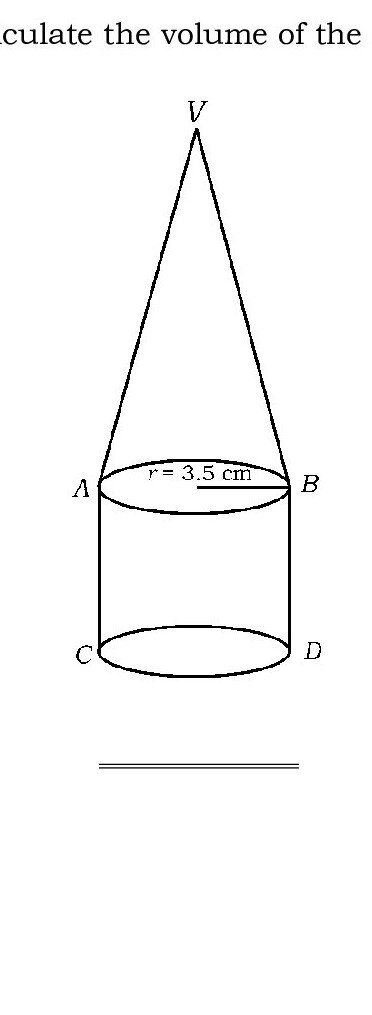
A metallic solid is formed by surmounting a right circular cone on a cylinder as shown in the figure. The radius of the base of cone and cylinder is equal to 3.5 cm. The curved surface area of cone...
Q38
long answer
A metallic solid is formed by surmounting a right circular cone on a cylinder as shown in the figure. The radius of the base of cone and cylinder is equal to 3·5 cm. The curved surface area of cone is equal to curved surface area of cylinder and the volume of cone is 154 cm^3. Calculate the volume of the metallic solid.