The first 5 questions are solved below. Log in as a CLASS 10th student to reveal solutions for the rest of this paper.
Log In →
Q1
mcq
1 mark
The probability of an impossible event is
Correct Answer: B —
Solution
The probability of an impossible event is always 0. A) 1 represents a sure event, while C and D are outside the valid probability range [0, 1].
Q2
mcq
1 mark
If $\text{cosec } \theta = \frac{5}{3}$, then the value of $\sin \theta$ is
-
A.
$\frac{3}{5}$
-
B.
$\frac{5}{4}$
-
C.
$\frac{3}{4}$
-
D.
$\frac{3}{5}$
Correct Answer: A —
Solution
We know that $\sin \theta = \frac{1}{\text{cosec } \theta}$. Given $\text{cosec } \theta = \frac{5}{3}$, therefore $\sin \theta = \frac{1}{5/3} = \frac{3}{5}$. Hence, option A is correct.
Q3
mcq
1 mark
The quadratic equation among the following is
-
A.
$x^{-2} - 3x + 2 = 0$
-
B.
$2x + 3 = 0$
-
C.
$x^2 - 5x + 6 = 0$
-
D.
$2x^3 + 7x + 1 = 0$
Correct Answer: C —
Solution
A quadratic equation must be of the form $ax^2 + bx + c = 0$ where $a \neq 0$. In $x^2 - 5x + 6 = 0$, the highest power of $x$ is 2. Option A has a negative exponent, B is linear, and D is cubic.
Q4
mcq
1 mark
In the pair of linear equations $a_1x + b_1y + c_1 = 0$ and $a_2x + b_2y + c_2 = 0$ if $\frac{a_1}{a_2} \neq \frac{b_1}{b_2}$, then the equations
-
A.
have unique solution
-
B.
do not have any solution
-
C.
have three solutions
-
D.
have infinitely many solutions
Correct Answer: A —
Solution
For a pair of linear equations, if the ratio of the coefficients $\frac{a_1}{a_2} \neq \frac{b_1}{b_2}$, the lines intersect at exactly one point, meaning the system has a unique solution.
Q5
mcq
1 mark
The volume of a sphere of radius 'r' units is
-
A.
$\frac{2}{3} \pi r^2$ cubic units
-
B.
$\frac{1}{3} \pi r^3$ cubic units
-
C.
$\frac{4}{3} \pi r^3$ cubic units
-
D.
$\frac{4}{3} \pi r^2$ cubic units
Correct Answer: C —
Solution
The standard formula for the volume of a sphere with radius $r$ is derived as $V = \frac{4}{3} \pi r^3$ cubic units.
Q6
mcq
1 mark
In an arithmetic progression if $a_n = 2n + 1$, then the common difference of the arithmetic progression is
Q7
mcq
1 mark
The coordinates of the mid-point of the line segment joining the points $(2, 3)$ and $(4, 7)$ are
-
A.
$(3, 5)$
-
B.
$(5, 3)$
-
C.
$(1, 2)$
-
D.
$(6, 10)$
Q8
mcq
1 mark
In trapezium ABCD, AB || DC and P, Q are points on the sides AD and BC respectively. If PQ || DC, PD = 18 cm, BQ = 35 cm and QC = 15 cm, then length of AD is
-
A.
5 cm
-
B.
50 cm
-
C.
57 cm
-
D.
60 cm
Q9
short answer
1 mark
State the ‘fundamental theorem of arithmetic’.
Q10
short answer
1 mark
If the first term of an arithmetic progression is ‘a’ and the last term is ‘$a_n$’, then write the formula to find the sum of the first ‘n’ terms of the arithmetic progression.
Q11
short answer
1 mark
Write the degree of a cubic polynomial.
Q12
short answer
1 mark
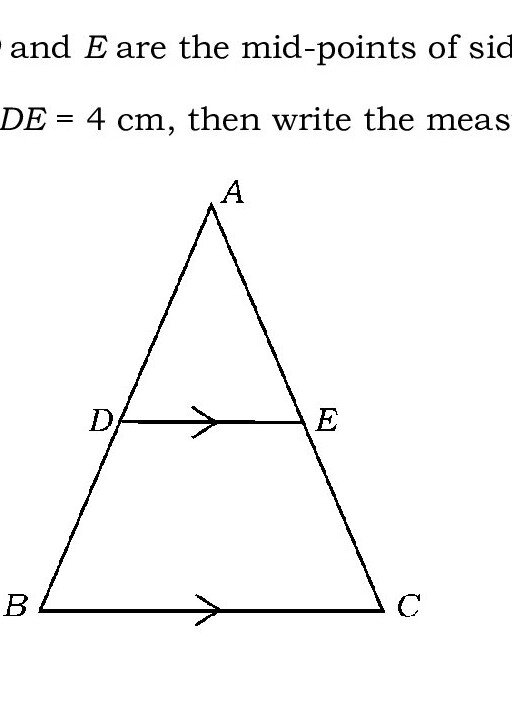
In the figure, D and E are the mid-points of sides AB and AC respectively. If DE = 4 cm, then write the measure of BC.
Q13
short answer
1 mark
Write the formula to find the total surface area of a cube of edge of length ‘a’ units.
Q14
short answer
1 mark
If the lines represented by the equations $4x + py + 8 = 0$ and $4x + 4y + 2 = 0$ are parallel, then find the value of ‘p’.
Q15
short answer
1 mark
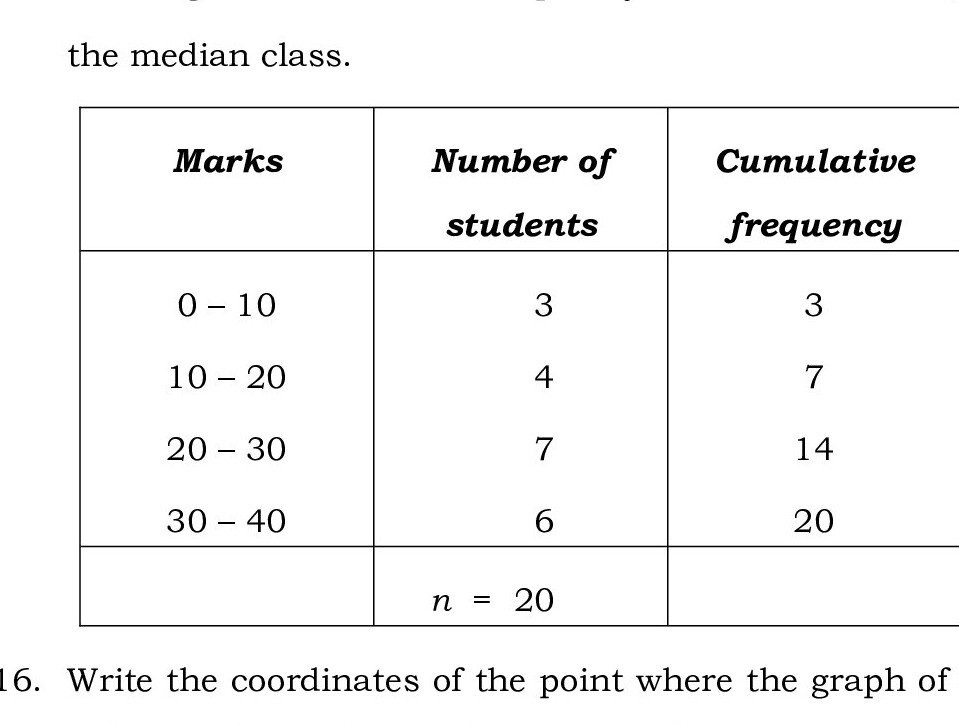
In the given cumulative frequency distribution table, write the median class.
Q15
short answer
In the given cumulative frequency distribution table, write the median class.
Marks | Number of students | Cumulative frequency
0 – 10 | 3 | 3
10 – 20 | 4 | 7
20 – 30 | 7 | 14
30 – 40 | 6 | 20
n = 20
Q16
short answer
1 mark
Write the coordinates of the point where the graph of linear polynomial $p(x) = x + 5$ intersects the x-axis.
Q17
short answer
2 marks
Prove that $5 + \sqrt{3}$ is an irrational number.
Q18
short answer
2 marks
Solve the given pair of linear equations by elimination method: $2x + y = 8$, $3x - y = 7$.
Q19
short answer
2 marks
Find the sum of the first 20 terms of the arithmetic progression 5, 8, 11, .......... using formula.
Q19
short answer
2 marks
Find the number of terms of the arithmetic progression 100, 96, 92, .... 12 using formula.
Q20
short answer
2 marks
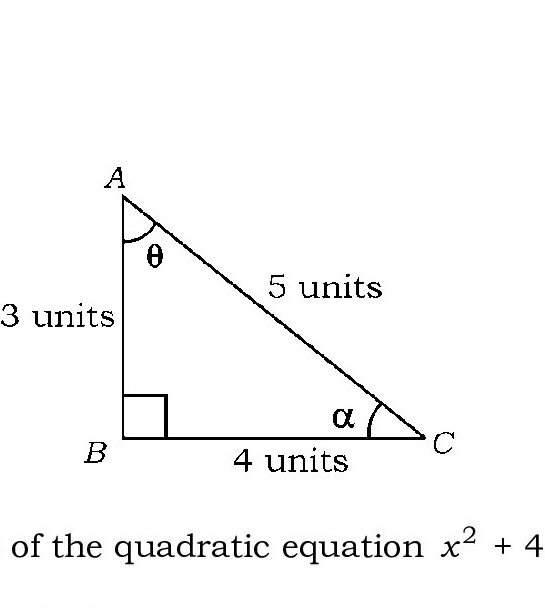
In the figure, $\angle ABC = 90^\circ$. Write the values of the following: (i) $\sin \alpha$ (ii) $\tan \theta$
Q21
short answer
2 marks
Find the roots of the quadratic equation $x^2 + 4x - 60 = 0$ by factorisation method.
Q21
short answer
2 marks
Find the discriminant of the quadratic equation $2x^2 + 3x – 7 = 0$ and write the nature of the roots.
Q22
short answer
2 marks
Find the HCF of 135 and 75 by prime factorisation method.
Q22
short answer
2 marks
Find the HCF of 135 and 75 by prime factorisation method and then find the LCM of HCF (135, 75) and 20.
Q23
short answer
2 marks
$A(x, 5)$ and $B(2, y)$ are the coordinates of the end points of the diameter $AB$ of a circle with centre $P(4, 3)$. Find the values of '$x$' and '$y$'. Also find the length of the diameter of the circle.
Q24
long answer
3 marks
$AB$ is a tangent to the circle with centre '$O$' and '$A$' is the point of contact. If $\angle OBA = 45^\circ$, then prove that $\Delta AOB$ is an isosceles triangle. If $OB = 5\sqrt{2}\text{ cm}$, then find the radius of the circle.
Q25
long answer
3 marks
Find the zeroes of the quadratic polynomial $p(x) = x^2 – 2x – 8$ and verify the relationship between the zeroes and the coefficients.
Q26
long answer
3 marks
Prove that “The tangent at any point of a circle is perpendicular to the radius through the point of contact”.
Q27
long answer
3 marks
$\Delta ABC \sim \Delta PQR$. In $\Delta ABC, \angle A = 55^\circ, \angle C = 35^\circ$ and the sides of $\Delta ABC$ are in the ratio $3 : 4 : 5$. If the perimeter of $\Delta PQR$ is $60\text{ cm}$, then find the measure of sides and angles of $\Delta PQR$.
Q28
long answer
3 marks
Find the mean for the following data :
Class-interval | Frequency
0 – 10 | 4
10 – 20 | 9
20 – 30 | 15
30 – 40 | 14
40 – 50 | 8
Q29
long answer
3 marks
Prove that, $(\text{cosec } A – \sin A) (\sec A – \cos A) = \frac{1}{\tan A + \cot A}$
Q29
long answer
3 marks
Prove that, $\frac{\sec 60^\circ}{\cot 45^\circ} - \frac{2 \sin 90^\circ}{\cos 0^\circ} + \frac{\tan 45^\circ}{\text{cosec } 30^\circ} = \sin^2 45^\circ (\text{cosec}^2 45^\circ – \sec^2 0^\circ)$
Q30
long answer
3 marks
A hand fan is made up of cloth fixed in between the metallic wires. It is in the shape of a sector of a circle of radius $21\text{ cm}$ and of an angle $120^\circ$ as shown in the figure. Calculate the area of the cloth used and also find the total length of the metallic wire required to make such a fan.
Q30
long answer
3 marks
In the given figure, ‘$O$’ is the centre of the circle of radius $21\text{ cm}$. If $\angle AOB = 60^\circ$, then find the area of the segment $APB$. [ Take $\sqrt{3} = 1.73$ ]
Q31
long answer
3 marks
The perimeter of square $ABCD$ is $12\text{ m}$ less than the perimeter of the square $PQRS$. The sum of the areas of these two squares is $117\text{ m}^2$. Find the ratio of the area of the square $ABCD$ to the area of the square $PQRS$.
Q32
long answer
3 marks
In the figure, find the coordinates of the point which divides the line segment $AB$ internally in the ratio $1 : 2$ using section formula.
Q32
long answer
3 marks
Verify whether the points $A(1, 5), B(2, 4)$ and $C(9, – 3)$ are collinear with the help of ‘distance formula’.
Q33
long answer
3 marks
Two fair dice whose faces are numbered from 1 to 6 are rolled once. Find the probability
a) that the sum of the numbers on the top faces is 6
b) of getting a square number on one of the faces only.
Q34
long answer
4 marks
Find the solution of the given pair of linear equations by graphical method :
$x + 2y = 6$
$x + y = 5$
Q35
long answer
4 marks
The $7^{\text{th}}$ term of an arithmetic progression is four times its $2^{\text{nd}}$ term and the $12^{\text{th}}$ term is 2 more than thrice its $4^{\text{th}}$ term. Find the progression.
Q36
long answer
4 marks
Prove that, “If in two triangles, corresponding angles are equal, then their corresponding sides are in the same ratio (or proportion) and hence the two triangles are similar”.
Q36
long answer
4 marks
Prove that, “If one angle of a triangle is equal to one angle of the other triangle and the sides including these angles are proportional, then the two triangles are similar”.
Q37
long answer
4 marks
In the given figure, a rope is tightly stretched and tied from the top of a vertical pole on a level ground to a peg on the same level ground such that the length of the rope is $20\text{ m}$. The angle made by the rope with the ground is $30^\circ$. A circus artist climbs the rope, reaches the top of the pole and from there he observes that the angle of elevation of the top of another pole on the same ground to be $60^\circ$. If the distance of the foot of the longer pole from the peg is $30\text{ m}$, then find the height of this pole. [ Take $\sqrt{3} = 1.73$ ]
Q37
long answer
4 marks
A tower AB and a building DE are standing vertically on a level ground. The angles of elevation of the top of the tower from a point on the same ground and from the top of the building are found to be 30° and 60° respectively as shown in the figure. If the distance of the point from the foot of the tower is $30\sqrt{3}$ m and height of the building is 10 m, then find the distance ( BE ) between the foot of the tower and the building and also the distance between their tops ( AD ).
Q38
long answer
5 marks
From a solid cuboidal metallic block of dimensions 15 cm × 10 cm × 8 cm, three cylindrical depressions each having diameter 4.2 cm and height 6 cm are drilled out as shown in the figure. Find the total surface area and volume of the remaining metallic block.
Q38
long answer
5 marks
In a cylinder of height 24 cm and radius 10 cm, water is filled up to the height of 14.4 cm. A solid is made by placing a cone of slant height 10 cm and curved surface area 60 $\pi$ cm$^2$ on the hemisphere having the same radius as that of the cone. If this solid is completely immersed in the cylinder as shown in the figure, then find the rise in the water level in the cylinder. Also find the amount of water still to be filled in the cylinder so that the water level rises up to the brim of the cylinder. ( Take $\pi = 3.14$ )
