The first 5 questions are solved below. Log in as a CLASS 10th student to reveal solutions for the rest of this paper.
Log In →
Q1
mcq
1 mark
If the lines represented by the pair of linear equations $a_1x + b_1y + c_1 = 0$ and $a_2x + b_2y + c_2 = 0$ are coincident, then the correct relation among the following is
-
A.
$\frac{a_1}{a_2} = \frac{b_1}{b_2} = \frac{c_1}{c_2}$
-
B.
$\frac{a_1}{a_2} \neq \frac{b_1}{b_2} \neq \frac{c_1}{c_2}$
-
C.
$\frac{a_1}{a_2} = \frac{b_1}{b_2} \neq \frac{c_1}{c_2}$
-
D.
$\frac{a_1}{a_2} \neq \frac{b_1}{b_2}$
Correct Answer: A —
Solution
Two lines are coincident if they have infinitely many solutions, which occurs when their coefficients are in the same proportion: $\frac{a_1}{a_2} = \frac{b_1}{b_2} = \frac{c_1}{c_2}$. Option (c) represents parallel lines, (d) represents intersecting lines, and (b) is not a standard condition.
Q2
mcq
1 mark
The coordinates of the point ‘P’ which divides the line segment joining the points $A(x_1, y_1)$ and $B(x_2, y_2)$ internally in the ratio $1:1$ is,
-
A.
$\left(\frac{x_1 + x_2}{2}, \frac{y_1 + y_2}{2}\right)$
-
B.
$(x_1 + x_2, y_1 + y_2)$
-
C.
$(x_1 - x_2, y_1 - y_2)$
-
D.
$\left(\frac{x_1 - x_2}{2}, \frac{y_1 - y_2}{2}\right)$
Correct Answer: A —
Solution
The section formula for a point dividing the line in ratio $m:n$ is $\left(\frac{mx_2+nx_1}{m+n}, \frac{my_2+ny_1}{m+n}\right)$. For a midpoint ($1:1$), this simplifies to $\left(\frac{x_1+x_2}{2}, \frac{y_1+y_2}{2}\right)$.
Q3
mcq
1 mark
If $\sin \theta = \frac{5}{13}$, then the value of $\text{cosec } \theta$ is,
-
A.
$\frac{13}{12}$
-
B.
$\frac{5}{12}$
-
C.
$\frac{13}{5}$
-
D.
$\frac{12}{13}$
Correct Answer: C —
Solution
By definition, $\text{cosec } \theta$ is the reciprocal of $\sin \theta$. Since $\sin \theta = \frac{5}{13}$, then $\text{cosec } \theta = \frac{1}{\sin \theta} = \frac{13}{5}$.
Q4
mcq
1 mark
The surface area of a sphere of radius $7\text{ cm}$ is
-
A.
$77\text{ cm}^2$
-
B.
$154\text{ cm}^2$
-
C.
$308\text{ cm}^2$
-
D.
$616\text{ cm}^2$
Correct Answer: D —
Solution
The surface area of a sphere is $A = 4\pi r^2$. Substituting $r = 7\text{ cm}$ and $\pi \approx \frac{22}{7}$: $A = 4 \times \frac{22}{7} \times 7^2 = 4 \times 22 \times 7 = 616\text{ cm}^2$.
Q5
mcq
1 mark
If the $n^{\text{th}}$ term of an arithmetic progression $a_n = 3n - 2$, then its $9^{\text{th}}$ term is
-
A.
$-5$
-
B.
$25$
-
C.
$5$
-
D.
$-25$
Correct Answer: B —
Solution
Given $a_n = 3n - 2$. For the $9^{\text{th}}$ term, substitute $n = 9$: $a_9 = 3(9) - 2 = 27 - 2 = 25$.
Q6
mcq
1 mark
Which of the following can be the probability of an event?
-
A.
$\frac{3}{2}$
-
B.
$-1.5$
-
C.
$105\%$
-
D.
$0.7$
Q7
mcq
1 mark
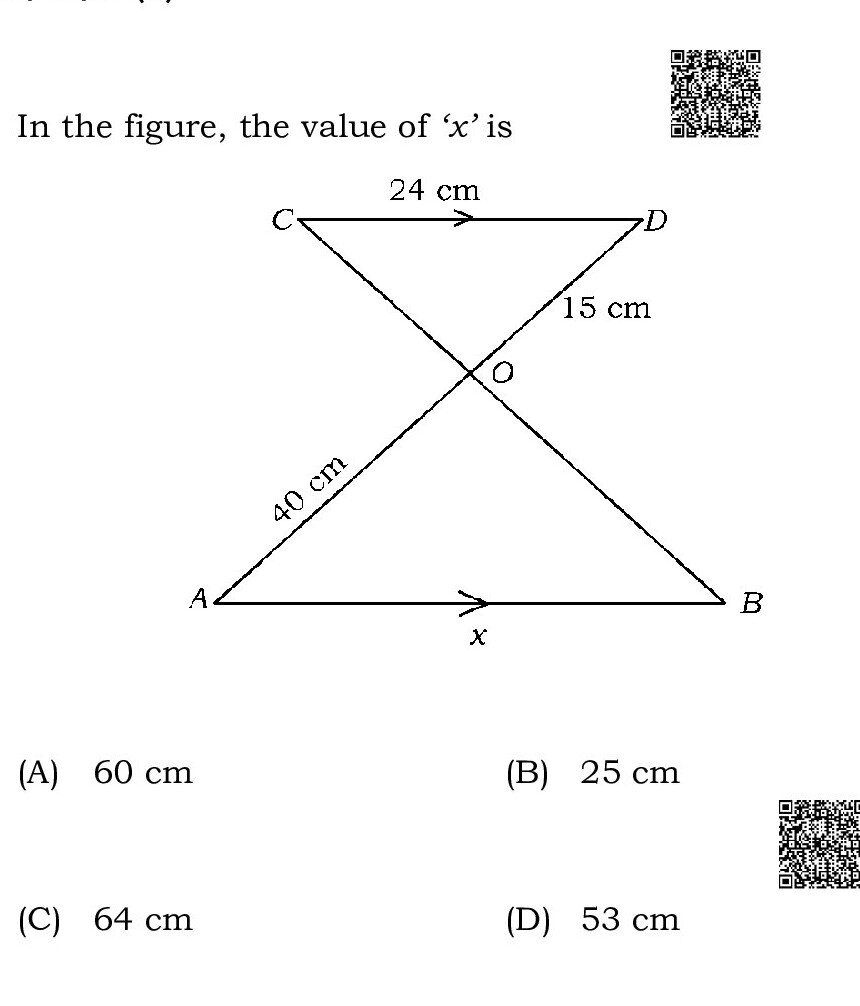
In the figure, the value of ‘x’ is
-
A.
$60\text{ cm}$
-
B.
$25\text{ cm}$
-
C.
$64\text{ cm}$
-
D.
$53\text{ cm}$
Q8
mcq
1 mark
If the sum of the zeroes of the polynomial $P(x) = kx^2 + 2x + 3k$ is equal to the product of its zeroes, then the value of ‘k’ is
-
A.
$\frac{2}{3}$
-
B.
$\frac{3}{4}$
-
C.
$-\frac{2}{3}$
-
D.
$-\frac{3}{4}$
Q9
short answer
1 mark
Write the degree of a cubic polynomial.
Q10
short answer
1 mark
How many solutions does the pair of linear equations in two variables have if they are inconsistent ?
Q11
short answer
1 mark
State Basic Proportionality theorem ( Thales theorem ).
Q12
short answer
1 mark
The circumference of the base of a cylinder is $10\text{ cm}$ and its height is $25\text{ cm}$. Find its curved surface area.
Q13
short answer
1 mark
Find the product of HCF and LCM of the numbers 15 and 20.
Q14
short answer
1 mark
If one of the roots of the quadratic equation $(x + 4)(x + 3) = 0$ is $-4$, then find the other root.
Q15
short answer
1 mark
If 6, $x$, 14 are in arithmetic progression, then find the value of ‘x’.
Q16
short answer
1 mark
If the mode and mean of a data is 7 and 8 respectively, then find the median.
Q17
long answer
2 marks
Prove that $6 + \sqrt{2}$ is an irrational number.
Q18
long answer
2 marks
Solve the given pair of linear equations by elimination method: $3x - y = 15$ and $2x - y = 5$
Q19
long answer
2 marks
Find the roots of the quadratic equation $2x^2 + x - 6 = 0$ by factorisation method.
Q19
long answer
2 marks
Find the discriminant of the quadratic equation $4x^2 - 4x + 1 = 0$ and write the nature of roots.
Q20
long answer
2 marks
Find the sum of the first 20 terms of the arithmetic progression 3, 7, 11, .... using formula.
Q20
long answer
2 marks
Find how many two digit numbers are divisible by 3 using formula.
Q21
long answer
2 marks
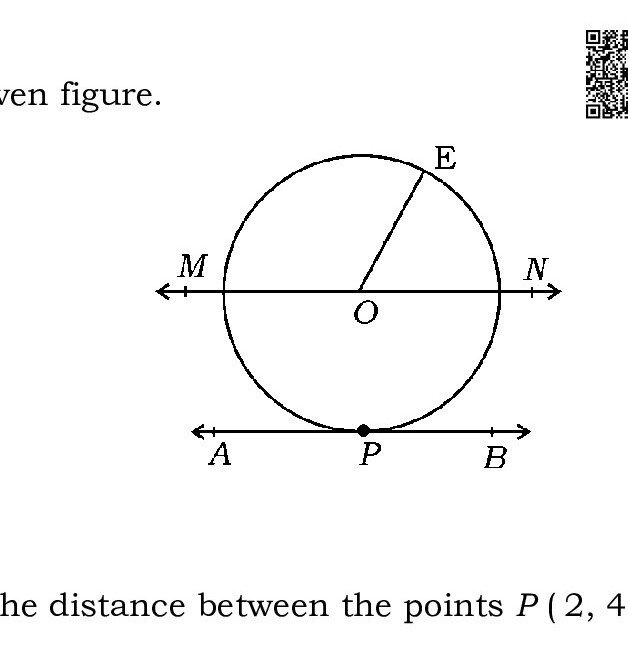
What is secant of a circle ? Name the tangent of the circle in the given figure.
Q22
long answer
2 marks
Find the distance between the points $P(2, 4)$ and $Q(8, 12)$ using ‘distance formula’.
Q23
long answer
2 marks
Prove that $\sin 30^\circ \times \cos 60^\circ + \cos 30^\circ \times \sin 60^\circ = \sin 90^\circ$.
Q24
long answer
2 marks
The LCM and HCF of the numbers $2^m \times 3^2$, $3^n \times 2^2$ and $3^3 \times 2^3$ are $2^4 \times 3^3$ and $2^x \times 3^y$ respectively. Find the values of $m, n, x$ and $y$.
Q36
long answer
A person observes the top of a pole standing vertically on a level ground from the point ‘C’ on the same ground. Then the angle of elevation is found to be 45° as shown in the figure. The person moves a distance of $(\sqrt{3}-1)$ times the length of $BC$ (in metres) from the point ‘C’ and reaches the point ‘D’ on the same ground. If $AD = 12$ m, then find the angle of elevation ($\theta$) from the point ‘D’ to the top of the pole, the height of the pole and the distance between the foot of the pole and the point D.
Q37
long answer
Prove that “If in two triangles, corresponding angles are equal, then their corresponding sides are in the same ratio ( or proportion ) and hence the two triangles are similar”.
Q37
long answer
OR
Prove that “If one angle of a triangle is equal to one angle of the other triangle and the sides including these angles are proportional, then the two triangles are similar”.
Q38
long answer
A toy is made by attaching a hemisphere to one side and a cone on the other side of a cylinder as shown in the figure. The diameter of these three solids is same. The diameter of cylinder is 10 cm and its height is 20 cm. If the slant height of the cone is 13 cm, then find the total surface area and volume of the toy.
Q38
long answer
OR
From a solid cylinder of base radius 6 cm and height 27 cm, a hemisphere and a cone of radius same as that of the cylinder are carved out from the bases of the cylinder as shown in the figure. If the height of the cone is 8 cm then find the total surface area and volume of the remaining solid.
