
- A. electric generator
- B. electric heater
- C. electric motor
- D. electric fan
An electric generator works on the principle of electromagnetic induction (Faraday's law), where mechanical energy is converted into electrical energy by rotating a coil in a magnetic field. An electric motor (c) and fan (d) typically use the magnetic effect of current to produce motion, and an electric heater (b) works on the heating effect of electric current.
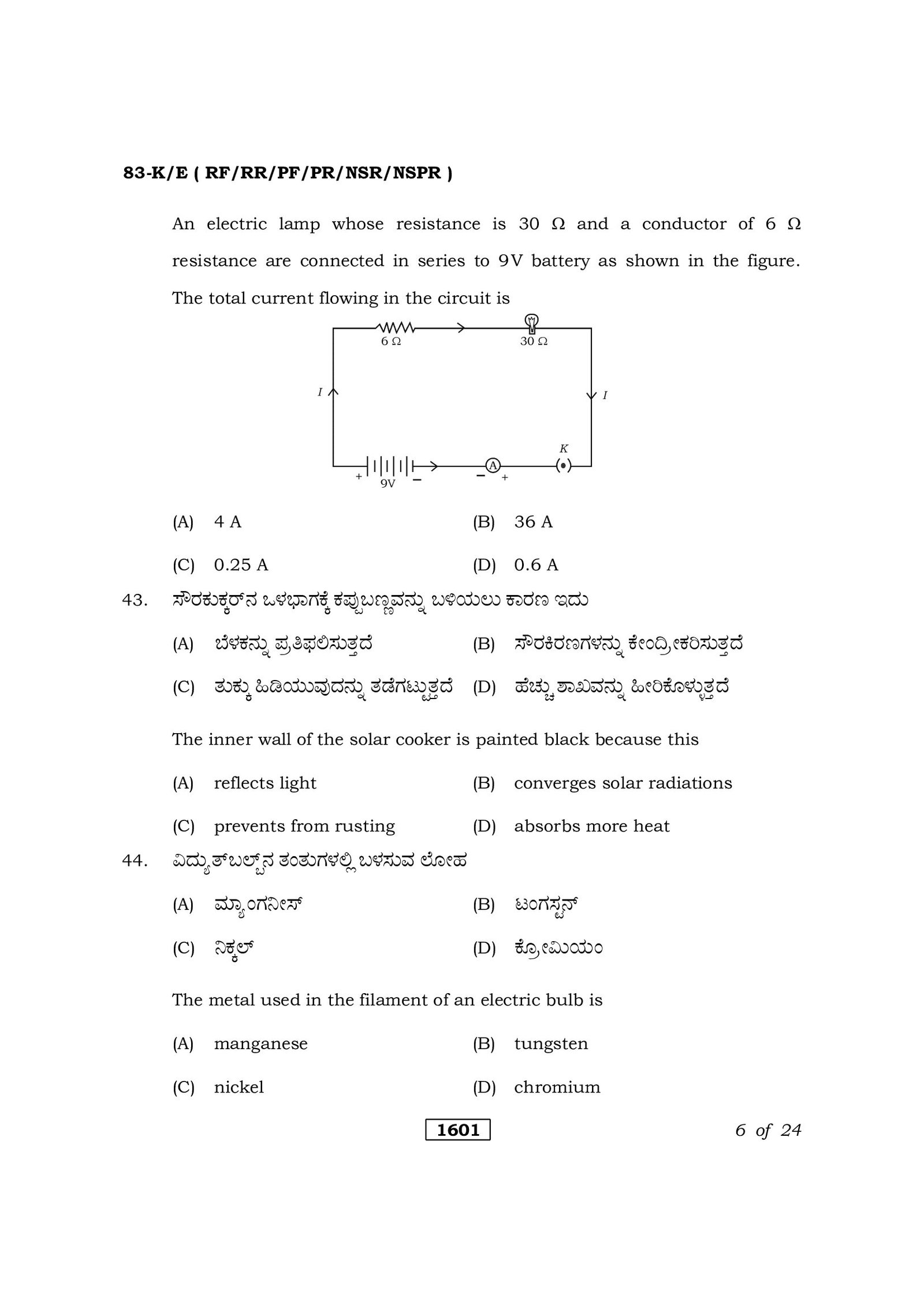
- A. 4 A
- B. 36 A
- C. 0.25 A
- D. 0.6 A
In a series circuit, the total resistance $R_{total} = R_1 + R_2$. Given $R_1 = 30 \, \Omega$ and $R_2 = 6 \, \Omega$, $R_{total} = 30 + 6 = 36 \, \Omega$. Using Ohm's Law $V = I \cdot R$, the current $I = V / R_{total} = 9 \text{ V} / 36 \, \Omega = 0.25 \text{ A}$.
- A. reflects light
- B. converges solar radiations
- C. prevents from rusting
- D. absorbs more heat
Black surfaces are excellent absorbers of heat radiation. Painting the inner wall of a solar cooker black ensures that the solar energy falling on it is absorbed efficiently to cook the food inside, rather than being reflected (a).
- A. manganese
- B. tungsten
- C. nickel
- D. chromium
Tungsten is used for the filament of an electric bulb because it has a very high melting point ($3380^\circ \text{C}$), allowing it to glow at high temperatures without melting, and it does not oxidize readily.
- A. two revolutions
- B. one revolution
- C. half revolution
- D. one-fourth revolution
In a DC generator (or simple rotating coil), the current changes direction every half revolution as the sides of the coil swap positions relative to the magnetic poles, which is why a split-ring commutator is often used to ensure unidirectional output.
- A. + 2.0 D and convex lens
- B. + 2.0 D and concave lens
- C. – 2.0 D and concave lens
- D. – 2.0 D and convex lens
Solution hidden
Log in to view solution →- A. voltmeter
- B. ammeter
- C. galvanometer
- D. rheostat
Solution hidden
Log in to view solution →- A. very high
- B. uniform
- C. zero
- D. produced by electric current
Solution hidden
Log in to view solution →- A. virtual, erect and enlarged
- B. real, inverted and small size
- C. virtual, inverted and small size
- D. real, inverted and enlarged
Solution hidden
Log in to view solution →- A. electric generator
- B. solar cell
- C. dry cell
- D. electric motor
Solution hidden
Log in to view solution →- A. electric potential difference
- B. resistance
- C. electric current
- D. electric charge
Solution hidden
Log in to view solution →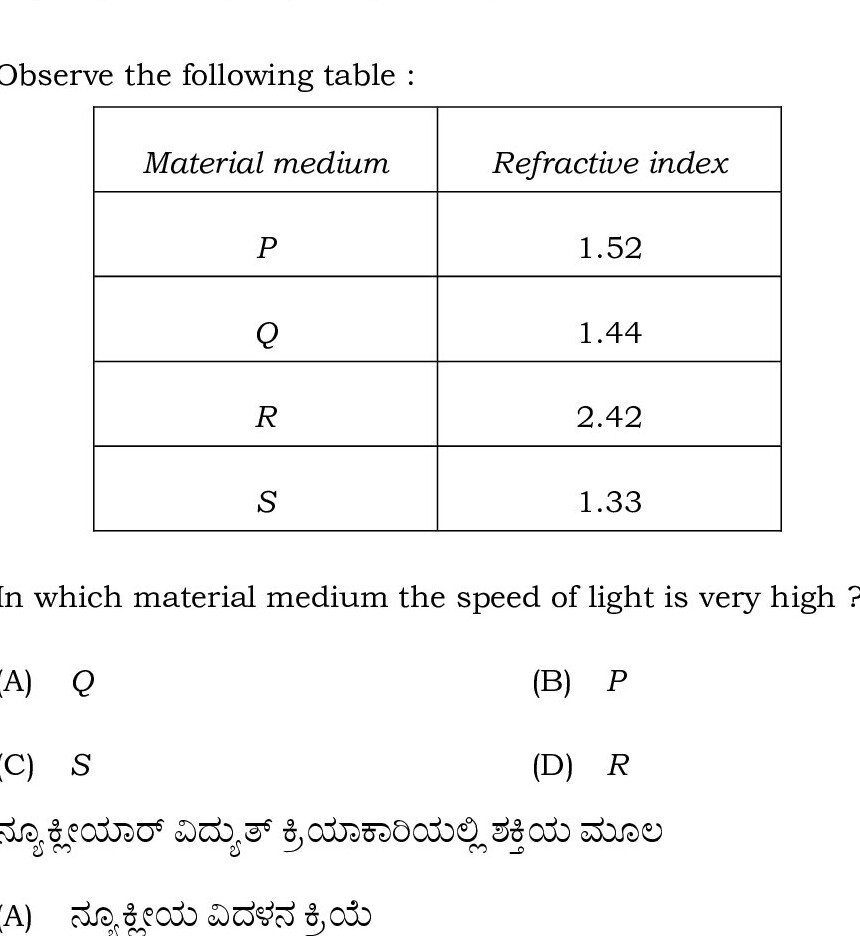
- A. Q
- B. P
- C. S
- D. R
Solution hidden
Log in to view solution →- A. nuclear fission reaction
- B. controlled nuclear fission chain reaction
- C. exothermic reaction
- D. nuclear fusion reaction
Solution hidden
Log in to view solution →- A. diverges the light rays
- B. is thicker at the edges and thinner at the middle
- C. forms real and erect image
- D. is thinner at the edges and thicker at the middle
Solution hidden
Log in to view solution →- A. aluminium oxide
- B. copper oxide
- C. iron oxide
- D. sodium oxide
Solution hidden
Log in to view solution →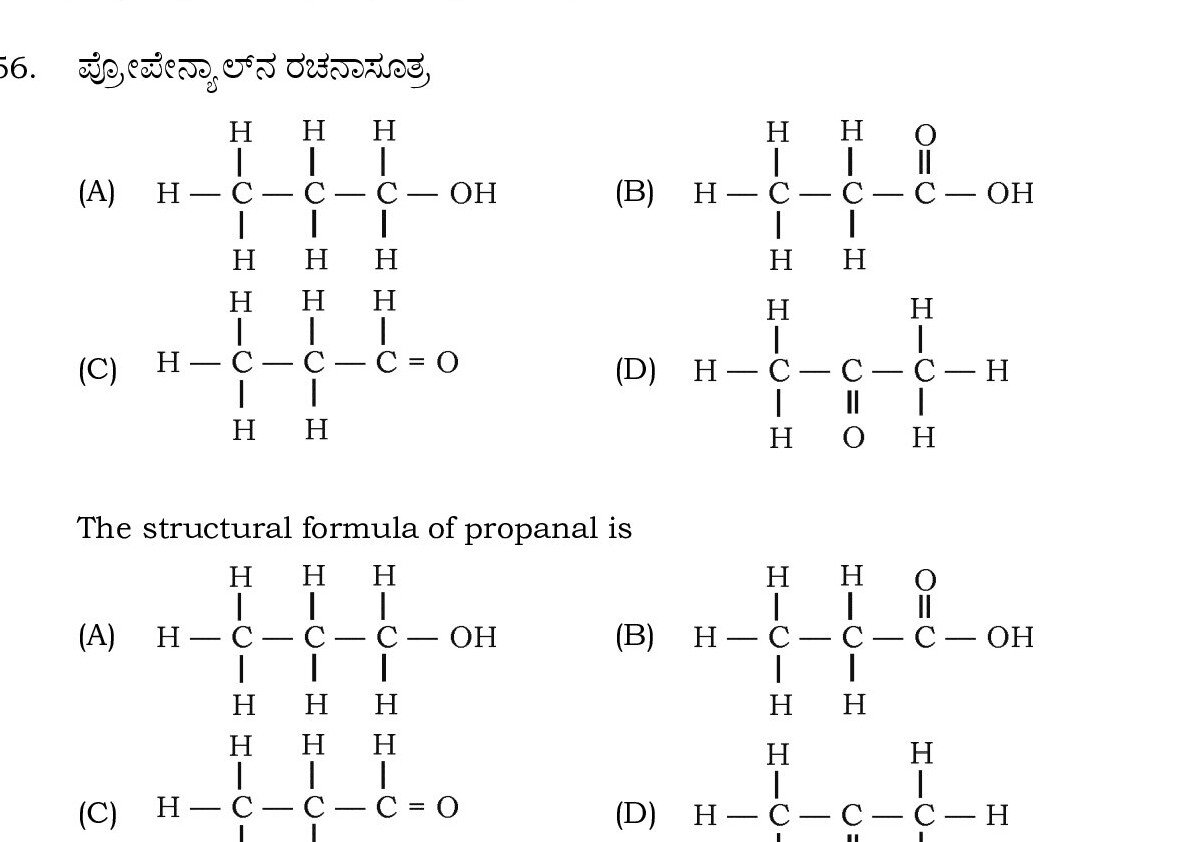
- A. (A)
- B. (B)
- C. (C)
- D. (D)
Solution hidden
Log in to view solution →- A. Newlands
- B. Mendeleev
- C. Dobereiner
- D. Henry Moseley
Solution hidden
Log in to view solution →- A. Zn > Fe > Cu
- B. Fe > Cu > Zn
- C. Zn > Cu > Fe
- D. Cu > Fe > Zn
Solution hidden
Log in to view solution →- A. 2
- B. 8
- C. 4
- D. 3
Solution hidden
Log in to view solution →- A. 3 and 9
- B. 9 and 3
- C. 6 and 6
- D. 7 and 5
Solution hidden
Log in to view solution →- A. carbon dioxide
- B. nitrogen dioxide
- C. hydrogen
- D. chlorine
Solution hidden
Log in to view solution →- A. butane
- B. ethane
- C. methane
- D. propane
Solution hidden
Log in to view solution →- A. lime water
- B. pure water
- C. sodium hydroxide solution
- D. gastric juice
Solution hidden
Log in to view solution →- A. calcination
- B. roasting
- C. reduction
- D. electrolysis
Solution hidden
Log in to view solution →- A. C6 H6
- B. C6 H14
- C. C6 H12
- D. C6 H10
Solution hidden
Log in to view solution →- A. methanoic acid
- B. oxalic acid
- C. citric acid
- D. lactic acid
Solution hidden
Log in to view solution →- A. Testosterone
- B. Adrenaline
- C. Insulin
- D. Thyroxin
Solution hidden
Log in to view solution →- A. Chemotropism
- B. Phototropism
- C. Geotropism
- D. Hydrotropism
Solution hidden
Log in to view solution →- A. undergo recycling naturally in the environment
- B. harm various organisms in the ecosystem
- C. increase the density of harmful chemicals in different trophic levels
- D. remain inert in the environment for a long time
Solution hidden
Log in to view solution →- A. pollination, fertilization, seed, embryo
- B. seed, embryo, fertilization, pollination
- C. embryo, seed, pollination, fertilization
- D. pollination, fertilization, embryo, seed
Solution hidden
Log in to view solution →- A. refuse
- B. reduce
- C. reuse
- D. repurpose
Solution hidden
Log in to view solution →- A. round and green seeds
- B. wrinkled and yellow seeds
- C. round and yellow seeds
- D. wrinkled and green seeds
Solution hidden
Log in to view solution →- A. have same structure and perform same function
- B. have same structure and perform different functions
- C. have different structures and perform same function
- D. have different structures and perform different functions
Solution hidden
Log in to view solution →- A. arteries
- B. capillaries
- C. pulmonary arteries
- D. veins
Solution hidden
Log in to view solution →- A. Transpiration
- B. Photosynthesis
- C. Respiration
- D. Translocation
Solution hidden
Log in to view solution →- A. dendrite
- B. axon
- C. synapse
- D. cell body
Solution hidden
Log in to view solution →- A. Fallopian tube
- B. Ovary
- C. Uterus
- D. Placenta
Solution hidden
Log in to view solution →- A. Urethra
- B. Ureter
- C. Vas deferens
- D. Urinary bladder
Solution hidden
Log in to view solution →- A. Recharge the ground water
- B. Water does not evaporate
- C. Provide breeding grounds for mosquitoes
- D. Provide moisture for vegetation
Solution hidden
Log in to view solution →- A. inherited traits
- B. acquired traits
- C. dominant traits
- D. recessive traits
Solution hidden
Log in to view solution →