The first 5 questions are solved below. Log in as a CLASS 10th student to reveal solutions for the rest of this paper.
Log In →
Q1
mcq
1 mark
In Fleming’s left hand rule, the finger that indicates the direction of the electric current is
-
A.
thumb
-
B.
index finger
-
C.
middle finger
-
D.
little finger
Correct Answer: C —
Solution
According to Fleming's left-hand rule: the thumb indicates the direction of the force (motion) on the conductor, the index finger indicates the direction of the magnetic field, and the middle finger indicates the direction of the electric current.
Q2
mcq
1 mark
If a device of $840W$ is to be used with $220V$ potential difference, then the rate of the fuse that is to be connected in this electrical circuit is
Correct Answer: B —
Solution
The power $P = 840 W$ and voltage $V = 220 V$. Using the formula $P = VI$, the current $I = P / V = 840 / 220 \approx 3.82 A$. Since the fuse rating must be slightly higher than the operating current to prevent nuisance tripping, a 4A fuse is the appropriate choice.
Q3
mcq
1 mark
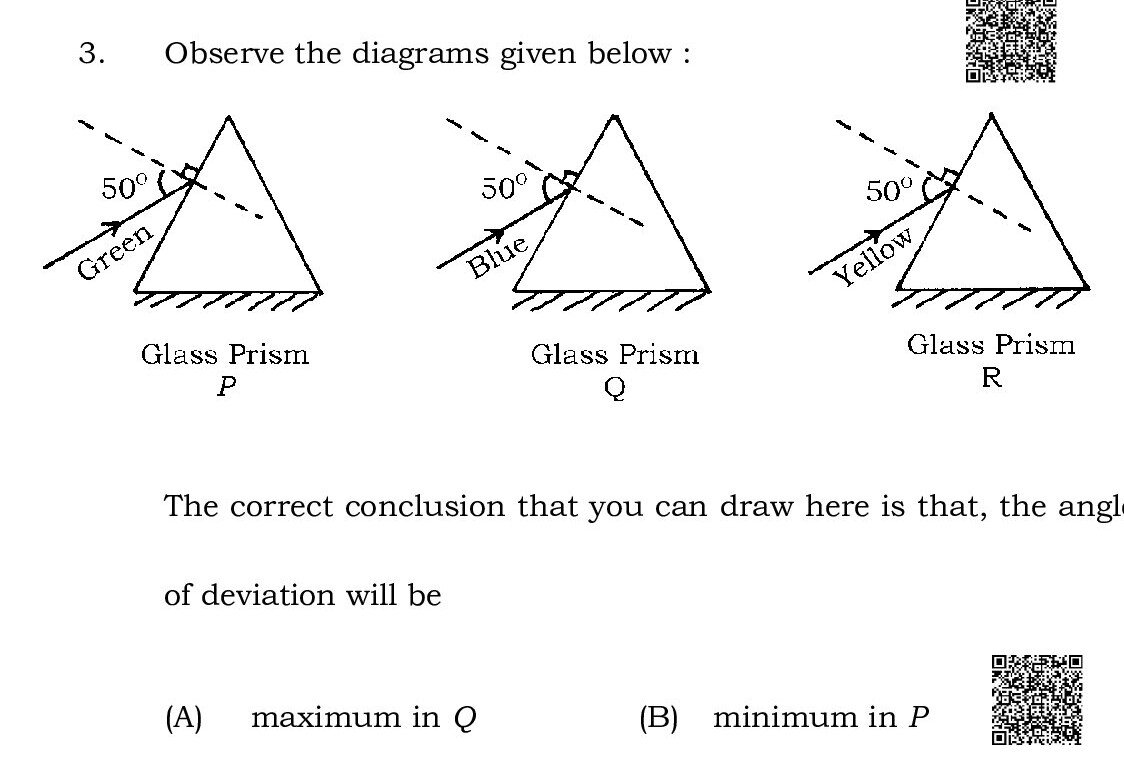
Observe the diagrams given below : The correct conclusion that you can draw here is that, the angle of deviation will be
-
A.
maximum in Q
-
B.
minimum in P
-
C.
more in P than in Q
-
D.
more in R than in Q
Correct Answer: A —
Solution
The angle of deviation is inversely proportional to the wavelength of the light. Among blue, green, and yellow light, blue light has the shortest wavelength and thus undergoes the maximum deviation through a glass prism. Since Q represents the blue light ray, the angle of deviation is maximum in Q.
Q4
short answer
1 mark
Draw the symbol of ‘variable resistance’ or ‘Rheostat’ used in the electric circuit.
Solution
The symbol for a rheostat (variable resistance) is typically drawn as a resistor symbol with an arrow pointing across it, or an arrow pointing to the middle of the resistor symbol.
Q5
short answer
1 mark
Among the two types of particles ‘A’ and ‘B’ in the atmosphere, particles ‘A’ scatter mainly the blue light and particles ‘B’ scatter mainly the red light. Which type of the particles have larger size ?
Solution
Particles 'B' have a larger size. Rayleigh scattering explains that shorter wavelengths are scattered by smaller particles (like air molecules scattering blue light), while larger particles (like dust or water droplets) scatter longer wavelengths, such as red light.
Q6
short answer
2 marks
Write any four properties of magnetic field lines.
Q7
short answer
2 marks
Explain the working of earth wire in the domestic electric circuit.
Q8
short answer
a) What happens if the electric current is increased in a solenoid ?
Q8
short answer
3 marks
What is myopia ( near sightedness ) ? Write any two causes for this defect. How can this defect of the eye be corrected ?
Q9
short answer
b) What happens to the soft iron rod when it is placed inside the solenoid carrying electric current ?
Q9
short answer
3 marks
Draw the ray diagram showing the formation of image by a convex lens when the object is placed in front of the lens beyond $2F_1$. ($F_1$ : Principal focus of the lens )
Q10
short answer
3 marks
A wire of length ‘l’ and area of cross-section ‘A’ has resistance of $2 \Omega$. What is the resistance of another wire of same material having length ‘2l’ and area of cross-section ‘A/2’ ?
Q11
short answer
4 marks
a) State Joule’s law of heating effect. Write its mathematical form.
b) Write any two differences between series combination of resistors and parallel combination of resistors in an electric circuit.
Q12
short answer
5 marks
a) Give reason:
i) Tungsten is used as the filament of an electric bulb.
ii) Electric filament bulbs are usually filled with nitrogen gas.
b) Write the use of an ammeter and a voltmeter. How are they connected in an electric circuit?
Q12
short answer
5 marks
a) Write any four uses of concave mirror.
b) What is magnification? If the value of magnification of an image is $+3.0$, then mention the size and nature of the image.
Q13
short answer
a) State Joule’s law of heating effect. Write its mathematical form.
Q13
mcq
1 mark
$\text{Zn} + \text{CuSO}_4 \rightarrow \text{ZnSO}_4 + \text{Cu}$. The above reaction is an example for
-
A.
Endothermic reaction
-
B.
Precipitation reaction
-
C.
Displacement reaction
-
D.
Double displacement reaction
Q14
short answer
b) Write any two differences between series combination of resistors and parallel combination of resistors in an electric circuit.
Q14
mcq
1 mark
The metal that exists in liquid state at room temperature is
-
A.
Mercury
-
B.
Silver
-
C.
Sodium
-
D.
Gold
Q15
short answer
a) Give reason : i) Tungsten is used as the filament of an electric bulb. ii) Electric filament bulbs are usually filled with nitrogen gas.
Q15
mcq
1 mark
In a homologous series of compounds containing alcohols, the first member is $\text{CH}_3\text{OH}$. Then the third member of the same series will be
-
A.
$\text{C}_2\text{H}_5\text{OH}$
-
B.
$\text{C}_4\text{H}_9\text{OH}$
-
C.
$\text{C}_6\text{H}_5\text{OH}$
-
D.
$\text{C}_3\text{H}_7\text{OH}$
Q16
short answer
b) Write the use of an ammeter and a voltmeter. How are they connected in an electric circuit ?
Q16
short answer
1 mark
How is rancidity prevented in foods containing fat or oil?
Q17
short answer
a) Write any four uses of concave mirror.
Q17
short answer
1 mark
Pure ethanoic acid is commonly called ‘glacial acetic acid’. Why?
Q18
short answer
b) What is magnification ? If the value of magnification of an image is + 3·0, then mention the size and nature of the image.
Q18
short answer
1 mark
10 ml of an acidic solution is added to a beaker containing 50 ml of water. What change takes place in the concentration of hydronium ions of that solution?
Q19
short answer
2 marks
Translate the following statement into chemical equation and then balance it. ‘Hydrogen gas combines with chlorine gas to form hydrogen chloride.’
OR
Balance the following chemical equations:
a) $\text{CH}_4 + \text{O}_2 \to \text{CO}_2 + \text{H}_2\text{O}$
b) $\text{Pb}(\text{NO}_3)_2 \to 2\text{PbO} + \text{NO}_2 + \text{O}_2$
Q20
short answer
2 marks
What is water of crystallisation? Write the molecular formula of any two salts that contain water of crystallisation.
Q21
short answer
2 marks
Complete the given structure of carbon compound with hydrogen atoms and name the compound: $\text{C} = \text{C}$
Q22
long answer
3 marks
a) Write the differences between saturated hydrocarbons and unsaturated hydrocarbons.
b) Write the structural formula of propane.
OR
a) Explain the mechanism of cleaning action of soaps.
b) Carbon does not form $\text{C}^{-4}$ anion. Why?
Q23
long answer
3 marks
When a salt ‘X’ that is used to remove permanent hardness of water reacts with hydrochloric acid, the gas ‘Y’ releases. Later the gas ‘Y’ is passed through lime water to produce a white precipitate ‘Z’. Then name ‘X’, ‘Y’ and ‘Z’.
OR
When the brine solution is subjected to electrolysis, name the compound formed and the gases released at the cathode and the anode. Write one use of each product.
Q24
short answer
3 marks
Draw the diagram of the arrangement of apparatus showing action of steam on metal and label the following parts:
i) Metal sample
ii) Delivery tube
Q25
short answer
4 marks
a) Show the formation of magnesium chloride by the transfer of electrons.
b) Give reason:
i) Aluminium oxide is called amphoteric oxide.
ii) Copper articles exposed to air for a long time gain green coat.
Q26
mcq
1 mark
The part of the male reproductive system that produces sperms is
-
A.
Seminal vesicle
-
B.
Testis
-
C.
Scrotum
-
D.
Penis
Q27
mcq
1 mark
Pyruvate $\xrightarrow{\text{Lack of oxygen, Muscle cells}}$ X + Energy. Here ‘X’ represents
-
A.
Carbon dioxide
-
B.
Ethanol
-
C.
Carbon monoxide
-
D.
Lactic acid
Q28
short answer
1 mark
What is double circulation?
Q29
short answer
1 mark
What is ozone? Write the advantage of this layer.
Q30
short answer
1 mark
The sex cells should have half the amount of genetic material. Why?
Q31
short answer
2 marks
The flow of energy in an ecosystem is always unidirectional. Give reason.
Q32
short answer
2 marks
How is the movement of diaphragm and ribs helpful in sucking the air into lungs ?
Q33
short answer
2 marks
Draw the diagram that shows the germination of pollen grain on stigma. Label the pollen tube.
Q34
long answer
3 marks
a) Write the events that occur during the process of photosynthesis. In what form the carbohydrates not used immediately are stored in plants ?
b) Write the functions of stomata.
Q34
long answer
3 marks
What is excretion ? What are the methods used by plants to get rid of excretory products ?
Q35
long answer
3 marks
The regeneration that takes place in planaria is not equal to the reproduction. Justify.
Q35
long answer
3 marks
‘Vegetative propagation is a boon to the farmers.’ Justify.
Q36
long answer
3 marks
Draw the diagram to show the structure of the human brain. Label the following parts.
i) Pons
ii) Cerebrum.
Q37
long answer
4 marks
A tall pea plant bearing round seeds (TTRR) is crossed with dwarf pea plant bearing wrinkled seeds (ttrr).
i) Write the type of plants obtained in $F_1$ generation.
ii) With the help of checker board represent the plants of $F_2$ generation obtained by the self pollination of $F_1$ plants.
iii) Write the ratio of different plants obtained in $F_2$ generation.
Q38
long answer
4 marks
a) Write the functions of the following hormones :
i) Insulin
ii) Adrenaline.
b) The leaves of chui-mui (touch-me-not) plant fold up when this plant is being touched. How does this response take place ? Explain.
