The first 5 questions are solved below. Log in as a CLASS 12 SECOND PUC student to reveal solutions for the rest of this paper.
Log In →
Q1
mcq
1 mark
The partnership deed should be properly drafted as per provisions of the
-
A.
Partnership Act
-
B.
Stamps Act
-
C.
Companies Act
-
D.
Consumer Protection Act
Correct Answer: A —
Solution
The Partnership Act, 1932 (in India) governs the formation, rights, and duties of partners. A partnership deed is a legal document that outlines these terms, and it must comply with the provisions of the Partnership Act. Other options like the Stamps Act relate to the payment of duties on the deed, but the governing legal framework for the partnership itself is the Partnership Act.
Q2
mcq
1 mark
Abhishek and Ravi are partners sharing profits in the ratio of 3 : 2. Hari is admitted into the partnership for 1/4th share. The sacrificing ratio of Abhishek and Ravi will be:
-
A.
1 : 1
-
B.
3 : 1
-
C.
2 : 1
-
D.
3 : 2
Correct Answer: D —
Solution
When a new partner is admitted and the problem is silent regarding how the new partner acquires their share from the existing partners, the existing partners sacrifice their shares in their old profit-sharing ratio. Since Abhishek and Ravi share profits in 3:2, their sacrificing ratio remains 3:2.
Q3
mcq
1 mark
Sandeep Company forfeited 1,000 equity shares of ₹ 100 each for non-payment of first and final call money of ₹ 40 per share. On forfeiture of shares, forfeited shares account will be credited by
-
A.
₹ 90,000
-
B.
₹ 80,000
-
C.
₹ 60,000
-
D.
₹ 40,000
Correct Answer: C —
Solution
Forfeited shares account is credited with the amount already paid by the shareholder. The total face value is ₹100, and the amount unpaid is ₹40 per share. Therefore, the amount paid is ₹100 - ₹40 = ₹60 per share. For 1,000 shares, the amount credited to the Forfeited Shares account is $1,000 \times 60 = ₹60,000$.
Q4
mcq
1 mark
Fixed assets does not include
-
A.
Building
-
B.
Machinery
-
C.
Furniture
-
D.
Inventories
Correct Answer: D —
Solution
Building, Machinery, and Furniture are tangible non-current assets held for long-term use, classified as fixed assets. Inventories (stock) are current assets held for sale in the ordinary course of business and are not considered fixed assets.
Q5
mcq
1 mark
Which of the following is not a cash flow from investing activities?
-
A.
Cash receipts from sale of fixed assets
-
B.
Interest received in cash from loans and advances.
-
C.
Dividend received from investments in other enterprises.
-
D.
Cash receipts from sale of goods and rendering service.
Correct Answer: D —
Solution
Cash receipts from the sale of goods and rendering services are part of Operating Activities, as they relate to the principal revenue-producing activities of the enterprise. Options A, B, and C are directly related to investing activities.
Q6
short answer
1 mark
______ is used for adjustments of continuing partners capital.
Q7
short answer
1 mark
Executors account is generally prepared at the time of _____ of a partner.
Q8
short answer
1 mark
Debentures cannot be redeemable at _____.
Q9
short answer
1 mark
_____ statements are the basic and formal annual reports.
Q10
short answer
1 mark
The _____ ratios are primarily measures of return.
Q11
short answer
1 mark
Match the following: A: (a) Fluctuating capital system, (b) Goodwill, (c) Realisation account, (d) Vertical analysis, (e) Debentures. B: (i) Tangible asset, (ii) Acknowledgement of debt, (iii) Common size statement, (iv) Dissolution of partnership firm, (v) Intangible asset, (vi) Change in capital account balance.
Q11
short answer
5 marks
Match the following:
(a) Fluctuating capital system (i) Tangible asset
(b) Goodwill (ii) Acknowledgement of debt
(c) Realisation account (iii) Common size statement
(d) Vertical analysis (iv) Dissolution of partnership firm
(e) Debentures (v) Intangible asset
(vi) Change in capital account balance.
Q12
short answer
1 mark
How do you close realisation account?
Q13
short answer
1 mark
Expand OPC.
Q14
short answer
1 mark
Name any one user of financial statement analysis.
Q15
short answer
1 mark
State any one type of solvency ratio.
Q16
short answer
1 mark
Cash received on sale of goods is an operating activity. (State True/False).
Q17
short answer
2 marks
Define Partnership.
Q18
short answer
2 marks
Give the journal entry to close Revaluation account when there is loss at the time of retirement of a partner.
Q19
short answer
2 marks
State any two features of a company.
Q20
short answer
2 marks
Mention any two items that are shown under the head current liabilities of company Balance Sheet.
Q21
short answer
2 marks
State any two activities which are classified as per AS-3.
Q22
long answer
6 marks
Akhila and Madhu are partners in a firm. Akhila withdrew ₹ 5,000 quarterly at the beginning of each quarter. Calculate the interest on drawings of Akhila at 6% p.a. for the year ending 31.03.2024 under product method.
Q23
long answer
6 marks
Rajesh, Vasu and Sachin are partners sharing profits in the ratio of 4 : 3 : 2. Vasu retires. Rajesh and Sachin decided to share profits in future in the ratio of 5 : 3. Calculate the gain ratio of Rajesh and Sachin.
Q24
long answer
6 marks
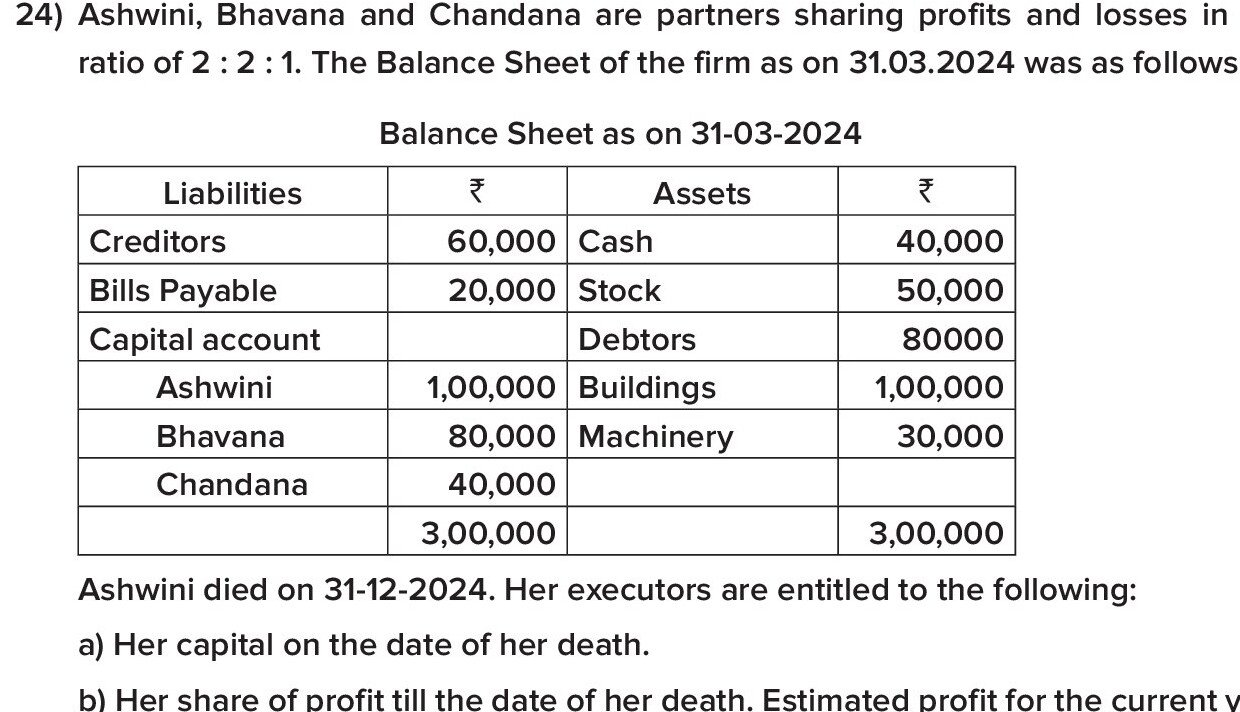
Ashwini, Bhavana and Chandana are partners sharing profits and losses in the ratio of 2 : 2 : 1. The Balance Sheet of the firm as on 31.03.2024 was as follows (see table). Ashwini died on 31-12-2024. Her executors are entitled to the following: a) Her capital on the date of her death. b) Her share of profit till the date of her death. Estimated profit for the current year is ₹ 80,000. c) Interest on capital is allowed at 10% p.a. d) Her drawings till death amounted to ₹ 20,000. e) Salary of Ashwini is ₹ 1,000 per month. Prepare Ashwini's capital account.
Q25
long answer
6 marks
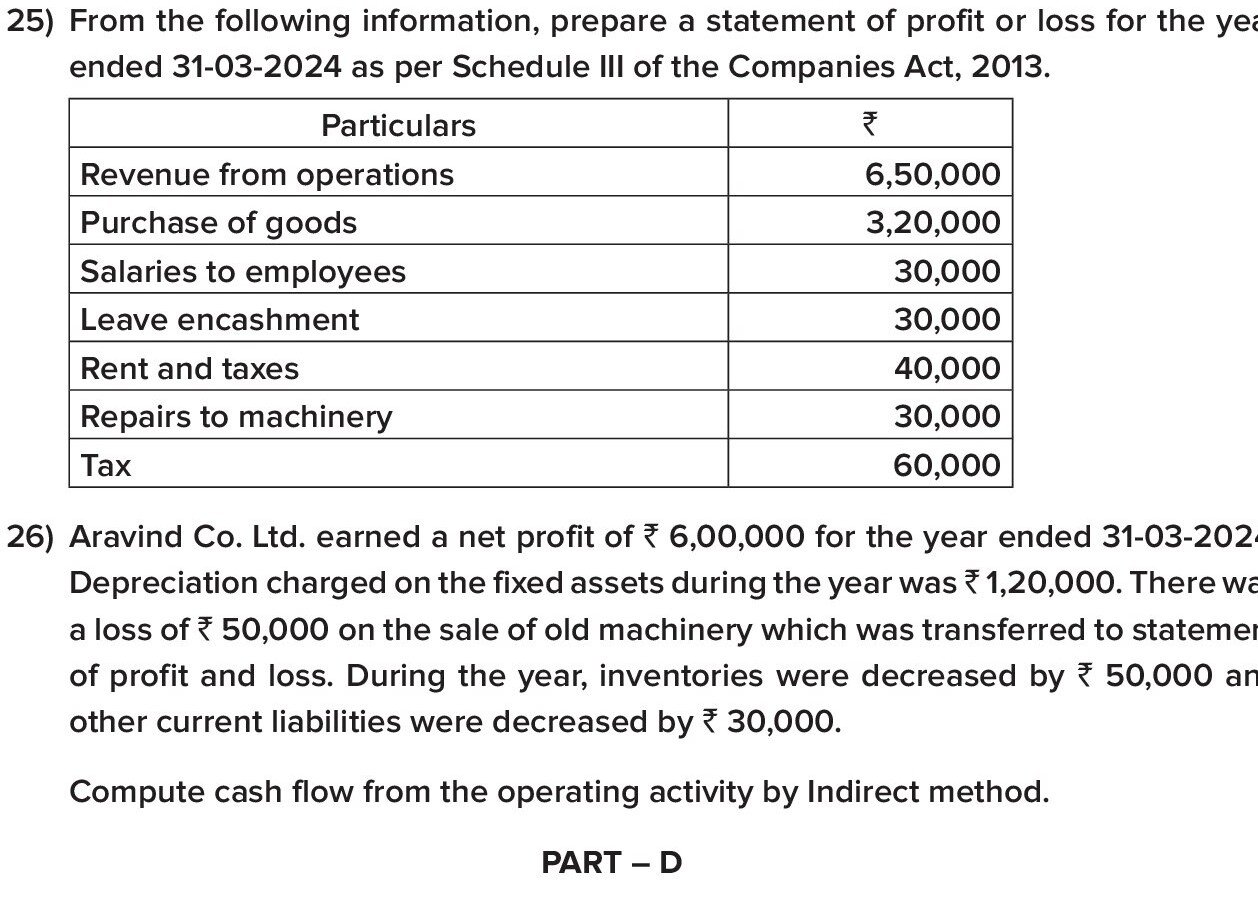
From the following information, prepare a statement of profit or loss for the year ended 31-03-2024 as per Schedule III of the Companies Act, 2013.
Q26
long answer
6 marks
Aravind Co. Ltd. earned a net profit of ₹ 6,00,000 for the year ended 31-03-2024. Depreciation charged on the fixed assets during the year was ₹ 1,20,000. There was a loss of ₹ 50,000 on the sale of old machinery which was transferred to statement of profit and loss. During the year, inventories were decreased by ₹ 50,000 and other current liabilities were decreased by ₹ 30,000. Compute cash flow from the operating activity by Indirect method.
Q27
long answer
12 marks
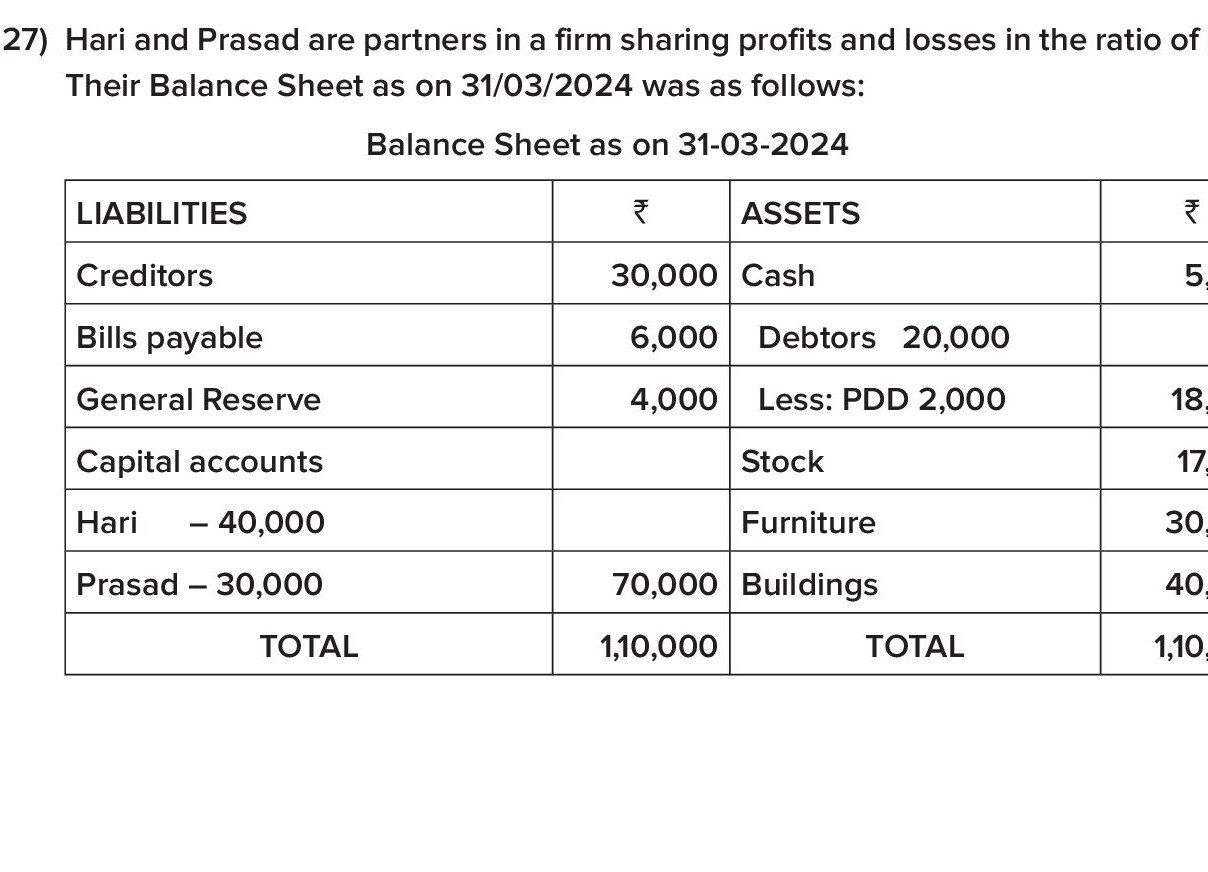
Hari and Prasad are partners in a firm sharing profits and losses in the ratio of 3 : 2. Their Balance Sheet as on 31/03/2024 is given. On 01-04-2024, Sharma was admitted into partnership on the following terms: a) Sharma should bring in ₹ 25,000 as capital for 1/6th share and ₹ 8,000 towards Goodwill (as per AS-26). b) Goodwill is withdrawn by the old partners. c) Depreciate furniture by 10% d) Appreciate buildings by 20% e) Provision for Doubtful Debts is no longer necessary. Prepare: i) Revaluation Account ii) Partners' capital Account iii) New Balance Sheet of the firm as on 01/04/2024
Q27
long answer
Hari and Prasad are partners in a firm sharing profits and losses in the ratio of 3 : 2. Their Balance Sheet as on 31/03/2024 was as follows:
Balance Sheet as on 31-03-2024
LIABILITIES ₹ ASSETS ₹
Creditors 30,000 Cash 5,000
Bills payable 6,000 Debtors 20,000
General Reserve 4,000 Less: PDD 2,000 18,000
Capital accounts Stock 17,000
Hari – 40,000 Furniture 30,000
Prasad – 30,000 70,000 Buildings 40,000
TOTAL 1,10,000 TOTAL 1,10,000
On 01-04-2024, Sharma was admitted into partnership on the following terms:
a) Sharma should bring in ₹ 25,000 as capital for 1/6th share and ₹ 8,000 towards Goodwill (as per AS-26).
b) Goodwill is withdrawn by the old partners.
c) Depreciate furniture by 10%
d) Appreciate buildings by 20%
e) Provision for Doubtful Debts is no longer necessary.
Prepare:
i) Revaluation Account
ii) Partners' capital Account
iii) New Balance Sheet of the firm as on 01/04/2024
Q28
long answer
Pavan and Shreshta are partners sharing profits and losses in the ratio of 3 : 2. Their Balance Sheet as on 31/03/2024 was as follows:
Balance Sheet as on 31-03-2024
LIABILITIES ₹ ASSETS ₹
Creditors 20,000 Cash at bank 25,000
Bills payable 20,000 Bills Receivable 10,000
Pavan's Loan 10,000 Debtors 25,000
Reserve fund 10,000 Investments 10,000
Stock 10,000
Capital Account Machinery 20,000
Pavan – 50,000 Furniture 20,000
Shreshta – 30,000 80,000 Building 20,000
1,40,000 1,40,000
On the above date, the firm was dissolved.
a) The assets were realised as follows:
Bills receivable ₹ 7,500
Debtors and stock 10% less than book value.
Machinery realised 5% more than book value.
Building realised for ₹ 15,000
b) Furniture and Investment were taken over by Pavan and Shreshta at ₹ 10,000 and ₹ 5,000 respectively.
c) Dissolution expenses were ₹ 2,000.
d) Creditors and Bills payable were paid in full.
Prepare:
i) Realisation account
ii) Partners capital account
iii) Bank account
Q29
long answer
Jayashree Company Ltd. issued 10,000 equity shares of ₹ 100 each at a premium of ₹ 10 per share. The amount was payable as follows:
i) ₹ 10 on application
ii) ₹ 55 on allotment (including premium)
iii) ₹ 45 on first and final call
All the shares were subscribed and the money duly received except the first and final call on 1,000 equity shares.
The directors forfeited these shares and reissued at ₹ 90 as fully paid.
Pass the necessary journal entries in the books of the company.
Q30
long answer
Give the necessary journal entries for the following:
a) Issue of 4,000, 10% Debentures of ₹ 100 each at a discount of 10% and redeemable at par.
b) Issue of 4,000, 10% Debentures of ₹ 100 each at a premium of 10% and redeemable at par.
c) Issue of 4,000, 10% Debentures of ₹ 100 each at a premium of 10% and redeemable at premium of 10 %.
d) Issue of 4,000, 10% Debentures of ₹ 100 each at par and redeemable at par.
Q31
long answer
From the following Balance Sheet of Sunrise Company Limited, Shimoga, prepare common size Balance Sheet as on 31-03-2023 and 31-03-2024.
Balance Sheet as on 31-03-2023 and 31-03-2024
Particulars 31/03/2023 31/03/2024
I Equity and Liabilities ₹ ₹
1. Shareholders' fund
Share capital 8,00,000 10,00,000
Reserves and surplus 2,00,000 2,50,000
2. Non-current liabilities
Long-term borrowings 4,00,000 5,00,000
3. Current liabilities
Short-term borrowings 2,00,000 2,50,000
Total 16,00,000 20,00,000
II Assets
1. Non-current assets
Tangible assets 7,00,000 8,00,000
Intangible assets 3,00,000 4,00,000
2. Current assets
Inventories 4,00,000 5,00,000
Other current assets 2,00,000 3,00,000
Total 16,00,000 20,00,000
Q32
long answer
From the following information, calculate:
a) Quick Ratio.
b) Proprietary Ratio.
c) Fixed Assets Turnover Ratio
d) Working Capital Turnover Ratio
e) Book Value per Share
f) Dividend Payout Ratio.
Particulars ₹
Sales - revenue from operations 6,00,000
Stock 1,00,000
Current Assets (including stock) 4,00,000
Fixed assets 8,00,000
70,000 equity shares of ₹ 10 each 7,00,000
Net profit after tax but before dividend 1,75,000
Debentures 1,25,000
Current liabilities 2,00,000
Earnings per share ₹ 2.50
Dividend declared @ 15 %
