The first 5 questions are solved below. Log in as a CLASS 12 SECOND PUC student to reveal solutions for the rest of this paper.
Log In →
Q1
mcq
1 mark
Incorrect statement regarding vitamins,
-
A.
Excess vitamin intake is harmful
-
B.
Most of the vitamins contain amino groups
-
C.
Vitamins can be produced by plants
-
D.
Vitamin deficiency causes diseases
Solution not generated yet — check back soon.
Q2
mcq
1 mark
Camphor in nitrogen gas, is an example of __________.
-
A.
liquid solution
-
B.
solid solution
-
C.
gaseous solution
-
D.
aqueous solution
Solution not generated yet — check back soon.
Q3
mcq
1 mark
Which of the following is not a subdivision of structural isomerism?
-
A.
Coordination isomerism
-
B.
Linkage isomerism
-
C.
Ionisation isomerism
-
D.
Geometrical isomerism
Solution not generated yet — check back soon.
Q4
mcq
1 mark
Cumene hydroperoxide on hydrolysis with dilute acid gives _________.
-
A.
alcohol and phenol
-
B.
only phenol
-
C.
phenol and acetone
-
D.
alcohol and acetone
Solution not generated yet — check back soon.
Q5
mcq
1 mark
An example for pseudo first-order reaction is,
-
A.
The decomposition of gaseous ammonia on a hot platinum surface
-
B.
Photochemical reaction between hydrogen and chlorine
-
C.
Inversion of cane sugar
-
D.
Hydrogenation of ethene
Solution not generated yet — check back soon.
Q6
mcq
1 mark
The hybridisation of ‘N’ atom in trimethyl amine is,
-
A.
sp^3
-
B.
sp^2
-
C.
sp
-
D.
dsp^2
Q7
mcq
1 mark
The IUPAC name of $HCCHCHHC$ (with structure shown as $Br$ on $CH$ and $O=CH$ on the terminal carbon) is

-
A.
3–bromobutyraldehyde
-
B.
2–bromopropanaldehyde
-
C.
3–bromobutanal
-
D.
2–bromobutanal
Q7
mcq
The IUPAC name of $HC_3 - CH - CH_2 - C - H$ with Br at the CH and O on the C.
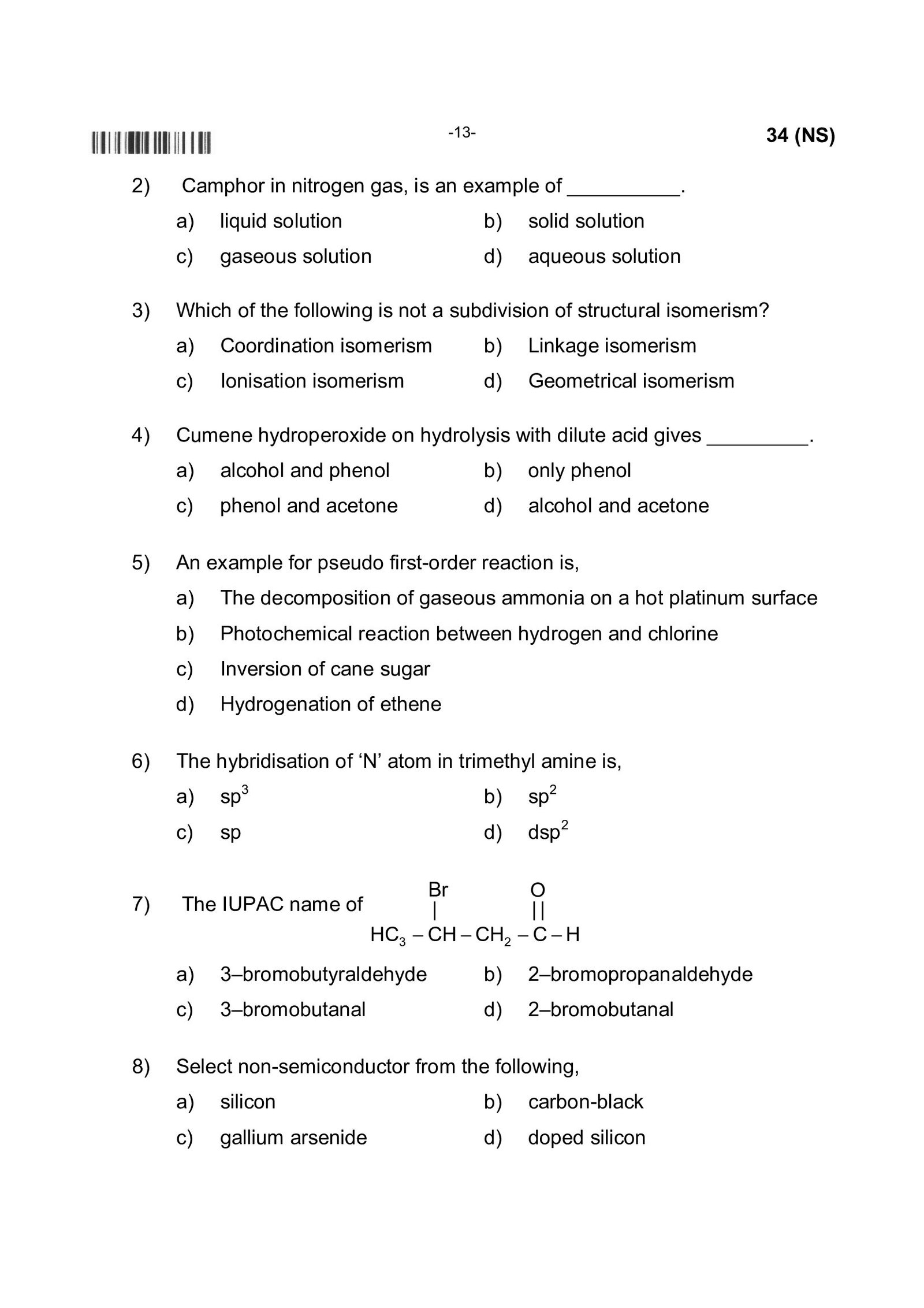
-
A.
3–bromobutyraldehyde
-
B.
2–bromopropanaldehyde
-
C.
3–bromobutanal
-
D.
2–bromobutanal
Q8
mcq
1 mark
Select non-semiconductor from the following,
-
A.
silicon
-
B.
carbon-black
-
C.
gallium arsenide
-
D.
doped silicon
Q9
mcq
1 mark
Given below are two statements :
Statement I : Ammonolysis of alkyl halides has the disadvantage of yielding a mixture of primary, secondary, tertiary amines and quaternary ammonium salt.
Statement II : Tertiary amine is obtained as a major product by taking large excess of ammonia in ammonolysis of alkyl halides.
In the light of the above statements, choose the appropriate answer from the options given below :
-
A.
Statement I is incorrect but Statement II is correct
-
B.
Both Statement I and Statement II are correct
-
C.
Both Statement I and Statement II are incorrect
-
D.
Statement I is correct but Statement II is incorrect
Q10
mcq
1 mark
The structure of pentacarbonyliron(0) is,
-
A.
tetrahedral
-
B.
trigonal bipyramidal
-
C.
octahedral
-
D.
square pyramidal
Q11
mcq
1 mark
Two compounds ‘A’ and ‘B’ were being tested for their boiling points. It was observed that ‘A’ started boiling after ‘B’, when both were subjected to same conditions. If the compound ‘B’ is acetone, which of the following can be compound ‘A’?
-
A.
Propanal
-
B.
Propan-1-ol
-
C.
Methoxyethane
-
D.
n-Butane
Q12
mcq
1 mark
Select the correct order of melting points of isomeric dichlorobenzenes.
-
A.
o-dichlorobenzene > m-dichlorobenzene > p-dichlorobenzene
-
B.
p-dichlorobenzene > m-dichlorobenzene > o-dichlorobenzene
-
C.
p-dichlorobenzene > o-doorobenzene > m-dichlorobenzene
-
D.
m-dichlorobenzene > o-dichlorobenzene > p-dichlorobenzene
Q13
mcq
Match the following given in List - I with List - II:
List - I: i) $V_2O_5$, ii) $TiCl_4$ with $Al(CH_3)_3$, iii) $PdCl_2$, iv) Nickel complexes
List - II: A) Oxidation of ethyne to ethanal, B) Polymerisation of alkynes, C) Oxidation of $SO_2$ in the manufacture of sulphuric acid, D) Manufacture of polyethylene
Choose the correct option:
-
A.
i – C, ii – D, iii – A, iv – B
-
B.
i – A, ii – B, iii – C, iv – D
-
C.
i – A, ii – C, iii – B, iv – D
-
D.
i – C, ii – A, iii – D, iv – B
Q14
mcq
Which of the following explains the increase in the reaction rate by a catalyst?
-
A.
Catalyst decreases the rate of backward reaction so that rate of forward reaction increases
-
B.
Catalyst provides extra energy to reacting molecules, so that they produce effective collisions
-
C.
Catalyst provides an alternative pathway by reducing the activation energy between the reactants and products
-
D.
Catalyst increases the number of collisions between the reacting molecules
Q15
mcq
Sufficient amount of 2-methylpropan-2-ol heated with 20% phosphoric acid at 358 K gives main product ‘X’ with the elimination of water and tert-butyl alcohol undergoes dehydration when it is passed over heated copper at 573 K gives ‘Y’. Pick the correct statement regarding X and Y.
-
A.
The boiling points of ‘X’ and ‘Y’ are equal
-
B.
The boiling point of ‘X’ is greater than the boiling point of ‘Y’
-
C.
The boiling point of ‘X’ is lesser than the boiling point of ‘Y’
-
D.
At room temperature both ‘X’ and ‘Y’ exists as a solids
Q16
short answer
1 mark
Arrhenius factor is also called __________ factor.
Q17
short answer
1 mark
Paramagnetism arised from the presence of _________ electrons.
Q18
short answer
1 mark
_________ is one of the most common freon in industrial use.
Q19
short answer
1 mark
The electrophilic attack of $H_3O^+$ on alkene forms _________.
Q20
short answer
1 mark
The hormone glucorticoids control the __________ metabolism.
Q21
short answer
2 marks
Explain Wurtz reaction with suitable chemical equation.
Q22
short answer
2 marks
Molarity (M), molality (m) and mole fraction ($\chi$) are some methods for expressing concentration of solutions. Which of these are temperature dependent? Give reason.
Q23
short answer
2 marks
What are non-essential amino acids? Name an optically inactive naturally occuring $\alpha$-amino acid.
Q24
short answer
2 marks
Write any two characteristic properties of interstitial compounds.
Q25
short answer
2 marks
While separating a mixture of ortho and para nitrophenols by steam distillation, name the isomer which will be steam volatile. Give reason.
Q26
long answer
3 marks
State any three postulates of Werner’s theory of coordination compounds.
Q27
short answer
3 marks
Write the balanced chemical equations involved in the manufacture of potassium dichromate ($K_{2}Cr_{2}O_{7}$) from chromite ore ($FeCr_{2}O_{4}$).
Q28
short answer
3 marks
$[Co(NH_{3})_{5}Br]SO_{4}$ is an octahedral coordination compound. Write its IUPAC name and draw the diagram which indicates the splitting of d-orbitals in above complex with respect to CFT (Crystal Field Theory).
Q29
short answer
3 marks
What is lanthanoid contraction? Write one comparison and one difference between lanthanoids and actinoids with respect to oxidation states shown by them.
Q30
short answer
3 marks
Write the facial (fac) and meridional (mer) isomeric structures of $[Co(NH_{3})_{3}(NO_{2})_{3}]$. Mention the coordination number of a metal ion in an above complex.
Q31
long answer
3 marks
Derive an integrated rate equation for the rate constant of zero-order reaction.
Q32
long answer
3 marks
Write a neat labelled diagram, cell representation and half-cell reaction of Standard Hydrogen Electrode (S.H.E.).
Q33
short answer
3 marks
Define azeotropes. What type of azeotropes are formed by solutions with negative deviation from Raoult’s law? Give an example for it.
Q34
short answer
3 marks
Lead storage battery is commonly used as a secondary cell in automobiles. What is secondary cell? Write down the reactions occurs at anode and cathode during discharging of the lead storage battery.
Q35
long answer
5 marks
a) Write the $S_{N}2$ mechanism for the conversion of chloromethane to methanol. Mention its order.
b) What is racemic mixture? Represent the butan-2-ol in racemic mixture form.
Q36
long answer
5 marks
a) Amylose and Amylopectin are two components of the starch. Write any two differences between them.
b) List any two nitrogenous bases commonly found in both RNA and DNA.
c) Name the enzyme that catalyses hydrolysis of maltose into glucose.
Q37
long answer
5 marks
a) Write the mechanism of addition of HCN (Hydrogen Cyanide) to carbonyl group in presence of base.
b) Explain Rosenmund reduction with chemical equation.
Q38
long answer
5 marks
a) Describe carbylamine reaction with suitable chemical equation.
b) Explain the conversion of aniline to benzene diazonium chloride with chemical equation.
c) Among aryl amines and ammonia which is more basic?
Q39
long answer
5 marks
a) Lucas reagent is an important reagent which helps to distinguish between three classes of alcohols. Write the chemical composition of the Lucas reagent and explain how the above reagent helps to distinguish $1^{\circ}$ and $3^{\circ}$-alcohols?
b) Illustrate preparation of ether by Williamson synthesis with a general chemical equation.
Q40
long answer
5 marks
An organic compound ‘A’ on treatment with ethanoic acid in the presence of hydrochloric acid gas as a catalyst produces an ester ‘B’. ‘A’ on oxidation with $CrO_{3}$ in an anhydrous medium gives ‘C’. ‘C’ is heated with concentrated KOH followed by acidification with dilute HCl generates ‘A’ and ‘D’. Three moles of ‘D’ reacts with $PCl_{3}$ gives three moles of compound with molecular formula HCOCl and ‘E’. ‘D’ is reduced to ‘A' by lithium aluminium hydride followed by hydrolysis. Write the molecular formulas of the compounds ‘A’, ‘B’, ‘C’, ‘D’ and ‘E’.
Q41
short answer
3 marks
The initial concentration of $N_{2}O_{5}$ in the following first order reaction $2N_{2}O_{5}(g) \rightarrow 4NO_{2}(g) + O_{2}(g)$ was $1.24 \times 10^{-2} mol L^{-1}$ at 318K. The concentration of $N_{2}O_{5}$ after 60 minutes was $0.20 \times 10^{-2} mol L^{-1}$. Calculate the rate constant of the reaction at 318 K.
Q42
short answer
3 marks
Calculate the osmotic pressure in Pascals exerted by a solution prepared by dissolving 1.0 g of polymer of molar mass 185000 in 450 mL of water at $37^{\circ}C$. $[R = 8.314 \times 10^{3} PaLK^{-1}mol^{-1}]$
Q43
short answer
3 marks
The standard electrode potential for Daniel cell is 1.1 V. Calculate the standard Gibbs energy for the reaction : $Zn(s) + Cu^{2+}(aq) \rightarrow Zn^{2+}(aq) + Cu(s)$
Q44
short answer
3 marks
The vapour pressure of pure liquids ‘A’ and ‘B’ are 450 and 700 mm Hg respectively, at 350 K. Find out the composition of the liquid mixture if total vapour pressure is 600 mm Hg.
Q45
short answer
3 marks
The rate constant of a first order reaction increases from $2 \times 10^{-2} s^{-1}$ to $4 \times 10^{-2} s^{-1}$ when the temperature changes from 300 K to 310 K. Calculate the energy of activation ($E_a$). [ $\log 2 = 0.3010, \log 2.5 = 0.3979, \log 4 = 0.6021, R = 8.314 \text{ JK}^{-1} \text{mol}^{-1}$ ]
Q46
short answer
3 marks
The conductivity of 0.001028 mol $L^{-1}$ acetic acid is $4.95 \times 10^{-5} S \text{ cm}^{-1}$. Calculate its dissociation constant if $\Lambda_m^{\circ}$ for acetic acid is $390.5 \text{ S cm}^2 \text{mol}^{-1}$.
