The first 5 questions are solved below. Log in as a CLASS 12 SECOND PUC student to reveal solutions for the rest of this paper.
Log In →
Q1
mcq
1 mark
f : R → R and g : R → R are given by f(x) = sin x and g(x) = x^2. Find fog.
-
A.
x^2 sin x
-
B.
(sin x)^2
-
C.
sin(x^2)
-
D.
sin x / x^2
Solution not generated yet — check back soon.
Q1
mcq
1 mark
If $f : R \to R$ and $g : R \to R$ are given by $f(x) = \sin x$ and $g(x) = x^2$, then the fog is
-
A.
$x^2 \sin x$
-
B.
$(\sin x)^2$
-
C.
$\sin(x^2)$
-
D.
$\frac{\sin x}{x^2}$
Solution not generated yet — check back soon.
Q2
mcq
1 mark
Statement 1 : Matrix $\begin{bmatrix} 3 & 0 & 0 \\ 0 & -2 & 0 \\ 0 & 0 & 4 \end{bmatrix}$ is scalar matrix. Statement 2 : Every scalar matrix is a diagonal matrix. Choose the correct answer from the options given below.
-
A.
Statement 1 is false and Statement 2 is true
-
B.
Statement 1 is true and Statement 2 is false
-
C.
Statement 1 is false and Statement 2 is false
-
D.
Statement 1 is true and Statement 2 is true
Solution not generated yet — check back soon.
Q3
mcq
1 mark
If A is a matrix of order 3 × 4 and B is a matrix such that A'B and BA' are both defined, then the order of matrix B is:
-
A.
4 × 3
-
B.
3 × 4
-
C.
3 × 3
-
D.
4 × 4
Solution not generated yet — check back soon.
Q4
mcq
1 mark
If A is a square matrix of order 3 × 3 and |A| = 5, then the value of |A(adj A)| is:
Solution not generated yet — check back soon.
Q4
mcq
1 mark
Let A be a non-singular matrix of order $3 \times 3$ and $|A| = 5$, then $|A(adj A)|$ is
Q5
mcq
1 mark
If y = cos^{-1}(sin x), then dy/dx is:
Q5
mcq
1 mark
If $y = \cos^{-1}(\sin x)$, then $\frac{dy}{dx}$ is
-
A.
-1
-
B.
1
-
D.
$\frac{\pi}{2}$
Q6
mcq
1 mark
If y = log_5(x), then dy/dx is:
-
A.
1/x
-
B.
log_x(5)
-
C.
1 / (x log_e(5))
-
D.
log_e(x) / 5
Q6
mcq
1 mark
If $y = \log_5 x$, then $\frac{dy}{dx}$ is
-
A.
$\frac{1}{x}$
-
B.
$\log_x 5$
-
C.
$\frac{1}{x \log_e 5}$
-
D.
$\frac{\log_e x}{5}$
Q7
mcq
1 mark
The interval in which the function f(x) = x^2 - 4x + 6 is increasing is:
-
A.
(-∞, 2)
-
B.
(2, ∞)
-
C.
[2, ∞)
-
D.
(-∞, ∞)
Q7
mcq
1 mark
The function f given by $f(x) = x^2 - 4x + 6$ is increasing in the interval
-
A.
$(-\infty, 2)$
-
B.
$(2, \infty)$
-
C.
$[2, \infty)$
-
D.
$(-\infty, \infty)$
Q8
mcq
1 mark
The total distance S (in cm) traversed by a particle in t seconds is given by S = t^3 + 3t^2 + 6t - 18. Find the initial velocity of the particle.
-
A.
3 cm/sec.
-
B.
18 cm/sec.
-
C.
8 cm/sec.
-
D.
6 cm/sec.
Q8
mcq
1 mark
A particle moving in a straight line covers a distance S cm in time t sec. is given by $S = t^3 + 3t^2 + 6t - 18$, the initial velocity of a particle is
-
A.
3 cm/sec.
-
B.
18 cm/sec.
-
C.
8 cm/sec.
-
D.
6 cm/sec.
Q9
mcq
1 mark
∫ e^x (1 + tan x + tan^2 x) dx =
-
A.
tan x + C
-
B.
e^x tan x + C
-
C.
e^x sec x + C
-
D.
sec x + C
Q9
mcq
1 mark
$\int e^x (1 + \tan x + \tan^2 x) dx =$
-
A.
$\tan x + C$
-
B.
$e^x \tan x + C$
-
C.
$e^x \sec x + C$
-
D.
$\sec x + C$
Q10
mcq
1 mark
Find the order of the differential equation: (1 + dy/dx)^3 = (d^2y/dx^2)^2
Q10
mcq
1 mark
The degree of the differential equation $\left(1 + \frac{dy}{dx}\right)^3 = \left(\frac{d^2y}{dx^2}\right)^2$ is
Q11
mcq
1 mark
The position vector of the point which divides the join of two points with position vectors $3\vec{a} - 2\vec{b}$ and $\vec{a} + \vec{b}$ in the ratio 2 : 1 internally is
-
A.
$\frac{3\vec{a}}{5}$
-
B.
$4\vec{b} - \vec{a}$
-
C.
$\frac{5\vec{a}}{3}$
-
D.
$\vec{a} + 4\vec{b}$
Q12
mcq
1 mark
In the given triangle ABC, which of the following is not correct?
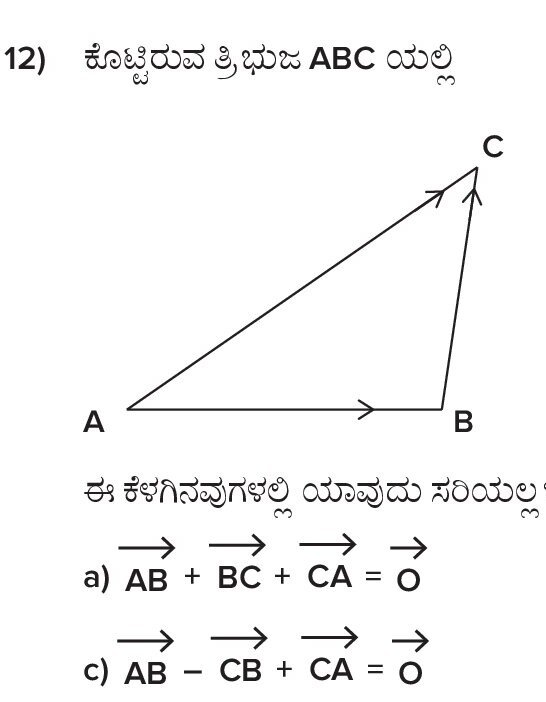
-
A.
AB + BC + CA = 0
-
B.
AB + BC - AC = 0
-
C.
AB - CB + CA = 0
-
D.
AB + BC - CA = 0
Q12
mcq
If $\vec{OA}, \vec{OB}, \vec{OC}$ are position vectors of the vertices of a triangle in the given order. Which of the following is not true?
-
A.
$\vec{AB} + \vec{BC} + \vec{CA} = O$
-
B.
$\vec{AB} + \vec{BC} - \vec{AC} = O$
-
C.
$\vec{AB} - \vec{CB} + \vec{CA} = O$
-
D.
$\vec{AB} + \vec{BC} - \vec{CA} = O$
Q13
mcq
1 mark
If a line makes angles α, β, γ with the positive axes, find the value of sin^2 α + sin^2 β + sin^2 γ.
Q13
mcq
1 mark
If a line makes angles $\alpha, \beta, \gamma$ with the positive direction of the co-ordinate axes, then the value of $\sin^2 \alpha + \sin^2 \beta + \sin^2 \gamma$ is
Q14
mcq
1 mark
Two cards are drawn at random from a deck of 52 cards without replacement. What is the probability that both cards are red?
-
A.
23/102
-
B.
25/102
-
C.
25/104
-
D.
1/4
Q14
mcq
Two cards are drawn at random and without replacement from a pack of 52 playing cards. The probability that both the cards are red is
-
A.
$\frac{23}{102}$
-
B.
$\frac{25}{102}$
-
C.
$\frac{25}{104}$
-
D.
$\frac{1}{4}$
Q15
mcq
1 mark
If P(A|B) > P(A), then which of the following is correct?
-
A.
P(A∩B) < P(A)P(B)
-
B.
P(B|A) < P(B)
-
C.
P(B|A) > P(B)
-
D.
P(B|A) = P(A)
Q16
short answer
1 mark
The value of $\tan^2(\sec^{-1} 2) + \cot^2(\text{cosec}^{-1} 3)$ is _______
Q17
short answer
1 mark
If $f(x) = |x – 5|$, then $f$ is continuous but not differentiable at $x = _______$.
Q18
short answer
1 mark
$\int_{-\frac{\pi}{4}}^{\frac{\pi}{4}} \frac{1}{1 + \cos 2x} dx = _______$.
Q19
short answer
1 mark
If $|\vec{a} \times \vec{b}|^2 + |\vec{a} \cdot \vec{b}|^2 = 144$ and $|\vec{a}| = 4$, then $|\vec{b}| = ________$.
Q20
short answer
1 mark
If $P(B) = \frac{5}{12}$, $P(A \cap B) = \frac{1}{3}$ and $P(A|B) = \frac{K}{5}$, then $K = ________$.
Q21
short answer
2 marks
Prove that $\cos^{-1}(4x^3 – 3x) = 3\cos^{-1} x$, $x \in [\frac{1}{2}, 1]$.
Q22
short answer
2 marks
If $A = \begin{bmatrix} \cos \alpha & -\sin \alpha \\ \sin \alpha & \cos \alpha \end{bmatrix}$, $I = \begin{bmatrix} 1 & 0 \\ 0 & 1 \end{bmatrix}$ and $A + A' = I$, find the value of $\alpha$.
Q23
short answer
2 marks
Find the area of the triangle whose vertices are $(-2, -3), (3, 2)$ and $(-1, -8)$ using determinants.
Q24
short answer
2 marks
Differentiate $\sin^2 x + \cos^2 y = 1$ with respect to $x$.
Q25
short answer
2 marks
Evaluate: $\int \frac{x^3 \tan^{-1}(x^4)}{1 + x^8} dx$.
Q26
short answer
2 marks
Find the integrating factor (IF) of the differential equation $x \log x \frac{dy}{dx} + y = \frac{2 \log x}{x}$.
Q27
short answer
2 marks
Find the area of Parallelogram whose adjacent sides are given by the vectors $\vec{a} = \hat{i} – \hat{j} + 3\hat{k}$ and $\vec{b} = 2\hat{i} – 7\hat{j} + \hat{k}$.
Q28
short answer
2 marks
Find the angle between the pair of lines given by $\frac{x – 2}{2} = \frac{y – 1}{5} = \frac{z + 3}{–3}$ and $\frac{x + 2}{–1} = \frac{y – 4}{8} = \frac{z – 5}{4}$.
Q29
short answer
2 marks
An unbiased die is thrown twice. Let the event A be 'odd number on the first throw' and B be the event 'odd number on the second throw'. Check the independence of the events A and B.
Q30
short answer
3 marks
Determine whether the relation R in the set N of natural numbers defined as $R = \{(x, y) | y = x + 5 \text{ and } x < 4\}$ is reflexive, symmetric and transitive.
Q31
short answer
3 marks
Prove that $\sin^{-1}\left(\frac{5}{13}\right) + \cos^{-1}\left(\frac{3}{5}\right) = \tan^{-1}\left(\frac{63}{16}\right)$.
Q32
short answer
3 marks
If $y^x = x^y$, then find $\frac{dy}{dx}$.
Q33
short answer
3 marks
The volume of a cube is increasing at a rate of 9 cm³/sec. How fast is the surface area increasing when length of an edge is 10 cm?
Q34
short answer
3 marks
Find the absolute maximum value of $2x^3 – 24x + 107$ in the interval $[1, 3]$.
Q35
short answer
3 marks
Find $\int \frac{\cos x}{(1 – \sin x)(2 – \sin x)} dx$.
Q36
short answer
3 marks
Let $\vec{a}, \vec{b}$ and $\vec{c}$ be three vectors such that $|\vec{a}| = 3, |\vec{b}| = 4, |\vec{c}| = 5$ and each one of them being perpendicular to the sum of the other two, find $|\vec{a} + \vec{b} + \vec{c}|$.
Q37
short answer
3 marks
Find the shortest distance between the lines $\vec{r} = (\hat{i} + 2\hat{j} + \hat{k}) + \lambda(\hat{i} – \hat{j} + \hat{k})$ and $\vec{r} = (2\hat{i} – \hat{j} – \hat{k}) + \mu(2\hat{i} + \hat{j} + 2\hat{k})$.
Q38
short answer
3 marks
In answering a question on a multiple choice test, a student either knows the answer or guesses. Let 3/4 be the probability that he knows the answer and 1/4 be the probability that he guesses. Assuming that a student who guesses the answer will be correct with probability 1/4. What is the probability that the student knows the answer given that he answered it correctly?
Q39
long answer
5 marks
Let $A = R – \{3\}$ and $B = R – \{1\}$. If $f : A \to B$ is a function defined by $f(x) = \frac{x – 2}{x – 3}$, then show that $f$ is one-one and onto. Also find $f^{-1}$.
Q40
long answer
5 marks
If $A = \begin{bmatrix} 0 & 6 & 7 \\ –6 & 0 & 8 \\ 7 & –8 & 0 \end{bmatrix}$, $B = \begin{bmatrix} 0 & 1 & 1 \\ 1 & 0 & 2 \\ 1 & 2 & 0 \end{bmatrix}$ and $C = \begin{bmatrix} 2 \\ –2 \\ 3 \end{bmatrix}$ calculate AC, BC and $(A–B)C$. Also verify $(A – B)C = AC – BC$.
Q41
long answer
5 marks
Solve the following system of linear equations using matrix method. $x – y + 2z = 7, 3x + 4y – 5z = –5, 2x – y + 3z = 12$.
Q42
long answer
5 marks
If $x = a(\cos \theta + \theta \sin \theta)$ and $y = a(\sin \theta – \theta \cos \theta)$, then show that $\frac{d^2y}{dx^2} = \frac{1}{a \theta} \sec^3 \theta$.
Q43
long answer
5 marks
Find the integral of $\frac{1}{a^2 – x^2}$ with respect to x and hence evaluate $\int \frac{1}{3 – x^2 – 2x} dx$.
Q44
long answer
5 marks
Find the area bounded by the curve $y = \cos x$ between $x = 0$ and $x = 2\pi$.
Q45
long answer
5 marks
Find the equation of a curve passing through the point $(0, 0)$ and whose differential equation is $\frac{dy}{dx} = e^x \sin x$.
Q46
long answer
6 marks
Prove that $\int_0^a f(x) dx = \int_0^a f(a – x) dx$ and hence evaluate $\int_0^1 x(1 – x)^n dx$.
Q46
long answer
6 marks
Solve the following linear programming problem graphically.
Maximise $Z = 3x + 2y$, subject to the constraints,
$2x + y \leq 50$
$x + 2y \leq 40$ and
$x \geq 0, y \geq 0$.
Q47
long answer
4 marks
If $A = \begin{bmatrix} 3 & -2 \\ 4 & -2 \end{bmatrix}$ and $I = \begin{bmatrix} 1 & 0 \\ 0 & 1 \end{bmatrix}$, show that $A^2 - A + 2I = 0$. Using this equation, find $A^{-1}$.
Q47
long answer
4 marks
Find the value of $k$ so that the function $f(x) = \begin{cases} \dfrac{k \cos x}{\pi - 2x} & \text{if } x \neq \frac{\pi}{2} \\ 3 & \text{if } x = \frac{\pi}{2} \end{cases}$ is continuous at $x = \frac{\pi}{2}$.
