The first 5 questions are solved below. Log in as a CLASS 12 SECOND PUC student to reveal solutions for the rest of this paper.
Log In →
Q1
mcq
1 mark
A point charge $q_1$ exerts a force $F$ on another point charge $q_2$ when placed at a fixed distance. If another point charge $q_3$ is brought near $q_2$, the force on $q_2$ due to $q_1$ :
-
A.
increases
-
B.
decreases
-
C.
may increase or decrease
-
D.
does not change
Solution not generated yet — check back soon.
Q2
mcq
1 mark
Equipotential surfaces for an isolated point charge are ________ in shape.
-
A.
spherical
-
B.
planar
-
C.
cylindrical
-
D.
conical
Solution not generated yet — check back soon.
Q3
mcq
1 mark
Resistivity of a metal wire depends on its :
-
A.
area of cross-section
-
B.
length
-
C.
material
-
D.
volume
Solution not generated yet — check back soon.
Q4
mcq
1 mark
The following table lists magnetic fields due to different current configurations. Column – I lists the current configurations and Column – II lists expressions for magnetic fields. Symbols have usual meanings.
Column – I | Column – II
---|---
i) At a distance r from an infinitely long straight wire. | p) $B = \mu_0 nI$
ii) At the centre of a circular current loop of radius r. | q) $B = \frac{\mu_0 I}{2r}$
iii) At the centre of a current carrying solenoid. | r) $B = \frac{\mu_0 I}{2\pi r}$
Match the current configurations in Column – I with the correct magnetic field expressions in Column – II.
-
A.
(i) – (p), (ii) – (q), (iii) – (r)
-
B.
(i) – (r), (ii) – (q), (iii) – (p)
-
C.
(i) – (r), (ii) – (p), (iii) – (q)
-
D.
(i) – (q), (ii) – (r), (iii) – (p)
Solution not generated yet — check back soon.
Q5
mcq
1 mark
‘The net magnetic flux through any closed surface is zero’. This law is called
-
A.
Gauss’ law in electrostatics
-
B.
Gauss’ law in magnetism
-
C.
Ampere’s circuital law
-
D.
Faraday’s law of electromagnetic induction
Solution not generated yet — check back soon.
Q6
mcq
1 mark
Consider the following statements :
Statement – 1 : A.C. Generator works on the principle of electromagnetic induction
Statement – 2 : In an A.C. Generator , as the armature is rotated in a uniform magnetic field , the magnetic flux linked with the coil changes which induces an emf in the coil.
Among the above two statements :
-
A.
Both Statements are true
-
B.
Both Statements are false
-
C.
Statement-1 is true and Statement-2 is false
-
D.
Statement-1 is false and Statement-2 is true
Q7
mcq
1 mark
The variation of voltage and current through an a.c. circuit with time is as shown in the figure. Along with the a.c. source, the circuit :
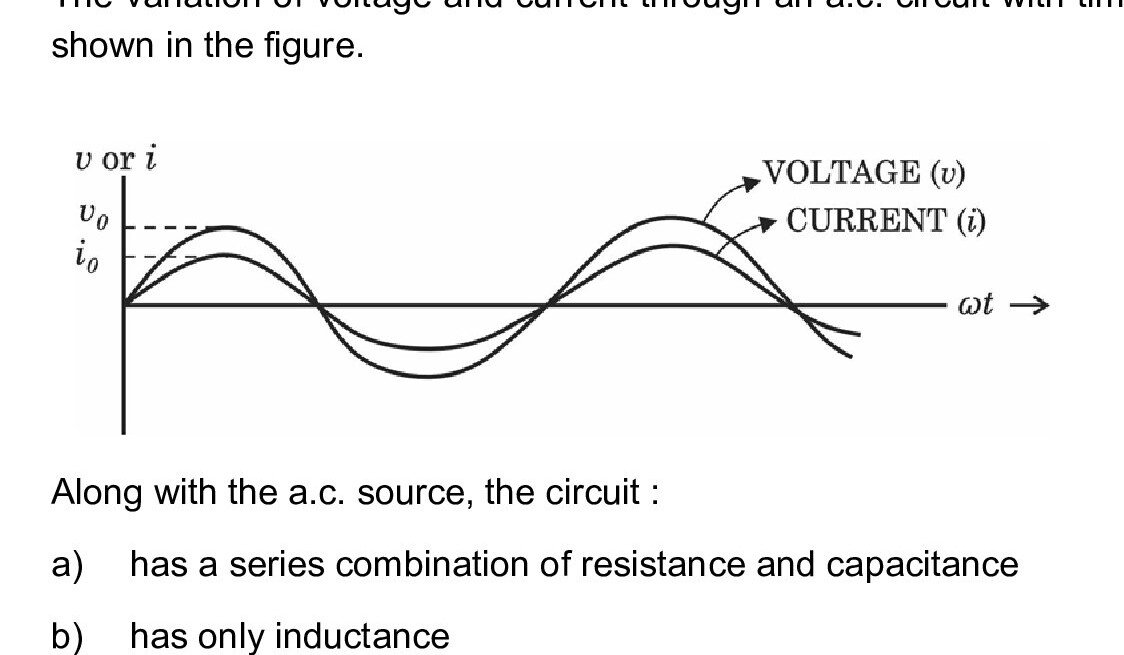
-
A.
has a series combination of resistance and capacitance
-
B.
has only inductance
-
C.
has only capacitance
-
D.
may have only resistance or may have a suitable series combination of inductance (L), capacitance (C) and resistance (R)
Q7
mcq
When a.c. is passed through an a.c. circuit, it is observed that the voltage and the current are in phase. Along with the a.c. source, the circuit :
-
A.
has a series combination of resistance and capacitance.
-
B.
has only inductance.
-
C.
has only capacitance.
-
D.
may have only resistance or may have a suitable series combination of inductance (L), capacitance (C) and resistance (R).
Q8
mcq
1 mark
Transformer cores are usually laminated. This is to reduce energy loss due to
-
A.
flux leakage
-
B.
winding resistance
-
C.
eddy currents
-
D.
hysteresis
Q9
mcq
1 mark
‘Ampere-Maxwell Law’ is written as (symbols have usual meanings) :
-
A.
$\oint \vec{B} \cdot d\vec{l} = \mu_0 i + \mu_0 \epsilon_0 \frac{d\phi_E}{dt}$
-
B.
$\oint \vec{B} \cdot d\vec{l} = \mu_0 i + \epsilon_0 \frac{d\phi_E}{dt}$
-
C.
$\oint \vec{B} \cdot d\vec{l} = \mu_0 i$
-
D.
$\oint \vec{E} \cdot d\vec{l} = -\frac{d\phi_B}{dt}$
Q10
mcq
1 mark
Final image of a real object formed by a compound microscope is ____________ with respect to the object.
-
A.
real, inverted and magnified
-
B.
virtual, erect and magnified
-
C.
virtual, erect and diminished
-
D.
virtual, inverted and magnified
Q11
mcq
1 mark
Which one of the following statements is WRONG about interference of light?
-
A.
Light waves of same wavelength coming from two independent sources can be coherent and can produce interference
-
B.
When the path difference between two interfering waves is $n\lambda$, bright fringe is produced (Here $n = 0, 1, 2, ....$ and $\lambda$ is the wavelength of light)
-
C.
When the phase difference between two interfering waves is $(2n+1)\pi$, dark fringe is produced (Here $n = 0, 1, 2, ..)$
-
D.
In Young’s double slit experiment, dark and bright fringes are equally spaced
Q12
mcq
1 mark
A ball is dropped from a certain height and it falls freely under gravity. During the fall, the de Broglie wavelength associated with it :
-
A.
keeps increasing
-
B.
keeps decreasing
-
C.
is zero
-
D.
may increase or decrease
Q13
mcq
1 mark
In Rutherford’s α-ray scattering experiment, α-particles of specific energy are projected towards a thin gold foil. If the impact parameter for the α-particles is zero, the angle of scattering is
-
A.
$\theta = 0^\circ$
-
B.
$\theta = 90^\circ$
-
C.
$\theta = 180^\circ$
-
D.
$\theta = 45^\circ$
Q14
mcq
Binding energy per nucleon of a nucleus is a measure of its
-
A.
radius
-
B.
mass
-
C.
volume
-
D.
stability
Q15
mcq
The energy gap for silicon is :
-
A.
0.72 eV
-
B.
1.1 eV
-
C.
3 eV
-
D.
5 eV
Q16
short answer
1 mark
An electric dipole placed in a uniform electric field experiences a net ____________.
Q17
short answer
1 mark
Water is an example for __________ material.
Q18
short answer
1 mark
When a ____________ rod is inserted into a coil, its self-inductance increases.
Q19
short answer
1 mark
Polarization of light shows that light is a _________ wave.
Q20
short answer
1 mark
Photoelectric effect is a/an _____________ effect.
Q21
short answer
2 marks
Define electric potential energy of a system of charges. What happens to the potential energy of a system of two unlike charges when the distance between them is increased (assume there is no external electric field)?
Q22
short answer
2 marks
List any two limitations of Ohm’s law.
Q23
short answer
2 marks
Write the expression for Lorentz force and explain the terms.
Q24
short answer
2 marks
State Lenz’s law. What is its significance?
Q25
short answer
2 marks
Give any two uses of microwaves.
Q26
short answer
2 marks
How are focal length ($f$) and radius of curvature ($R$) of a spherical mirror related? What is the sign of focal length of a convex mirror?
Q27
short answer
2 marks
Mention the conditions for total internal reflection.
Q28
short answer
2 marks
An intrinsic semi conductor crystal is doped with pentavalent atoms has an electron concentration of $10^{22} \times 5 \text{ m}^{-3}$. If, at thermal equilibrium, the intrinsic concentration $n_i = 1.5 \times 10^{16} \text{ m}^{-3}$, find the hole concentration.
Q29
short answer
3 marks
Mention three properties of electric field lines.
Q30
long answer
3 marks
Derive the expression for the equivalent capacitance of two capacitors connected in parallel.
Q31
long answer
3 marks
Explain with a circuit diagram, how a galvanometer can be converted into voltmeter.
Q32
short answer
3 marks
Define the terms: a) Magnetization, b) Magnetic permeability and c) Magnetic susceptibility.
Q33
long answer
3 marks
Derive the expression for motional emf induced in a rod moving in a uniform magnetic field.
Q34
short answer
3 marks
When a light radiation of energy 3 eV falls on a metal surface, photoelectrons with a maximum kinetic energy 1 eV are emitted from the surface. Find the threshold frequency for the metal surface. (Given: Planck’s constant, $h = 6.63 \times 10^{-34} \text{ Js}$; Charge on the electron $e = 1.6 \times 10^{-19} \text{ C}$).
Q35
short answer
3 marks
State the postulates of Bohr’s hydrogen atom model.
Q36
short answer
3 marks
Write any three properties of nuclear force.
Q37
long answer
5 marks
Derive the expression for the electric potential at a point due to a point charge.
Q38
long answer
5 marks
Arrive at the condition for balance of a Wheatstone’s network using Kirchhoff’s rules.
Q39
long answer
5 marks
Obtain the expression for the force per unit length between two infinitely long straight parallel current carrying conductors placed in vacuum. Hence define the unit ‘ampere’.
Q40
long answer
5 marks
a) State Huygen’s principle. b) Prove Snell’s law of refraction using Huygen’s principle by considering refraction of a plane wave by a surface.
Q41
long answer
5 marks
a) What is a rectifier? b) With the help of a circuit diagram, input and output waveforms, explain the working of a full wave rectifier.
Q42
long answer
5 marks
A uniformly charged spherical shell of radius 10 cm has a surface charge density of $16 \text{ } \mu\text{cm}^{-2}$. Find the electric field due to the shell at a distance of a) 20 cm from the centre of the shell, b) 5 cm from the centre of the shell.
Q42
long answer
5 marks
A uniformly charged spherical shell of radius $10\text{ cm}$ has a surface charge density of $16\ \mu\text{C m}^{-2}$. Find the electric field due to the shell at a distance of:
a) $20\text{ cm}$ from the centre of the shell.
b) $5\text{ cm}$ from the centre of the shell.
Q43
long answer
5 marks
Two identical cells each of emf 15 V either connected in series or connected in parallel across an external resistance of $5 \text{ } \Omega$ produce the same current through the resistor. a) Calculate the value of internal resistance of the cell. b) Find the current through the external resistor in either case.
Q44
short answer
1 mark
State Huygen’s principle.
Q44
long answer
5 marks
A series LCR circuit with $L = 0.5\text{ H}$ and $R = 100\ \Omega$ is connected to a $200\text{ V}, 50\text{ Hz}$ a.c. supply.
a) Calculate the value of capacitance of the capacitor that drives the circuit into resonance.
b) Find the value of voltage across the inductor at resonance.
Q45
short answer
1 mark
What is a rectifier?
Q45
long answer
5 marks
An object of height $1\text{ mm}$ is kept perpendicular to the axis of a thin convex lens of power $+10\text{ D}$. The distance between the object and the lens is $15\text{ cm}$. Find the position and height of the image formed.
