The first 5 questions are solved below. Log in as a CLASS 12 SECOND PUC student to reveal solutions for the rest of this paper.
Log In →
Q1
mcq
1 mark
According to Coulomb's law, electrostatic force F between two point charges separated by the distance r varies as
-
A.
$F \propto \frac{1}{r}$
-
B.
$F \propto r$
-
C.
$F \propto \frac{1}{r^2}$
-
D.
$F \propto r^2$
Correct Answer: C —
Solution
Coulomb's law states that the electrostatic force between two point charges is inversely proportional to the square of the distance between them, mathematically expressed as $F \propto \frac{1}{r^2}$.
Q2
mcq
1 mark
The maximum electric field that a dielectric medium can withstand without breakdown of dielectric property is
-
A.
dielectric constant
-
B.
dielectric strength
-
C.
dielectric polarization
-
D.
electrical susceptibility
Correct Answer: B —
Solution
Dielectric strength is defined as the maximum electric field that a dielectric material can withstand without undergoing electrical breakdown (i.e., becoming conductive).
Q3
mcq
1 mark
The electric current per unit area of cross-section of a conductor is called
-
A.
Conductivity
-
B.
Resistivity
-
C.
Current density
-
D.
Mobility
Correct Answer: C —
Solution
Current density is defined as the electric current $I$ passing per unit area $A$ of cross-section of a conductor, denoted as $J = \frac{I}{A}$.
Q4
mcq
1 mark
A Galvanometer which is converted to ammeter has
-
A.
low resistance in series
-
B.
low resistance in parallel
-
C.
high resistance in series
-
D.
high resistance in parallel
Correct Answer: B —
Solution
To convert a galvanometer into an ammeter, a very low resistance called a shunt must be connected in parallel with the galvanometer to allow most of the current to bypass the meter.
Q5
mcq
1 mark
The substances which have the tendency to move from stronger to weaker part of external magnetic field are
-
A.
Diamagnetic
-
B.
Ferromagnetic
-
C.
Paramagnetic
-
D.
Ferro and Paramagnetic
Correct Answer: A —
Solution
Diamagnetic substances are characterized by their tendency to move from a region of stronger magnetic field to a region of weaker magnetic field when placed in a non-uniform external magnetic field.
Q6
mcq
1 mark
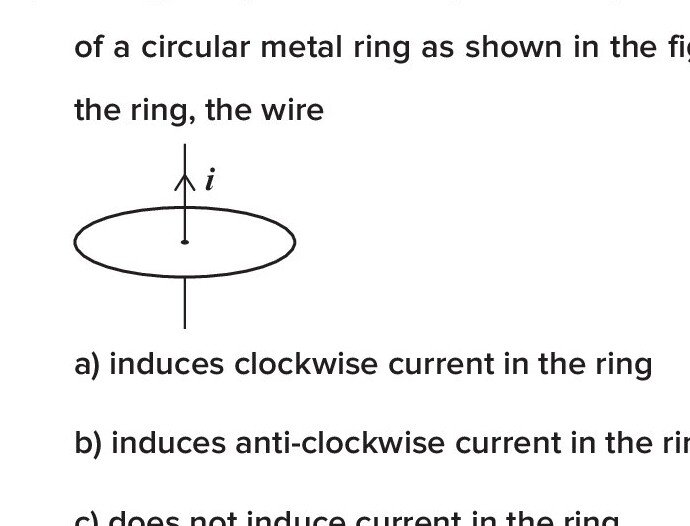
A long straight wire having increasing current at steady rate is placed along the axis of a circular metal ring as shown in the figure. When viewed from above towards the ring, the wire
-
A.
induces clockwise current in the ring
-
B.
induces anti-clockwise current in the ring
-
C.
does not induce current in the ring
-
D.
induces current in the ring which changes its direction with respect to time
Q6
mcq
A long straight wire having increasing current at steady rate is placed along the axis of a circular conducting ring with plane of the ring perpendicular to the plane of paper. When viewed from above towards the ring, the wire
-
A.
induces clockwise current in the ring
-
B.
induces anti-clockwise current in the ring
-
C.
does not induce current in the ring
-
D.
induces current in the ring, which changes its direction with respect to time.
Q7
mcq
1 mark
A transformer works on the principle of
-
A.
Mutual induction
-
B.
Self induction
-
C.
Force on coil in magnetic field
-
D.
Torque on coil in magnetic field
Q8
mcq
1 mark
The existence of electromagnetic waves by a set of equations was given by
-
A.
Michel Faraday
-
B.
Andre Ampere
-
C.
Albert Einstein
-
D.
JC Maxwell
Q9
mcq
1 mark
The relation between focal length f and radius of curvature R of a spherical mirror is
-
A.
R = f
-
B.
R = f/2
-
C.
f = R/2
-
D.
f = 1/R
Q10
mcq
1 mark
Statement I : Wave fronts obtained from a point source of light in an isotropic medium are always spherical at finite distance.
Statement II : Speed of light in an isotropic medium is constant.
-
A.
Only Statement I is correct
-
B.
Only Statement II is correct
-
C.
Both Statement I and Statement II are wrong
-
D.
Both Statement I and Statement II are correct
Q11
mcq
1 mark
Which of the following phenomenon confirms the transverse nature of light waves?
-
A.
Diffraction
-
B.
Polarization
-
C.
Interference
-
D.
Reflection
Q12
mcq
1 mark
Emission of electrons from a metal surface by heating is called as
-
A.
Photo-electric emission
-
B.
Field emission
-
C.
Secondary emission
-
D.
Thermionic emission
Q13
mcq
1 mark
Bohr's atom model is applicable to only
-
A.
Hydrogen atom
-
B.
Gold atom
-
C.
Silver atom
-
D.
Oxygen atom
Q14
mcq
1 mark
Match the following columns:
Column - I Column - II
a) Isotopes i) Nucleii having same number of neutrons
b) Isobars ii) Nucleii having same number of protons
c) Isotones iii) Nucleii having same number of nucleons
-
A.
a – ii, b – iii, c – i
-
B.
a – iii, b – ii, c – i
-
C.
a – ii, b – i, c – iii
-
D.
a – iii, b – i, c – ii
Q14
mcq
Match the following columns:
Column - I
a) Isotopes
b) Isobars
c) Isotones
Column - II
i) Nucleii having same number of neutrons
ii) Nucleii having same number of protons
iii) Nucleii having same number of nucleons
-
A.
a – ii, b – iii, c – i
-
B.
a – iii, b – ii, c – i
-
C.
a – ii, b – i, c – iii
-
D.
a – iii, b – i, c – ii
Q15
mcq
1 mark
The impurity atoms added to a pure semiconductor crystal to convert it into p-type semiconductor are
-
A.
tetravalent
-
B.
trivalent
-
C.
pentavalent
-
D.
hexavalent
Q16
short answer
1 mark
In a charge distribution, the ratio of electric charge to the length is _______ charge density.
Q17
short answer
1 mark
_______ is equal to work done to transfer unit positive test charge from infinity to a point in electric field opposite to field.
Q18
short answer
1 mark
An example for ferromagnetic substance is ________.
Q19
short answer
1 mark
The phase difference between peak value of voltage and current in a pure resistive circuit is ________.
Q20
short answer
1 mark
The bottom of a tank filled with water appears to be raised, it is due to ________ of light.
Q21
short answer
2 marks
Give any two properties of electric field lines.
Q22
short answer
2 marks
Calculate the force on a point charge of $2.0 \times 10^{-6} \text{ C}$ placed in a uniform electric field of $0.8 \text{ NC}^{-1}$.
Q23
short answer
2 marks
State Kirchhoff's rules of electrical networks.
Q24
short answer
2 marks
Mention any two factors on which current sensitivity of a galvanometer depends.
Q25
short answer
2 marks
Draw a neat diagram of a simple a.c. generator and label the parts.
Q26
short answer
2 marks
Write the expression for average power in an a.c LCR circuit and explain the terms.
Q27
short answer
2 marks
Mention any two uses of infrared radiations.
Q28
short answer
2 marks
a) Draw a diagram of unbiased depletion region of p-n junction showing immobile charges.
b) What is meant by rectification?
Q29
short answer
3 marks
a) What is meant by an equipotential surface?
b) Draw equipotential surfaces for uniform electric field and a point charge.
Q30
long answer
3 marks
Derive an expression for magnetic field due to a straight infinite conductor carrying current using Ampere's circuital law.
Q31
short answer
3 marks
Define a) magnetic susceptibility and b) magnetic relative permeability and write an expression relating them.
Q32
short answer
3 marks
a) What is meant by electromagnetic induction?
b) State and explain Faraday's law of electromagnetic induction.
Q33
short answer
3 marks
Calculate resonant angular frequency of a series LCR a.c. circuit.
Given $R = 100\Omega$, $L = 1.0\text{ mH}$ and $C = 1.0\text{ nF}$
Q34
short answer
3 marks
Write the two conditions for total internal reflection of light and mention its one technological application.
Q35
long answer
3 marks
Deduce an expression for total energy of electron in an orbit of hydrogen atom in terms of radius of orbit.
Q36
short answer
3 marks
a) What is meant by Nuclear fusion? Explain.
b) Why it is called thermonuclear reaction?
Q37
long answer
5 marks
Deduce an expression for electric field at a point outside a thin uniformly-charged spherical shell using Gauss's law.
Q38
long answer
5 marks
Obtain an expression for electrical conductivity of conducting electrons in a metallic conductor in terms of charge (e) and mass (m) of the electrons.
Q39
long answer
5 marks
Derive an expression for magnetic field at a point on the axis of a circular current loop.
Q40
long answer
5 marks
a) Prove Snell's law of refraction of light, when a plane wavefront passes from rarer to denser medium.
b) Mention any two uses of polaroids.
Q41
long answer
5 marks
a) Explain the classification of solids using band theory.
b) Give any two differences between intrinsic and extrinsic semiconductors.
Q42
long answer
5 marks
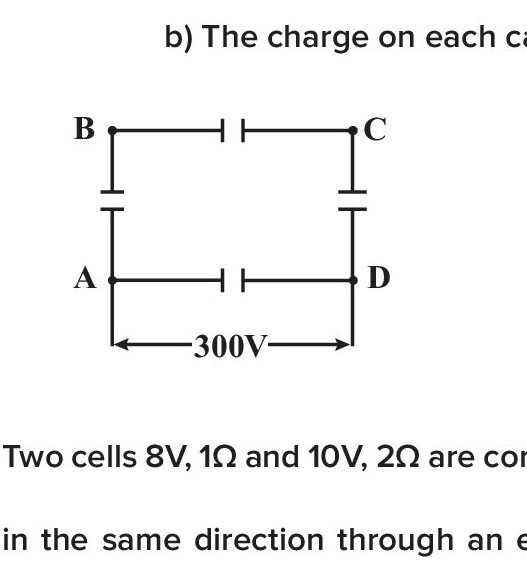
A network of four $9\mu\text{F}$ capacitors is connected to a 300V supply as shown in figure. Determine a) Equivalent capacitance of the network and b) The charge on each capacitor.
Q42
long answer
Four $9\mu\text{F}$ capacitors are connected at each side of a square. A 300V supply is connected across adjacent corners of the square. Determine a) Equivalent capacitance across adjacent corners of square and b) the charge on each capacitor.
Q43
long answer
5 marks
Two cells $8\text{V}, 1\Omega$ and $10\text{V}, 2\Omega$ are connected in parallel such that they send currents in the same direction through an external resistance $20\Omega$. Find the current and potential difference across $20\Omega$.
Q44
long answer
5 marks
A sharp object of height $3.0\text{ cm}$ is placed at $21\text{ cm}$ in front of a convex lens of focal length $14\text{ cm}$. Find the position and magnification of the image. What happens to the height of the image if the object is moved further away from the lens?
Q45
long answer
5 marks
The work function of a metal is $2.20\text{ eV}$ when radiation of frequency $6.50 \times 10^{14}\text{ Hz}$ incident on the metal surface photo emission of electrons occurs. Calculate a) energy of incident photon and b) stopping potential of photoelectrons. (Given $h = 6.63 \times 10^{-34}\text{ Js}$ and $e = 1.6 \times 10^{-19}\text{C}$)
